
Meta Ad Solutions: Which One is Right for You?
Why Meta Ad Solutions Are Worth Understanding Before You Spend a Dollar
Meta ad solutions give businesses access to one of the most powerful advertising ecosystems ever built — spanning Facebook, Instagram, Messenger, WhatsApp, and the Audience Network, all from a single platform.
Here’s a quick look at the main Meta ad solutions and what each one is best for:
| Ad Solution | Best For |
|---|---|
| Single Image / Video | Brand awareness, traffic, simple offers |
| Carousel | Multiple products, features, or locations |
| Collection | Mobile ecommerce, product discovery |
| Lead Ads | Lead generation without a landing page |
| Catalog / Dynamic Ads | Retargeting, ecommerce, large product sets |
| Reels Ads | High-reach, full-screen video engagement |
| Advantage+ Campaigns | AI-automated performance at scale |
With over 3 billion monthly active users across Meta’s platforms, the reach is hard to argue with. But reach alone doesn’t make a campaign work. The real challenge — especially for franchise marketers managing ads across multiple locations — is knowing which format to use, where to place it, and how to structure campaigns so the right people see the right message at the right time.
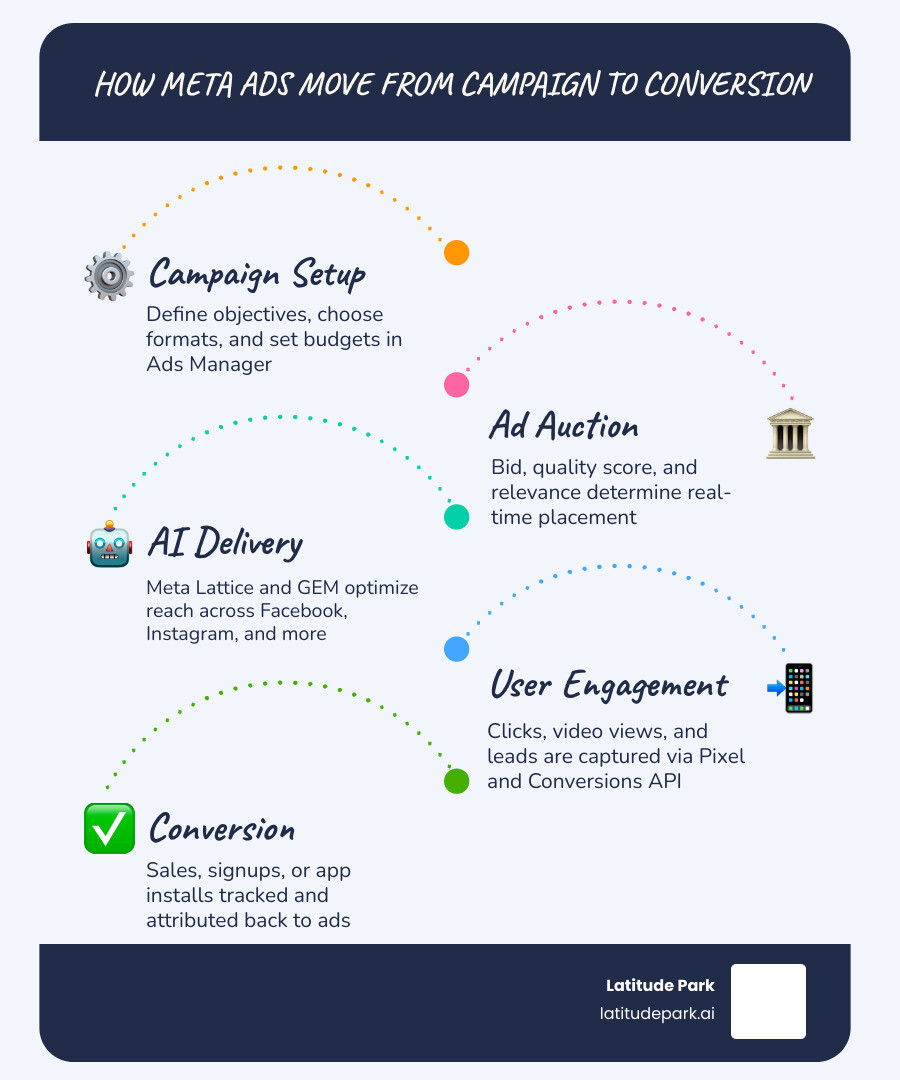
Meta’s ad system runs on a real-time auction model powered by AI. Your ad competes based on bid amount, ad quality, and predicted relevance to the viewer. Get those three things right, and the platform rewards you with lower costs and better results. Get them wrong, and you’ll burn budget fast.
This guide breaks down every major Meta ad solution — formats, placements, targeting, budgeting, tracking, and compliance — so you can make smarter decisions with your ad spend.
I’m Rusty Rich, President of Latitude Park, a full-service digital advertising agency based in St. Petersburg, Florida, and I’ve spent over 15 years helping small businesses and growing franchises build profitable campaigns across Meta ad solutions and beyond. Let’s get into what actually works.
Simple Meta ad solutions glossary:
What Are Meta Ad Solutions and How Do They Work?
At a basic level, Meta ad solutions are the paid advertising tools available across Meta’s family of apps and partner surfaces. That includes Facebook, Instagram, Messenger, Audience Network, and in some use cases Threads and WhatsApp-related experiences.
Everything is usually managed in Ads Manager. That is where we build campaigns, choose objectives, define audiences, set budgets, upload creative, and track results.
Meta then uses machine learning to decide:
- who is most likely to respond
- where the ad should appear
- how often it should be shown
- which creative variation is most likely to drive the chosen outcome
This matters because Meta is no longer just a “boost post” machine. It is an AI-driven delivery system that tries to match the right ad to the right person at the right moment, usually on mobile.
How Meta ad solutions deliver ads across Facebook, Instagram, Messenger, and more
One campaign can deliver across multiple placements and surfaces without needing a separate platform for each one. Depending on the format and objective, your ad may appear in:
- Facebook Feed
- Instagram Feed
- Facebook Stories
- Instagram Stories
- Facebook Reels
- Instagram Reels
- Messenger Inbox
- Audience Network apps and websites
That cross-platform delivery is one of Meta’s biggest advantages. We do not have to build four totally separate campaigns just to reach someone who scrolls Instagram at lunch and checks Facebook at night.
For local businesses and franchise systems, this is especially useful. A single account can support centralized strategy while still letting us localize creative, offers, and audience settings by territory or location group. If you want a broader primer on promotion across both core platforms, see More info about Facebook and Instagram promotion.
The auction, relevance, and AI systems behind Meta ad solutions
Meta uses a real-time auction, but the highest bidder does not automatically win. Delivery is influenced by three broad factors:
- your bid or bidding strategy
- estimated action rate, meaning how likely the user is to take the desired action
- ad quality and relevance
In plain English: a mediocre ad with a big budget can still lose to a better ad with a smarter setup.
Meta has invested heavily in AI systems that improve this recommendation process. Two notable examples are:
- Scientific research on Meta’s ads recommendation AI
- Scientific research on Meta ads system performance
According to Meta’s own engineering research, GEM contributed to a 5% increase in ad conversions on Instagram and a 3% increase on Facebook Feed in Q2. Meta Lattice also improved ad quality in early deployments. Translation: the platform is getting better at matching ads to users, which is good news if your account structure, creative, and data signals are solid.
Choosing the Right Meta Ad Formats for Your Goal
Format choice should follow campaign goal, not personal taste. We know, everyone loves the founder’s favorite square graphic from 2022. The algorithm does not share that nostalgia.
Flexible, image, and video formats: the best Meta ad solutions for awareness and traffic
Single image ads are still useful when:
- the offer is simple
- the message is clear
- the visual can do most of the selling
Single video ads work well when:
- you need demonstration
- you want stronger thumb-stop power
- you are leaning into short-form storytelling
Flexible ads give Meta more room to assemble and deliver variations. They can help when you want efficient testing without building a giant ad matrix by hand.
For awareness and traffic campaigns, our rule is simple:
- keep the message fast
- make the value obvious
- design for mobile first
- use authentic creative over overproduced fluff
UGC-style creative often performs extremely well. Research cited in the brief shows UGC-style ads can see up to 4x higher engagement. Typical CTR benchmarks often land around 1% to 2%, so if your click-through rate is below that, your hook, creative, or audience likely needs work.
For more platform-specific help, see More info about Facebook and Instagram promotion.
Carousel, collection, and catalog ads for product discovery and ecommerce
Carousel ads are ideal when you need to show:
- multiple products
- several features
- a before-and-after sequence
- multiple locations or service categories
They are often strong performers because they create more chances to earn attention. In many cases, carousel ads can drive 10% to 30% higher click-through rates.
Collection ads are especially useful for mobile ecommerce. They combine a hero asset with a product grid and can open into a fast-loading Instant Experience. These are great for product discovery because they reduce friction and keep users inside the Meta environment a little longer.
Catalog or dynamic ads are the workhorse for retargeting and ecommerce scale. They let Meta automatically show relevant items from your product set based on behavior like:
- viewed product
- added to cart
- previous purchase interest
If you are running product-focused campaigns, this guide is also worth reading: More info about Facebook Instagram ads.
Lead ads, instant forms, and app-focused Meta ad solutions
Lead ads are one of the most practical Meta ad solutions for service businesses, local operators, and franchise brands. They let people submit their information through an Instant Form without leaving the app.
They work well when:
- users are on mobile
- landing pages are slow
- the offer is simple
- speed matters more than long-form education
That said, not all lead forms are equal. Higher intent forms usually improve lead quality when we:
- add qualifying questions
- use a stronger offer
- align the form with the ad promise
- route leads into fast follow-up systems
In many industries, under $5 per lead is considered solid, though actual performance varies widely by niche and intent level.
Lead forms also have rules. Meta restricts certain sensitive questions and personal data requests, so advertisers must be careful about form fields.
For businesses focused on lead generation, start here: More info about Facebook lead generation.
Placements, Specs, and Creative Best Practices

Placement affects performance more than many advertisers expect. The same ad can look polished in Feed and awkward in Reels, like showing up to a beach party in a business suit.
Feed, Stories, Reels, and Audience Network: where performance changes
Feeds are usually strong for:
- static images
- clear offers
- moderate-length copy
- traffic and lead generation
Stories and Reels are better when:
- the creative is vertical
- the message lands in seconds
- the video feels native
- branding is not crammed into every corner
Reels in particular have become a major attention surface. Meta’s developer documentation notes that Reels ads should be built in 9:16 and kept under 90 seconds. Safe zones matter too, especially in the lower area where interface elements can cover text. See Scientific research on Reels ad requirements.
Audience Network can extend reach at lower cost, but performance quality varies by objective and account. For some direct-response campaigns it helps efficiency; for others it adds noise. We test it instead of assuming.
One useful 2026 update: Instagram Explore is no longer an ad placement option, so planning should focus on currently active surfaces.
Creative specs, testing, and automation that improve results
The core specs we use most often are:
- 1080×1080 for square
- 1080×1350 for vertical feed
- 1080×1920 for Stories and Reels
Other best practices:
- keep videos short and front-loaded
- assume sound may be on, but make visuals understandable without it
- leave room for interface overlays in Stories and Reels
- match creative format to placement, not just to brand guidelines
A/B testing still matters, even with automation. We typically test one variable at a time:
- hook
- thumbnail
- offer
- CTA
- audience
- landing page
Watch for creative fatigue too. If frequency rises and results get worse, the audience may simply be tired of seeing the same thing. Automation tools like Advantage+ creative can help by mixing assets and text variations, but they are not magic. Bad inputs still produce bad outputs, just faster.
Helpful references:
Campaign Structure, Budgets, Targeting, and Tracking
A clean account structure makes optimization easier. A messy one makes reporting feel like archaeology.
How to structure campaigns in Ads Manager for cleaner optimization
Meta campaigns follow a three-level hierarchy:
- Campaign
- Ad set
- Ad
A simple way to think about it:
- Campaign = the goal
- Ad set = the audience, budget, placement, optimization settings
- Ad = the creative people actually see
Common objectives include:
- awareness
- traffic
- leads
- sales
- app promotion
Budget can be controlled at the campaign or ad set level.
| Budget Type | Best Use Case | Tradeoff |
|---|---|---|
| Advantage+ campaign budget | When Meta should shift spend automatically to top performers | Less manual control |
| Ad set budget | When each audience or location needs dedicated spend | Less fluid optimization |
To help ad sets exit the learning phase, Meta generally wants enough budget to generate around 50 optimization events over 7 days. Constant edits can reset learning, so we avoid changing too much too often.
Clear naming conventions also help, especially for franchise or multi-location structures. If you want deeper management guidance, see More info about Facebook ad campaign management.
Targeting options, Advantage+ audiences, and non-discrimination rules
Meta targeting can include:
- demographics
- interests
- behaviors
- custom audiences
- lookalike audiences
- Advantage+ audience expansion
Custom audiences are built from first-party signals such as:
- website visitors
- customer lists
- lead form opens
- video viewers
Lookalike audiences help scale by finding people similar to your best customers. Tighter seeds, such as 1% to 2%, usually provide better precision before broader expansion.
Advantage+ audiences let Meta use machine learning to expand beyond your initial suggestions when it expects better performance. Often, broad targeting with good creative and strong conversion data beats ultra-narrow setups.
But there are important compliance rules. Special Ad Categories, such as housing, employment, and credit, have targeting restrictions designed to prevent discrimination. Advertisers must follow those rules carefully.
For franchise and local campaigns, geo controls still matter. Radius and local targeting can be useful, but structure should reflect territory realities, not just map circles. More here:
Pixel, Conversions API, retargeting, and CRM integrations
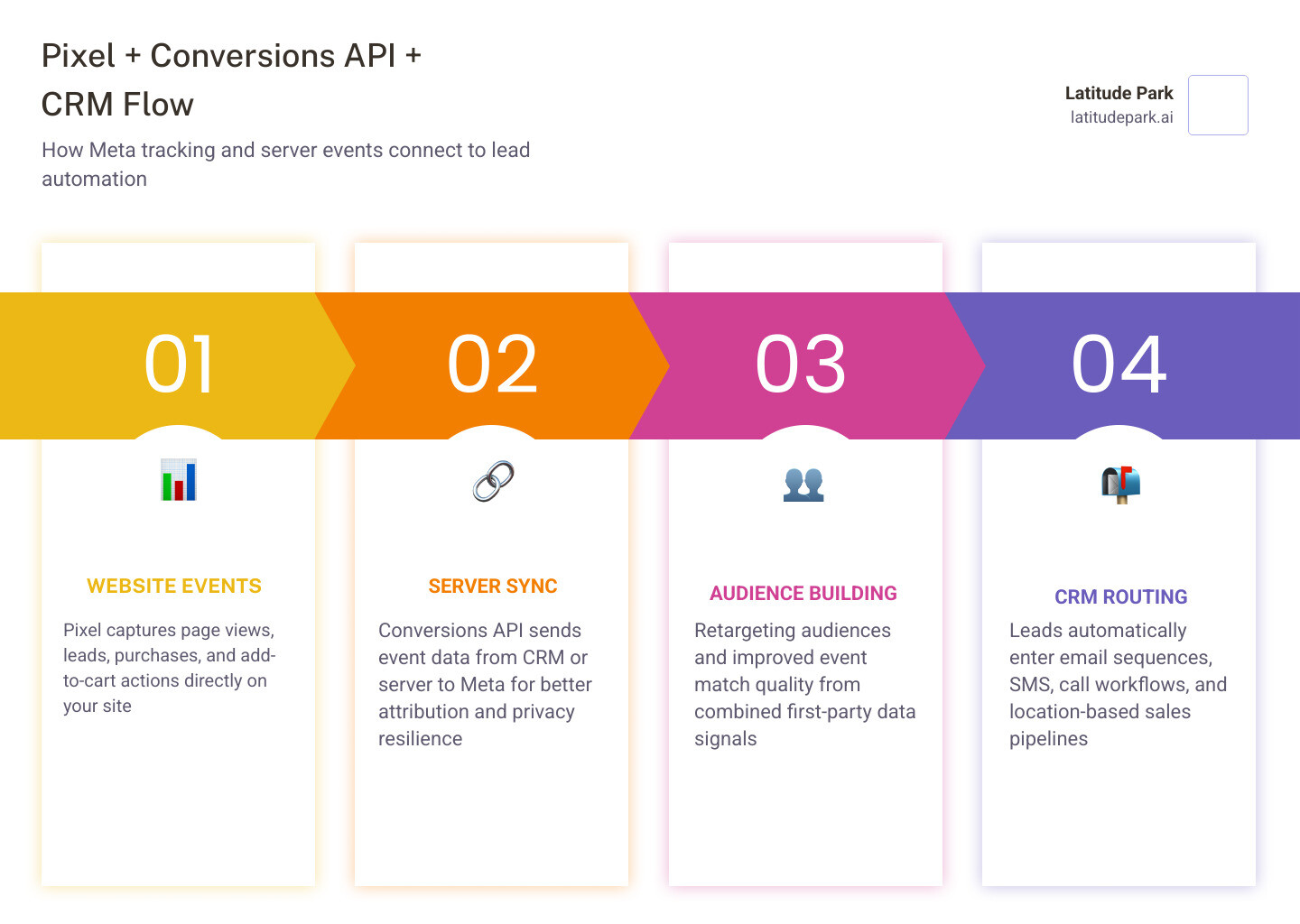
The Meta Pixel tracks actions on your website, such as:
- page views
- leads
- purchases
- add to cart events
Conversions API sends similar event data from your server or CRM to Meta, helping improve measurement and optimization in a more privacy-resilient way.
Used together, Pixel and Conversions API help with:
- better attribution
- stronger optimization signals
- retargeting audiences
- improved event match quality
This is especially important in a privacy-first advertising environment. First-party data is more valuable than ever.
For lead generation, CRM integrations can automatically route leads into:
- email sequences
- SMS follow-up
- call center workflows
- sales pipelines by location
Meta’s developer ecosystem supports this kind of automation at the API level: Scientific research on Meta campaign API and integrations.
Policies, Ad Review, and Common Rejection Risks
You can have a brilliant strategy, strong creative, and a healthy budget, then get stuck because the ad says something Meta does not allow. Fun.
How the Meta ad review and approval process works
Meta reviews ads before they go live. Review is largely automated, though manual checks can also happen. In most cases, review is completed within about 24 hours, though delays are possible.
Meta checks:
- copy
- images and video
- targeting
- landing pages
- form fields
- objective and category alignment
If an ad is rejected, we can usually:
- edit it to comply
- resubmit
- request another review through Account Quality if we believe the decision was wrong
Ads about social issues, elections, or politics have extra rules and may remain in the Ad Library for 7 years.
Prohibited and restricted content that can trigger rejection
Prohibited content can include:
- adult sexual content
- weapons and certain weapon accessories
- child exploitation material
- hateful or discriminatory content
- privacy violations
- deceptive or misleading claims
- misinformation in certain contexts
- unsafe substances or prohibited drugs
Restricted categories can include:
- alcohol
- dating services
- financial products
- gambling
- cryptocurrency
- prescription-related promotions in certain cases
Some categories need prior approval or stricter targeting. For example, alcohol ads should target adults only. Branded content may also require proper tagging.
Health claims are a common rejection point. Avoid copy that implies personal attributes or makes exaggerated outcomes. “You have back pain” is riskier than “Help your team book more service appointments” for obvious reasons.
How to stay compliant without hurting performance
Compliance and performance can absolutely coexist. Our best practices are:
- make claims specific and truthful
- ensure the landing page matches the ad
- avoid sensational or manipulative copy
- keep lead forms within policy limits
- review local legal requirements alongside Meta rules
- monitor Account Quality regularly
Even ads that are technically approved can perform poorly if users perceive them as low quality. Poor experience hurts rankings and costs.
If you need help cleaning up structure and compliance while improving output, these guides are useful:
- More info about Facebook ad campaign management
- More info about troubleshooting Facebook ad performance
Frequently Asked Questions About Meta Ad Solutions
Are Meta ad solutions good for local businesses and franchises?
Yes, especially when campaigns are structured correctly. Meta is strong for local service advertising because we can combine:
- local audience targeting
- location-specific creative
- lead forms
- retargeting
- centralized reporting
For franchises, this becomes even more valuable. We can build systems that protect brand consistency while still tailoring messaging to individual locations or regions. That is a big part of how we approach growth at Latitude Park.
Related reading: More info about Facebook ads for local services
How much should you budget before scaling Meta ad solutions?
A practical starting range is often $10 to $50 per day per ad set, depending on your objective and market. The real question is whether the budget is enough to produce meaningful data.
Use these rough benchmarks carefully:
- CTR around 1% to 2% is common
- ROAS of 3x to 5x is often considered strong
- under $5 per lead can be solid in many industries
Scaling too early is a classic mistake. We usually want stable performance and enough event volume before increasing spend. Budget jumps that are too aggressive can disrupt learning. More on cost planning here: More info about Facebook ads cost
What should you do if your ad gets rejected?
First, do not panic and start changing 19 things at once.
Instead:
- Read the rejection reason carefully.
- Check the ad copy, image, landing page, and form.
- Remove or revise anything that may violate policy.
- Resubmit the ad.
- If the rejection appears incorrect, request review in Account Quality.
Repeated violations can lead to restrictions on business assets, so it is better to fix root causes than keep resubmitting the same problem with a different headline and a prayer.
Conclusion: How to Pick the Best Meta Ad Solution for Your Business
The best Meta ad solutions depend on five things:
- your goal
- your format fit
- your placement strategy
- your data and tracking setup
- your compliance discipline
If you want reach and simple traffic, image and video ads may be enough. If you need to showcase multiple offers or locations, carousel is often the better choice. If you are in ecommerce, collection and catalog ads are hard to beat. If you need leads fast, Instant Forms can be extremely effective. And if you want Meta’s machine learning to do more of the heavy lifting, Advantage+ campaigns are worth testing.
For franchise systems and multi-location businesses, success usually comes from structure more than hacks. The right account setup, audience strategy, CRM flow, and localized creative can turn Meta from a budget leak into a growth engine.
If you want help choosing, building, and managing the right mix, explore More info about digital ads management services. We help brands and franchise organizations make Meta ad solutions work in the real world, not just in theory.