
How to Make Your Franchise Website Not Stink in 2026
Why Franchise Website Optimization Can Make or Break Your Multi-Location Growth
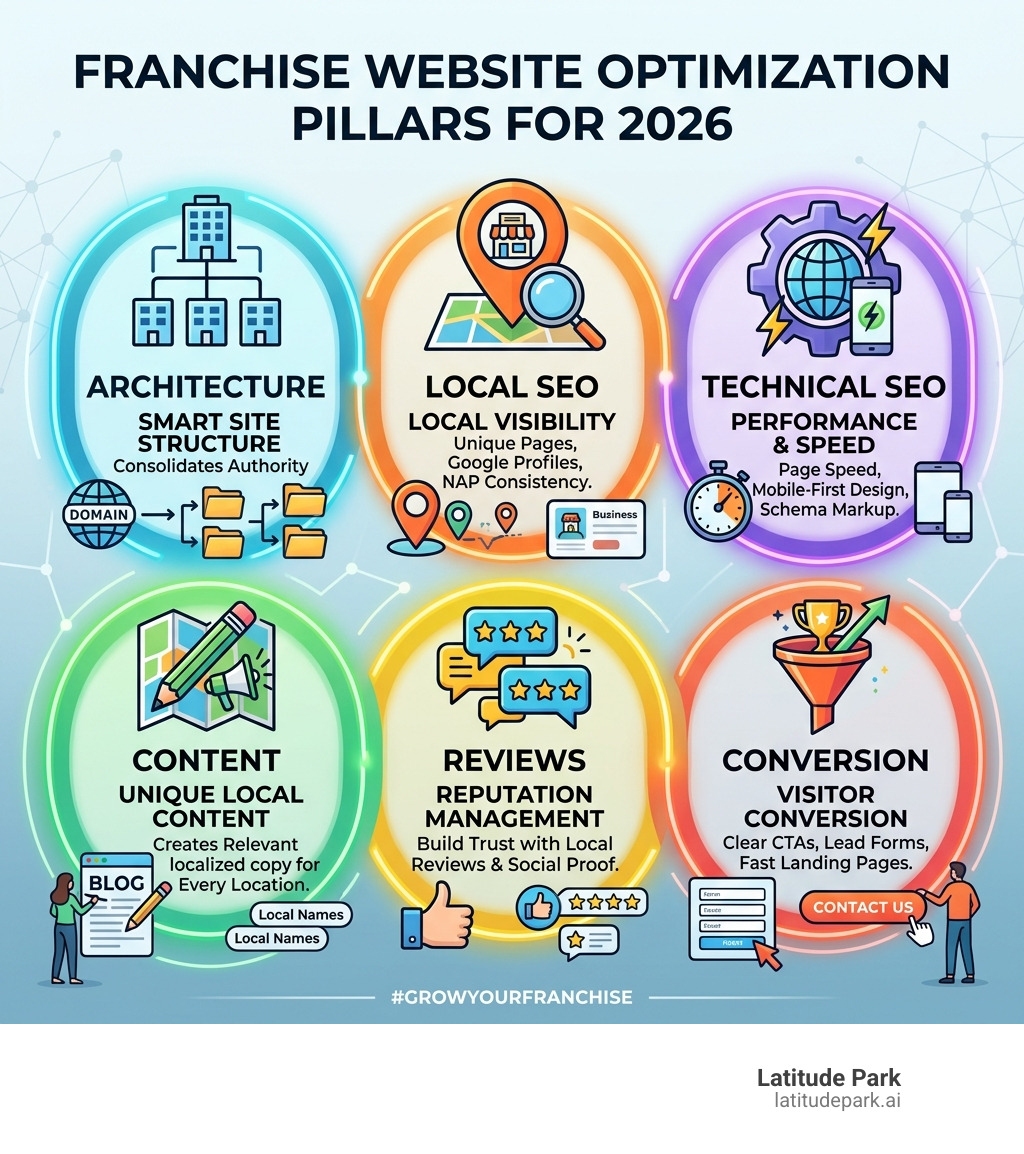
Franchise website optimization is the process of improving your franchise’s web presence — across all locations — so each one ranks in local search, builds trust, and converts visitors into customers or leads.
Here’s a quick breakdown of what it involves:
| Pillar | What It Means |
|---|---|
| Site Architecture | Subfolder structure to consolidate domain authority |
| Local SEO | Unique location pages, Google Business Profiles, NAP consistency |
| On-Page SEO | Localized keywords, meta tags, header hierarchy |
| Technical SEO | Page speed, schema markup, Core Web Vitals, mobile-first design |
| Content Strategy | Unique, localized copy for every location — no duplication |
| Conversion Optimization | Clear CTAs, lead forms, fast-loading landing pages |
| Reputation Management | Reviews, social proof, local authority signals |
The numbers tell the story clearly. 46% of all Google searches have local intent, and 90% of all clicks go to page-one results. If your franchise locations aren’t showing up on page one — locally — those customers are going to a competitor.
Most franchise brands have the opposite problem of a small business. It’s not a lack of locations. It’s that each location is invisible on its own. A strong national brand does not automatically translate into local search visibility. Every single franchise branch has to earn its own place in the local results.
And in 2026, with AI-powered search tools changing how people find businesses, the stakes are even higher.
I’m Rusty Rich, founder of Latitude Park and a digital strategist who has spent over 15 years helping franchises and small businesses turn their websites into growth engines through franchise website optimization. In this guide, I’ll walk you through exactly what it takes to build a franchise web presence that actually performs — at every location, at scale.
Basic franchise website optimization terms:
The Core Pillars of Franchise Website Optimization
When we talk about making a franchise website “not stink,” we are really talking about visibility and trust. It’s one thing to have a beautiful corporate site; it’s another to have 500 individual locations that all appear in the “Local Pack” when someone searches for your service “near me.”

Effective franchise website optimization requires a dual-focus strategy. We must satisfy the corporate need for brand authority while giving each franchisee the local tools they need to dominate their specific market. If you want to know how to optimize your franchise website for maximum SEO impact, you have to start by treating each location as its own local business that just happens to have a very powerful big brother (the corporate domain). You can find more info about SEO for franchise websites to see how this balance is struck.
On-Page Franchise Website Optimization Strategies
On-page SEO for franchises is about more than just slapping a city name in the title tag. We need to conduct deep keyword research that accounts for how people actually search in 2026. This means targeting long-tail intent keywords like “best emergency HVAC repair in Chicago” rather than just “HVAC repair.”
To win, your on-page elements must be flawless. Follow the ultimate guide to on-page SEO to ensure your header hierarchy (H1, H2, H3) is logical and your meta descriptions are within the 150-160 character sweet spot. Every location page should have a unique meta description that includes the local phone number and a localized call to action.
Balancing Global Branding with Local Relevance
One of the biggest headaches in the franchise world is the “branding tug-of-war.” Corporate wants everything to look identical to protect the brand, while franchisees want to mention the local high school football team they sponsor.
The solution is a robust style guide and a flexible franchise website design. We recommend using standardized templates for location pages that keep logos, colors, and typography consistent but allow for “local flavor” sections. This builds trust because the customer recognizes the national brand but feels the local connection.
Mastering Multi-Location Architecture and Branding
How you structure your website is the foundation of your entire SEO strategy. In the past, some brands used separate microsites or subdomains for every location. In 2026, that is a recipe for disaster.
| Structure | SEO Impact | Brand Consistency | Management |
|---|---|---|---|
| Subfolders (brand.com/location) | High (Shares main domain authority) | High (Centralized control) | Easy (One CMS) |
| Subdomains (location.brand.com) | Medium (Authority is diluted) | High | Medium |
| Microsites (localbrand.com) | Low (Starts from zero authority) | Low (Hard to police) | Hard (Multiple logins) |
We always advocate for a subfolder structure. It allows every local page to “borrow” the link equity of the main corporate domain. When the corporate site earns a high-quality backlink, every location page benefits. For a deeper dive into this, check out franchise SEO: strategies for boosting multi-location growth and our guide on designing for scale multi-location franchise website best practices.
Avoiding the Duplicate Content Trap
Google hates seeing the exact same 500 words on 50 different pages. If your location pages are carbon copies of each other with only the city name swapped out, you are falling into the duplicate content trap.
To fix this, each location page should have 300-600 words of unique content. This could include:
- Specific services offered at that branch.
- Bios of the local manager or team.
- Localized testimonials from residents in that specific ZIP code.
- City-specific H1 headers and mentions of local landmarks.
If you must use some boilerplate text, use canonical tags to tell search engines which page is the “master” version to avoid being penalized for “friendly fire” between your own locations.
User-Friendly Navigation for Complex Networks
If a customer has to click five times to find your address, they’ve already left. We follow the “three-click rule”: a user should be able to reach any destination on your site within three clicks.
For franchises, this means having a prominent “Find a Location” tool or store locator. On mobile, where 57% of local searches happen, your multi-location website design must include a collapsible hamburger menu to reduce cognitive load. Don’t overwhelm them with choices; guide them to the nearest branch as quickly as possible.
Local SEO: Dominating the “Near Me” Economy
Local SEO is the lifeblood of franchise website optimization. When someone pulls out their phone and searches for a service, they aren’t looking for a corporate headquarters in another state; they are looking for the “Local Pack”—the top three map results.
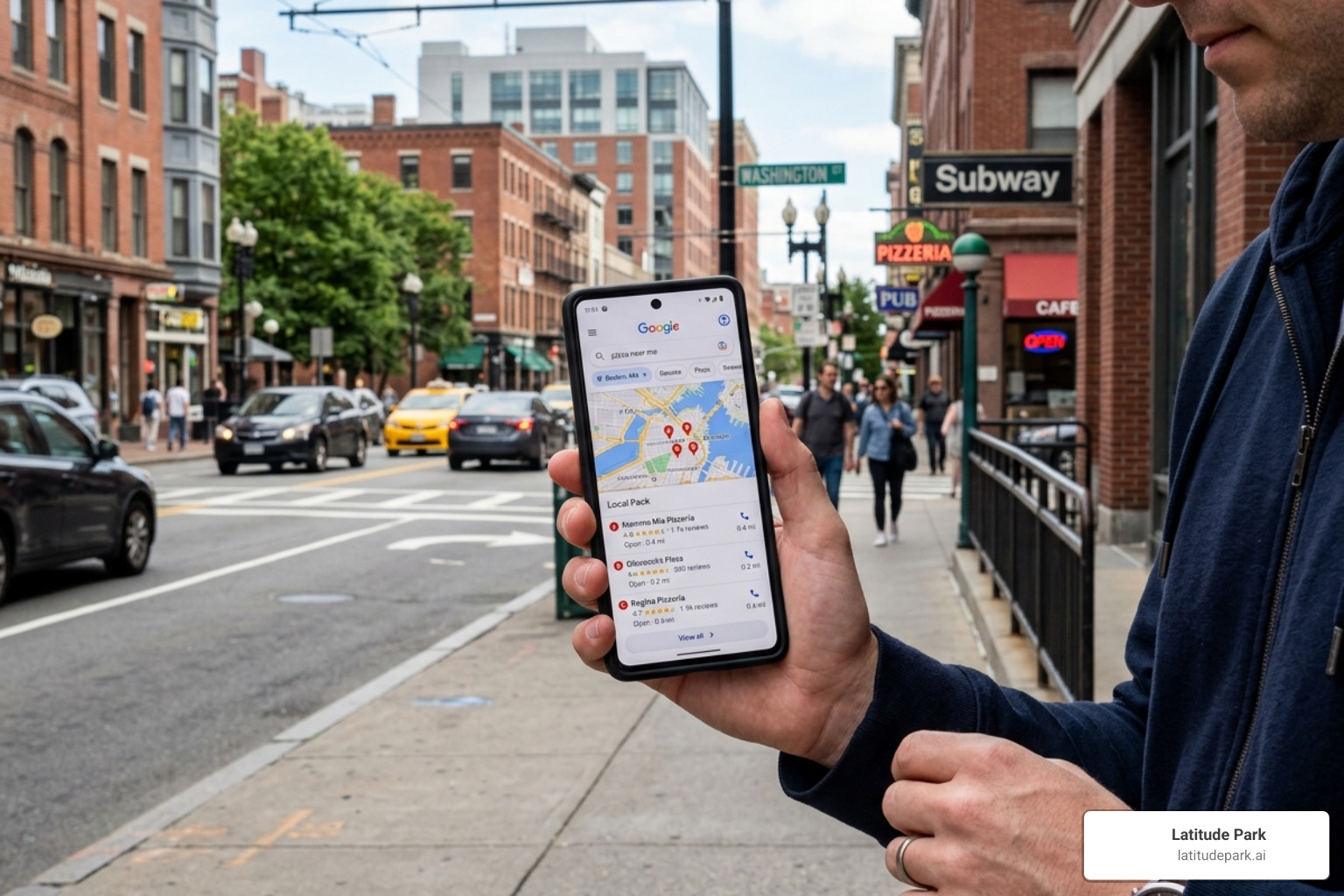
To dominate this space, you need three things: a perfect Google Business Profile (GBP), absolute NAP (Name, Address, Phone) consistency, and a high volume of local reviews. Our franchise website designs guide 2025 covers how to integrate these elements into your site’s DNA.
Managing Google Business Profiles at Scale
Managing 100+ GBPs manually is impossible. We use bulk verification tools to ensure every location is claimed and verified. But “set it and forget it” doesn’t work in 2026.
Search engines now look for “freshness signals.” This means you should be posting updates, offers, or photos to your GBPs at least once a week. We also recommend using UTM tracking on your GBP links so you can see exactly which location is driving the most traffic in your analytics.
The Power of Social Proof and Reviews
Statistics show that 84% of people trust online reviews as much as a personal recommendation. Furthermore, 72% of customers won’t take any buying action until they’ve read reviews.
For franchises, review velocity (how fast you get new reviews) and response time are critical. You should aim to respond to every review—positive or negative—within 24-48 hours. This signals to both the customer and Google that the local branch is active and cares about its reputation.
Technical Excellence and Future-Proofing for AI
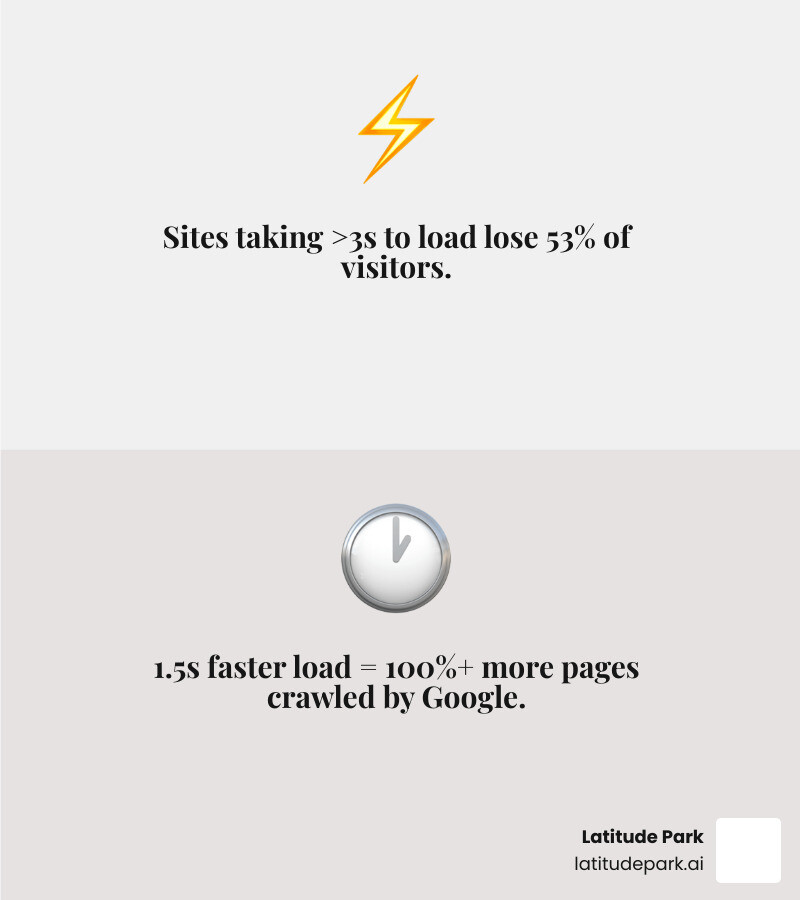
In 2026, technical SEO is not optional. If your site takes longer than 3 seconds to load, you’re losing money. In fact, reducing page load time by just 1.5 seconds can increase the number of pages Google crawls by over 100%.
Beyond speed, you must ensure your site is secure with SSL certificates and built with mobile-first website development in mind. Google uses the mobile version of your site for indexing and ranking, so if it looks bad on a phone, it doesn’t matter how good it looks on a desktop.
Technical Franchise Website Optimization for 2026
To help search engines understand your complex structure, you must implement LocalBusiness schema markup (JSON-LD). This acts as a “digital translator,” telling AI and search engines exactly where you are, what your hours are, and what services you offer.
Regularly performing a website audit is the only way to catch broken links, slow pages, or schema errors before they hurt your rankings.
Preparing for Generative Engine Optimization (GEO)
The newest frontier in franchise website optimization is GEO—optimizing for AI-generated search results (like ChatGPT or Google’s SGE). These engines prefer natural language and direct answers.
To prepare, we are moving toward “question-based headings.” Instead of just a heading that says “Our Services,” use “What services does our Chicago location offer?” This helps AI engines pull your content into their summaries. We are also focusing on “entity building”—ensuring your brand is recognized as a trusted authority across the entire web, not just on your own domain.
Frequently Asked Questions
Should each franchise location have its own separate website?
In almost every case, the answer is no. Using a single corporate domain with a subfolder structure (e.g., brand.com/locations/chicago) is significantly more effective. It centralizes your domain authority, ensures brand cohesion, and makes it much easier to manage technical SEO updates across the entire network. Separate websites often lead to “friendly fire,” where your own locations compete against each other for the same keywords, hurting everyone’s rankings.
How long does it take to see results from franchise SEO?
SEO is a marathon, not a sprint. You can often see “quick wins” from Google Business Profile optimization within 90 days. However, a full-scale franchise website optimization strategy typically takes 6 to 12 months to reach maturity. During this time, we measure ROI by tracking organic traffic growth, lead volume from local pages, and the “cost per lead” compared to paid advertising (which is often 80-90% higher for franchises).
What is the biggest mistake franchises make with their websites?
The “Big Three” mistakes are duplicate content across location pages, inconsistent NAP (Name, Address, Phone) data, and poor mobile user experience. If your Dallas location has the exact same text as your Houston location, Google may ignore one (or both). If one directory says you’re on “Main St.” and another says “Main Street,” search engines lose trust in your data. Finally, if a customer can’t easily click your phone number to call you on their mobile device, you’ve lost the lead.
Conclusion
Building a franchise website that doesn’t stink in 2026 requires a shift in mindset. You have to stop thinking of your website as a static brochure and start seeing it as a scalable, data-driven lead generation machine.
By focusing on the pillars of franchise website optimization—from a solid subfolder architecture to technical excellence and localized social proof—you can ensure that every single one of your locations is visible to the people who matter most: your local customers.
At Latitude Park, we specialize in navigating these complexities. Whether it’s through advanced SEO or our tailored Meta (Facebook) advertising strategies for franchises, we help multi-location businesses scale without losing their local touch. Ready to stop being invisible? Grow your revenue with franchise SEO services and let’s turn your website into your most valuable asset.