
Influence and Impact: What Public Affairs Consulting Firms Really Do
Core Capabilities of Modern Public Affairs Consulting Firms
Modern public affairs consulting firms operate at the intersection of public policy, corporate strategy, and media engagement. Unlike traditional PR agencies that focus primarily on consumer marketing, public affairs consultancies focus on how political decisions, government regulations, and public opinion impact an organization’s operational freedom.
To understand their full scope, check out our PR Services Complete Guide. The primary capabilities provided by top firms include:
- Crisis Management & Rapid Response: Protecting corporate reputation when sudden regulatory investigations, legislative shifts, or public controversies hit.
- Government Relations & Direct Advocacy: Communicating policy arguments to lawmakers, parliamentary bodies, and executive branch officials.
- Digital Advocacy & Public Mobilization: Executing targeted digital messaging to activate constituent pressure on key legislative swing votes.
- Coalition Building: Uniting non-traditional allies, trade associations, and grassroots networks behind shared policy objectives.
- Public Opinion & Sentiment Research: Running qualitative focus groups, quantitative polling, and deep policy analysis to understand stakeholder perception.
How Public Affairs Consulting Firms Combine Government Relations and Strategic Comms
Government relations and strategic communications used to function in separate corporate silos. Today, information moves instantly, and lawmakers are heavily influenced by digital media, public opinion, and local constituent chatter. Modern consultancies blur these lines by building unified campaigns.
When executing an issue campaign, strategic communications shape the surrounding public environment, making policy arguments understandable and sympathetic to everyday voters. Simultaneously, government relations teams leverage that public momentum to engage directly with elected officials, legislative staffers, and regulatory agencies. Effective execution requires proper oversight, as outlined in our guide on Managing Public Relations.
By mapping out key stakeholders, monitoring media signals, and refining core messages, public affairs firms ensure that an organization’s story is clear across print, broadcast, and digital platforms.
Specialized Services Across Federal, State, and Local Levels
Policy challenges rarely remain trapped in one level of government. A local ordinance regarding zoning, labor rules, or commercial permitting can quickly escalate into state-level policy battles or inspire federal regulatory scrutiny.
Top public affairs consulting firms offer multi-jurisdictional advocacy, maintaining footprints in Washington, D.C., state capitals, and major municipal markets. This multi-tiered coverage ensures that client messaging remains unified across different policy stages:
- Federal Advocacy: Focusing on broad national policy, trade enforcement, agency rulemaking, and congressional oversight hearings.
- State Government Relations: Navigating legislative sessions across multiple states simultaneously, addressing state tax codes, environmental mandates, and industry licensing.
- Local & Municipal Strategy: Engaging city councils, county commissions, and regional authorities on local site selection, tax incentives, and community-level permitting.
Strategic Architectures: Bipartisan Models and Geopolitical Risk Management
The structural model of a public affairs consultancy significantly impacts how effectively it navigates legislative shifts. In political environments characterized by intense polarization, selecting the right firm architecture is a crucial strategic choice.
Bipartisan vs. Single-Party Alignment in Public Policy
Organizations must choose between bipartisan agencies and single-party consulting firms. Bipartisan firms employ former senior officials from across the political spectrum, allowing them to maintain influence regardless of which party holds legislative control.
Conversely, single-party (all-Republican or all-Democrat) firms often provide deeper insider connections during single-party rule or within specific legislative committees. When a major political shift occurs during an election cycle, single-party firms tied to the incoming administration frequently experience significant demand surges, while bipartisan firms offer long-term stability across volatile political transitions.
Navigating Geopolitical Conflicts and Regulatory Shifts
Modern public affairs strategies extend far beyond domestic policy. Escalating trade tensions, sudden tariff implementations, supply chain adjustments, and international regulatory shifts (such as European digital governance frameworks) demand sophisticated international public affairs planning.
Geopolitical advisory capabilities help corporate leaders anticipate global policy risks before they disrupt cross-border supply chains or international investments. To explore how global communication strategies support cross-border outreach, view our overview on Global PR 101: The Ultimate Guide to International Public Relations.
Harnessing Grassroots Coalitions and Third-Party Validators

Direct lobbying carries inherent limits; elected officials listen most closely to their direct constituents, local business leaders, and trusted community validators.
Building Permanent Advocacy Infrastructure
Rather than assembling temporary campaigns whenever a policy threat arises, modern public affairs consultancies help organizations build permanent advocacy infrastructures. Instead of “renting” influence for brief legislative fights, companies establish independent non-profit entities, dedicated grassroots networks, and constituent databases.
This strategy builds long-term “Influence Equity.” By keeping engaged advocates informed between policy cycles, organizations can instantly activate thousands of localized constituent voices—generating calls, letters, and direct meetings—the moment a critical bill hits a legislative committee.
Overcoming Opposition Through Local Coalition Building
Commercial projects, site developments, and multi-location business expansions frequently face local NIMBY (“Not In My Backyard”) opposition. Public affairs consulting firms counter localized pushback by assembling broad third-party coalitions.
- Identifying Local Allies: Partnering with regional labor organizations, chambers of commerce, civic leaders, and local suppliers.
- Framing the Narrative: Highlighting economic development, job creation, and municipal tax base contributions to reframe the public debate.
- Mobilizing Supporters: Ensuring favorable local community voices attend public hearings, sign petitions, and submit public testimony during local approval processes.
AI, Data Analytics, and Demonstrating ROI in Strategic Advocacy
The public affairs industry has transitioned from intuitive, relationship-based lobbying to data-backed, highly measured campaign execution.
Proprietary Intelligence and AI in Modern Public Affairs
Advanced analytics and artificial intelligence have reshaped how firms analyze political landscapes. Modern public affairs teams deploy specialized technology suites:
- Predictive Policy Modeling: Analyzing legislative voting histories, committee member backgrounds, and bill text shifts to forecast policy outcome probabilities.
- Generative Engine Optimization (GEO): Optimizing owned executive perspectives and corporate policy positions so AI search tools reflect accurate organizational facts when policymakers query policy topics.
- Real-Time Sentiment Analysis: Processing millions of daily media signals, public forum discussions, and stakeholder feeds to spot emerging regulatory risks early.
Implementing these continuous updates to owned web properties helps ensure modern AI tools source accurate details during policy evaluations; read our framework on How to Optimize Your Website for Better PR Results.
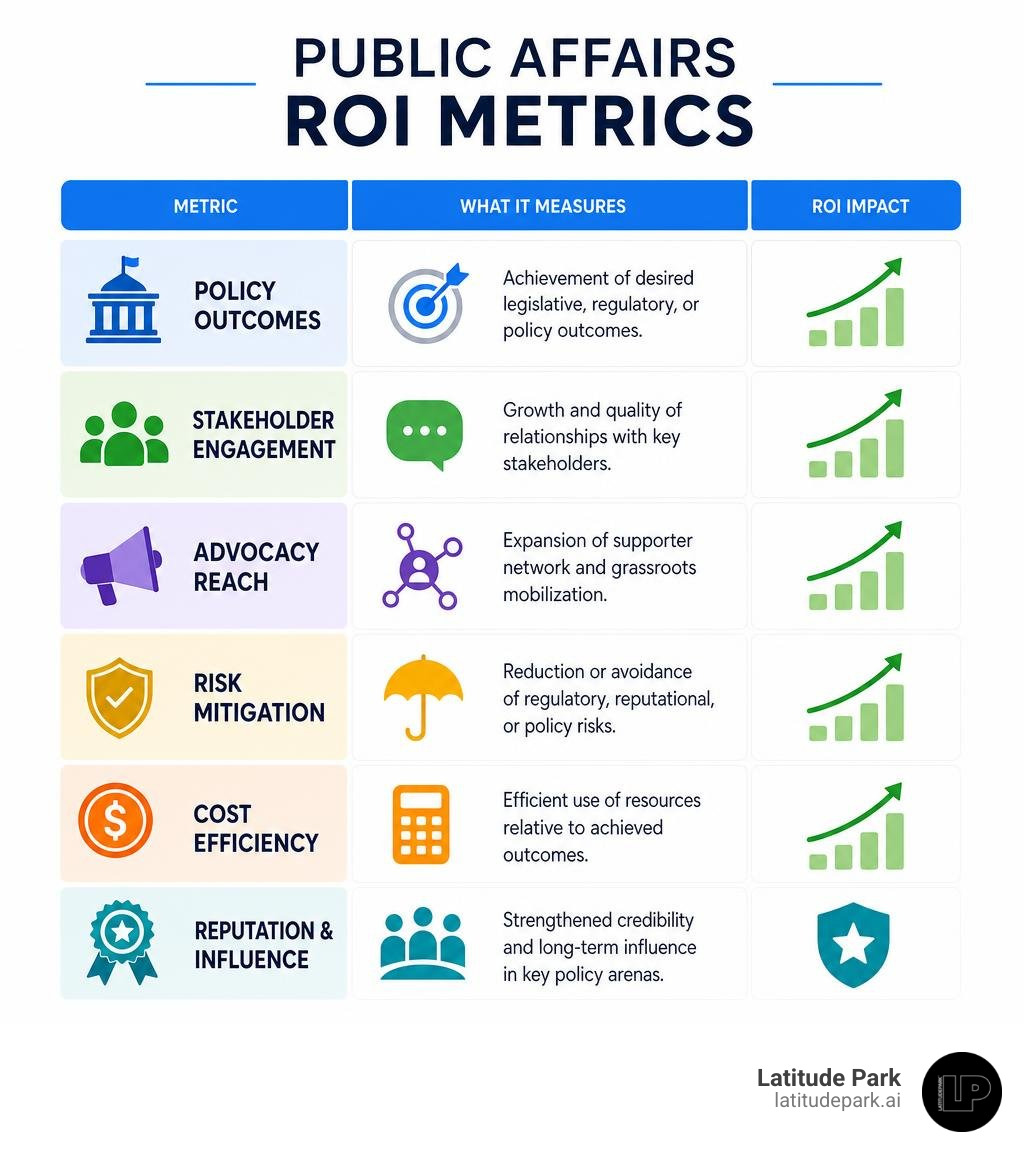
How Leading Public Affairs Consulting Firms Measure ROI
Measuring public affairs success requires moving past simple PR vanity metrics like impressions or raw reach. Leading consultancies measure outcome-oriented indicators:
| Traditional PR Metrics | Public Affairs Influence Metrics |
|---|---|
| Press Release Impressions | Policy Amendments Secured |
| Total Media Reach | Grassroots Constituent Message Volume |
| Advertising Value Equivalency (AVE) | Third-Party Coalition Expansion Rate |
| Website Referral Traffic | Committee Hearing Narrative Alignment |
Emerging Trends and Key Challenges Shaping Advocacy in 2026

As corporate operations become increasingly intertwined with societal concerns, public affairs consulting firms are guiding leadership teams through several emerging pressures.
Preparing Organizations for Complex Regulatory Shifts
- Artificial Intelligence & Tech Governance: State, national, and international governance frameworks around data privacy, agentic AI, and algorithmic transparency are evolving rapidly.
- Supply Chain & Trade Scrutiny: Escalating tariffs, trade sanctions, and regional sourcing rules require active trade policy engagement.
- Corporate Exposure & Polarization: Navigating political polarization requires precise messaging strategies to prevent routine policy positions from becoming reputational risks.
Organizations introducing complex products or technologies into changing regulatory markets benefit from coordinated strategic communications; see our specialized guide on Tech PR Demystified: A Guide to Go-to-Market Strategy.
Frequently Asked Questions About Public Affairs Consulting
What is the primary difference between PR agencies and public affairs consulting firms?
PR agencies typically focus on brand marketing, media placement, and product promotion to drive consumer purchasing decisions. Public affairs consulting firms specialize in shaping public policy, navigating government regulations, managing geopolitical risk, and managing relationships with government officials, community leaders, and regulatory agencies.
How do public affairs consultants protect corporate reputation during a political crisis?
Public affairs consultants protect corporate reputation by deploying swift crisis communications, engaging directly with regulators and legislative decision-makers, activating supportive third-party validators, and distributing data-backed messaging to counter inaccuracies before negative public sentiment solidifies.
Why is multi-jurisdictional advocacy necessary for modern enterprises?
Policy dynamics are highly interconnected. A local city council ordinance can quickly inspire statewide legislation or lead to national policy discussions. Multi-jurisdictional advocacy ensures an organization maintains consistent messaging, anticipates regulatory developments early, and protects its operational model across local, state, and federal levels simultaneously.
Conclusion

Navigating today’s legislative environment requires more than traditional lobbying or isolated public relations efforts. Public affairs consulting firms provide the multi-tiered expertise, data analytics, geopolitical risk analysis, and stakeholder engagement strategies necessary to turn complex regulatory threats into tangible policy wins.
At Latitude Park, we know that whether you are mobilizing local grassroots support for an issue campaign or expanding a multi-location brand footprint, clear narrative positioning, local audience engagement, and coordinated multi-channel execution are essential for success.
When your policy or marketing efforts require clear messaging, public engagement, and scalable execution across markets, explore how strategic campaign structures can deliver measurable impact.
Take control of your organization’s narrative and policy goals by learning more about Latitude Park PR Press Release Services.