
The Ultimate Starter Guide to Improve Site SEO
Understanding How Google Search Works and Setting Ranking Expectations
To improve site seo, we must first understand how search engines discover and evaluate content. Google does not manually review every webpage on the internet. Instead, it relies on automated programs called crawlers (primarily Googlebot) that continuously jump from link to link across the web, discovering new pages and updating existing records.
Fundamentals of Crawling, Indexing, and Search Intent
When Googlebot finds a page, it analyzes the page’s HTML, text, layout, and structured data to understand what the page is about. If the page complies with search quality standards, Google adds it to its massive database—a process called indexing.
To check if search engines have successfully indexed your domain, you can use the site: search operator directly in Google (for example, site:latitudepark.ai). If your key pages do not appear in the results, or if you want to see how Google’s US-based crawlers view your code, you can use the URL Inspection Tool inside Google Search Console. Official documentation like the SEO Starter Guide: The Basics emphasizes that webmasters should make their sites easy for bots to crawl while ensuring the content serves human intent above all else.
Modern search algorithms go far beyond exact keyword matching. Google uses advanced language models to evaluate conversational queries and understand semantic intent—the actual goal behind a user’s search. Search intent generally falls into four distinct stages:
- Informational: The user wants to learn something (e.g., “how to write a meta description”).
- Navigational: The user is looking for a specific website or page (e.g., “Latitude Park contact page”).
- Commercial Investigation: The user is comparing options before buying (e.g., “best franchise marketing agencies”).
- Transactional: The user is ready to purchase or take an immediate action (e.g., “hire SEO specialist”).
Aligning your content directly with user search intent is the single most fundamental rule when working to improve site seo.
How Long Does It Take to See SEO Impact?
One of the most common questions website owners ask is: “How long until we see organic ranking results?”
SEO is a long-term strategy, not an instant switch. Initial technical adjustments, such as updating title tags or fixing crawl blocks, can reflect in search results within a few days to 2–4 weeks. However, competitive search term improvements typically take between 4 to 6 months of continuous optimization, content updates, and link building.
As we outline in our guide on Effective SEO Techniques to Improve Your Website’s Search Ranking, search engines need time to re-crawl your site, process updated signals, compare your content against competitors, and measure how real searchers interact with your pages.
Core Pillars to Improve Site SEO: On-Page, Off-Page, and Technical

A balanced search engine optimization strategy rests on three interconnected core pillars. Neglecting any one of these pillars will limit your site’s ability to rank competitively.
| SEO Pillar | Focus Area | Key Elements & Tasks |
|---|---|---|
| On-Page SEO | Content & Page HTML | Title tags, meta descriptions, H1-H3 headings, primary/secondary keywords, image alt text, search intent matching |
| Off-Page SEO | Authority & Popularity | Backlinks, digital PR, brand citations, social signals, guest contributions |
| Technical SEO | Crawlability & Performance | Core Web Vitals, page speed, mobile responsiveness, XML sitemaps, canonical tags, schema markup |
Practical On-Page Techniques to Improve Site SEO
On-page SEO covers everything visible on your webpage alongside the underlying HTML elements. Start by establishing a clean heading structure. Every page should feature exactly one H1 tag containing your target query, followed by logical H2 and H3 subheadings for sections.
When optimizing meta tags:
- Title Tags: Keep them under 60 characters (around 600 pixels) to prevent truncation in search results. Front-load your primary keyword and make the title catchy.
- Meta Descriptions: Aim for 130 to 160 characters. While Google rewrites meta descriptions roughly 62% of the time, a compelling description with a clear call-to-action significantly increases click-through rates when displayed.
- Media Optimization: Compress every image under 100KB using WebP formats, and write descriptive
alttext so visual search engines and screen readers can understand the image context.
For an exhaustive walkthrough of on-page execution, read The Ultimate Guide to On-Page SEO.
Off-Page Strategy, Backlinks, and Building Domain Authority
Off-page SEO focuses on signals generated outside your own website. Search engines treat external backlinks from reputable sites as third-party votes of confidence. A single link from an authoritative, topically relevant publication holds far more weight than dozens of low-quality links from automated link farms.
To build meaningful domain authority:
- Create original data studies, industry reports, or comprehensive guides that naturally attract citations (linkable assets).
- Earn coverage in digital trade publications through strategic outreach and digital PR.
- Ensure consistent business name, address, and phone details across online directories and local profiles.
Strategic URL Structure and Website Architecture
A clean website architecture helps both users and search engine bots navigate your pages seamlessly. Organize topically similar pages into clear directories (e.g., latitudepark.ai/seo).

When setting up URLs, follow these standard practices:
- Use short, descriptive lowercase URL slugs separated by hyphens (never underscores).
- Avoid unnecessary stop words or arbitrary numeric parameters.
- Resolve duplicate content issues by setting explicit
rel="canonical"tags pointing to the master version of each page.
Check out the On-Page SEO Checklist 2026 to audit your website’s URL logic and link structures step-by-step.
Creating High-Quality Content and Building Topical Authority

To dominate competitive search topics, modern websites must demonstrate topical authority. Rather than creating isolated articles around random keywords, we structure content around comprehensive pillar pages surrounded by supporting topic clusters.
Executing Keyword Research and Intent Matching
Effective keyword research balances search volume, competition difficulty, and search intent. Instead of chasing high-volume, short-tail terms where competition is fierce, target conversational, long-tail phrases (queries containing 4 to 7+ words). Long-tail terms often carry strong commercial or transactional intent, attracting qualified visitors who are ready to convert.
When conducting keyword research:
- Identify primary target terms alongside secondary semantic variations (LSI keywords).
- Review current top-ranking pages on Google to determine the format searchers prefer (e.g., listicle, step-by-step guide, calculator).
- Map each keyword cluster to a single dedicated URL to prevent content cannibalization.
Learn more strategies for intent targeting in our piece on How to Rank Higher on Google: 10 Effective Strategies.
Maintaining Content Quality, E-E-A-T, and Regular Updates
Google’s Helpful Content system rewards people-first content that displays clear Experience, Expertise, Authoritativeness, and Trustworthiness (E-E-A-T). While E-E-A-T itself is not a direct algorithmic ranking factor, it guides how quality evaluators assess search results.
To improve content quality:
- Write for human comprehension first, maintaining a 7th to 9th grade Flesch-Kincaid readability level.
- Include original insights, real-world examples, screenshots, or case study data that AI generators cannot replicate.
- Include clear author bios highlighting verified credentials.
- Schedule bi-annual content audits to refresh outdated statistics, fix broken links, and update year references.
For advanced content tactics, explore our guide on How to Optimize Your Pages Like an Absolute SEO Pro.
Technical Optimization, Site Speed, and AI Search Readiness
A site can feature world-class written content, but if its technical foundation is broken, search engine crawlers will fail to index or prioritize its pages.
Leveraging Technical Audits to Improve Site SEO
Performing regular technical site audits is essential to catch silent crawl errors before they hurt your traffic. Real-world experiments show that resolving technical bottlenecks alone can jump page rankings from page 5 to page 1 within weeks, as detailed in I Spent 30 Days Doing Technical SEO on a Website in 2026.
Key technical cleanup tasks include:
- Fixing 404 errors by implementing clean 301 permanent redirects (avoiding slow redirect chains).
- Compression of web assets via host-level tools like LiteSpeed Caching.
- Reviewing Google Search Console Coverage reports to address indexing exclusions.
Review our step-by-step instructions in How to Do a Website Audit to evaluate your site’s technical baseline.
Optimizing for Core Web Vitals, Schema, and Generative AI Search
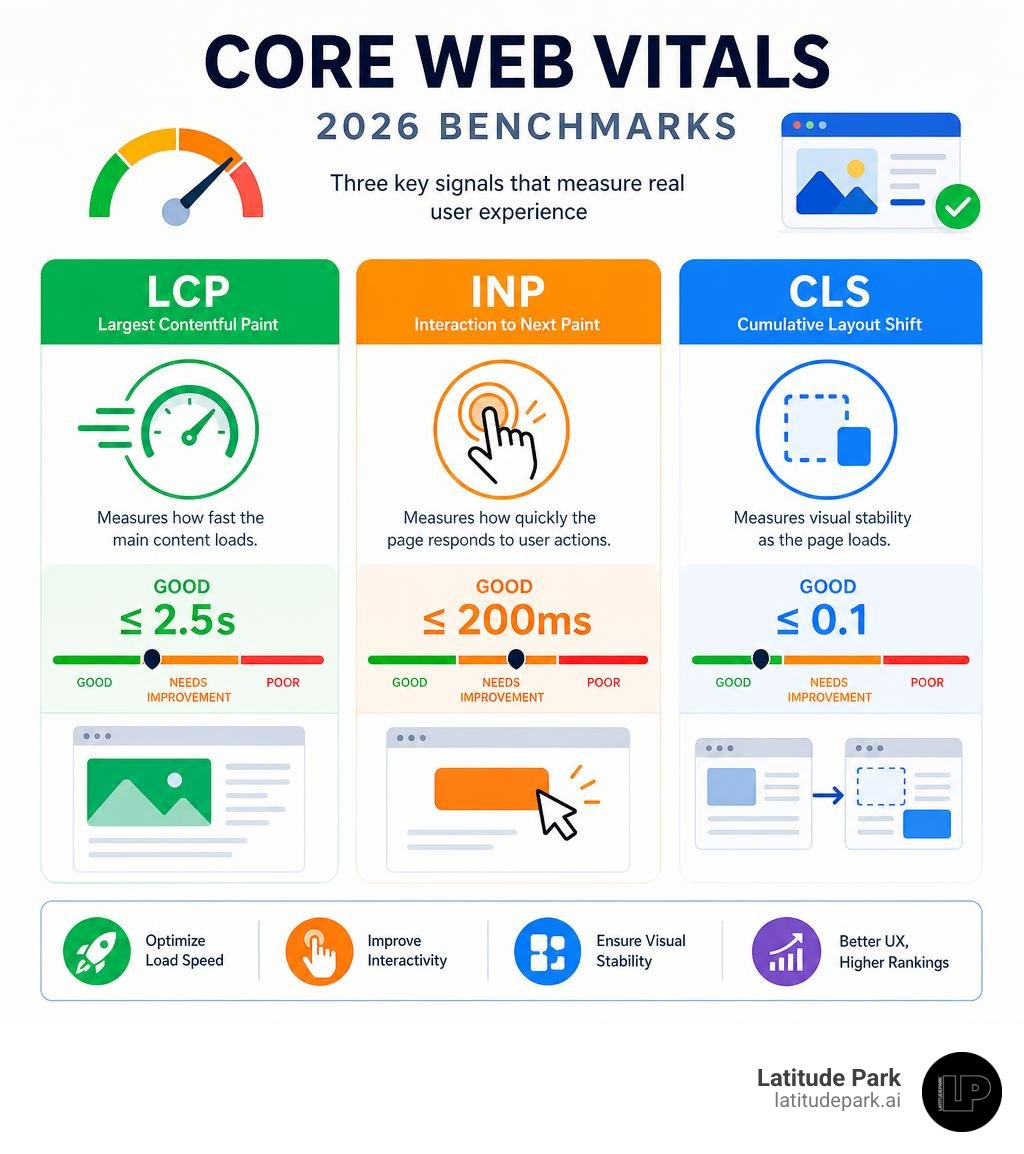
Page load speed and user experience are explicit Google ranking signals measured through Core Web Vitals:
- Largest Contentful Paint (LCP): Measures main content loading speed (target: under 2.5 seconds).
- Interaction to Next Paint (INP): Measures visual responsiveness to user actions (target: under 200 milliseconds).
- Cumulative Layout Shift (CLS): Measures visual layout stability during page load (target: under 0.1).
Beyond traditional search, modern web optimization requires Generative Engine Optimization (GEO)—ensuring your content can be read, parsed, and cited by AI answer engines such as Google AI Overviews, Perplexity, and ChatGPT Search.
To prepare your website for AI search models:
- Add JSON-LD structured data (schema markup) such as
Article,Organization,FAQPage, andLocalBusinesstags to assist machines in parsing key entities. - Structure direct, definition-first answers (40–60 words) immediately under clear H2 or H3 question headers.
- Verify your
robots.txtdirectives to allow access for legitimate search and AI crawlers (e.g.,GPTBot,PerplexityBot). - Host an
llms.txtfile at your root directory to give clear usage permissions and brand summaries to AI platforms.
Read On-Page SEO in 2026: The Complete Guide for AI Search for insights on blending technical schema with generative AI optimization.
Measuring SEO Success and Avoiding Common Mistakes
You cannot improve site seo without accurately tracking performance data over time. Setting up proper analytics enables you to focus efforts on strategies that actively generate conversions.
Key Metrics and Tools to Track Organic Ranking Growth
To evaluate search performance, connect Google Search Console and Google Analytics 4 (GA4). Focus your evaluation on metrics that reflect true business growth:
- Impression Growth & Clicks: Tracked via Google Search Console to monitor search demand and click-through rates (CTR).
- Non-Branded Keyword Rankings: Monitoring how your content ranks for general industry terms rather than your business name alone.
- Organic Conversions & Revenue: Setting up conversion events in GA4 to trace leads, contact form submissions, or sales directly back to search traffic.
To maintain perspective during tracking, read our guide on How to Master Google Search Ranking in 2025 Without Losing Your Mind.
Pitfalls That Hurt Search Engine Visibility
Avoid these common execution errors that undermine organic reach:
- Keyword Stuffing: Artificially repeating exact-match keywords makes text unreadable and triggers automated search filters.
- Orphan Pages: Publishing pages that lack internal links from other parts of your site leaves them undiscovered by crawlers.
- Duplicate Meta Tags: Using identical title tags or meta descriptions across multiple tool or service landing pages confused indexing bots.
- Poor Touch Targets: Failing to size mobile buttons and navigation links to at least 48px leads to mobile usability errors in Search Console.
Frequently Asked Questions About Website SEO
What is the most important on-site SEO factor for ranking?
The title tag remains the single most impactful on-page SEO element because it directly informs search engine crawlers of the page subject, displays as the primary clickable headline in search results, and heavily influences click-through rates. Combining a strong title tag with clear search intent alignment forms the backbone of on-page success.
How often should existing website content be updated?
We recommend conducting a full content audit at least bi-annually (every six months), with high-traffic commercial pages reviewed quarterly. Updating outdated figures, refreshing title tags, fixing broken outbound links, and adding new sections signals content freshness to search crawlers, encouraging higher crawl frequency.
Does site speed affect both search rankings and AI citations?
Yes. Page speed metrics—specifically Core Web Vitals like LCP and INP—directly affect search rankings. Furthermore, recent industry research shows fast-loading pages with First Contentful Paint under 0.4 seconds earn up to three times more AI Overview citations than slow, laggy pages.
Strategic Steps to Scale Your Organic Visibility
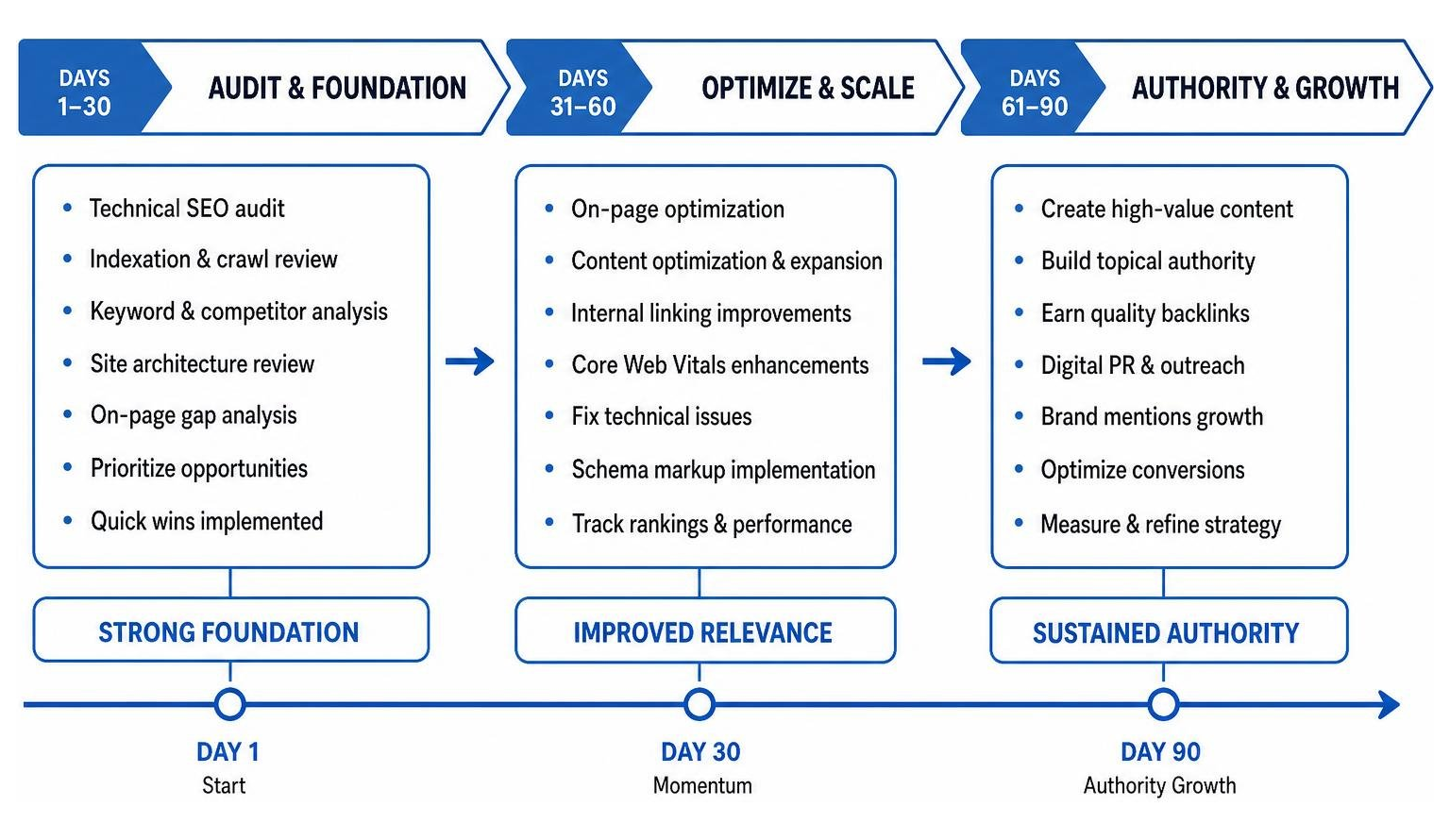
When you systematically apply these practices—aligning search intent, structuring clean technical code, optimizing Core Web Vitals, and building topical authority—your site creates an enduring competitive advantage.
At Latitude Park, we help expanding brands and multi-location franchises implement scalable search and digital marketing frameworks that deliver measurable lead growth. To learn how our team can tailor an organic strategy for your business, explore our Tailored Marketing and SEO Solutions.