
How Digital Ad Management Can Double Your Revenue
What Is Digital Ad Management and Why It Drives Revenue
As advertising options expand, businesses frequently struggle with platform fragmentation across search, social, and display channels. Managing campaigns natively inside isolated interfaces like Google Ads Manager or Meta Ads Manager often leads to blind spots. Effective cross-channel orchestration unifies these disparate efforts, driving ad efficiency and overall performance. By leveraging workflow automation and comprehensive Digital Ads Management Services, companies can manage multi-channel marketing performance through a cohesive framework that maximizes return on investment and drives sustained top-line growth.
Core Benefits of Digital Ad Management Solutions
The primary advantage of implementing advanced campaign management lies in continuous campaign optimization and real-time budget pacing. Sophisticated system monitoring provides instant anomaly detection, ensuring that sudden cost spikes or drops in engagement are flagged immediately. For instance, platform delivery algorithms can occasionally spike ad spend up to 50% above daily targets during short-term volume surges; automated budget guardrails prevent these unexpected overspends by checking pacing metrics continuously.
When campaigns operate within structured parameters, advertisers see direct performance improvements:
- Lower cost per acquisition (CPA) through automated bid adjustments and real-time negative keyword sweeps.
- Elimination of wasted ad spend by pausing underperforming ads before budget bleeds.
- Streamlined team workflows—agencies report up to a 95% simplification of cross-platform operations when adopting unified management hubs.
- Higher subscription and lead conversion rates by systematically reallocating media spend toward top-performing audience clusters.
This operational vigilance lowers overall acquisition costs while establishing the operational foundation needed for rapid conversion scaling.
Supported Advertising Networks and Channels
Modern digital ad management strategy encompasses a full spectrum of digital environments, including Google Ads, Meta Ads (Facebook & Instagram), TikTok Ads, LinkedIn Ads, and Microsoft Ads. Each platform possesses unique operational rules and delivery dynamics:
- Google Ads: Focuses heavily on high-intent search queries, YouTube video placements, and Performance Max campaign networks.
- Meta Ads: Structures campaigns across three hierarchical levels (Campaign, Ad Set, Ad) to deliver highly targeted visual ad formats based on user interest and demographic clusters.
- TikTok Ads: Requires tight monitoring because the platform tends to front-load daily budget delivery and resets campaign learning whenever major edits occur.
- LinkedIn Ads: Essential for account-based marketing (ABM) and reaching decision-makers in specific industries or job roles.
- Microsoft Ads: Serves as a cost-effective search expansion channel that complements Google Ads coverage.
By combining multi-network coverage with granular audience targeting, brands reach high-intent prospective customers across every digital touchpoint where they actively spend time.
Essential Features of Modern Ad Management Platforms
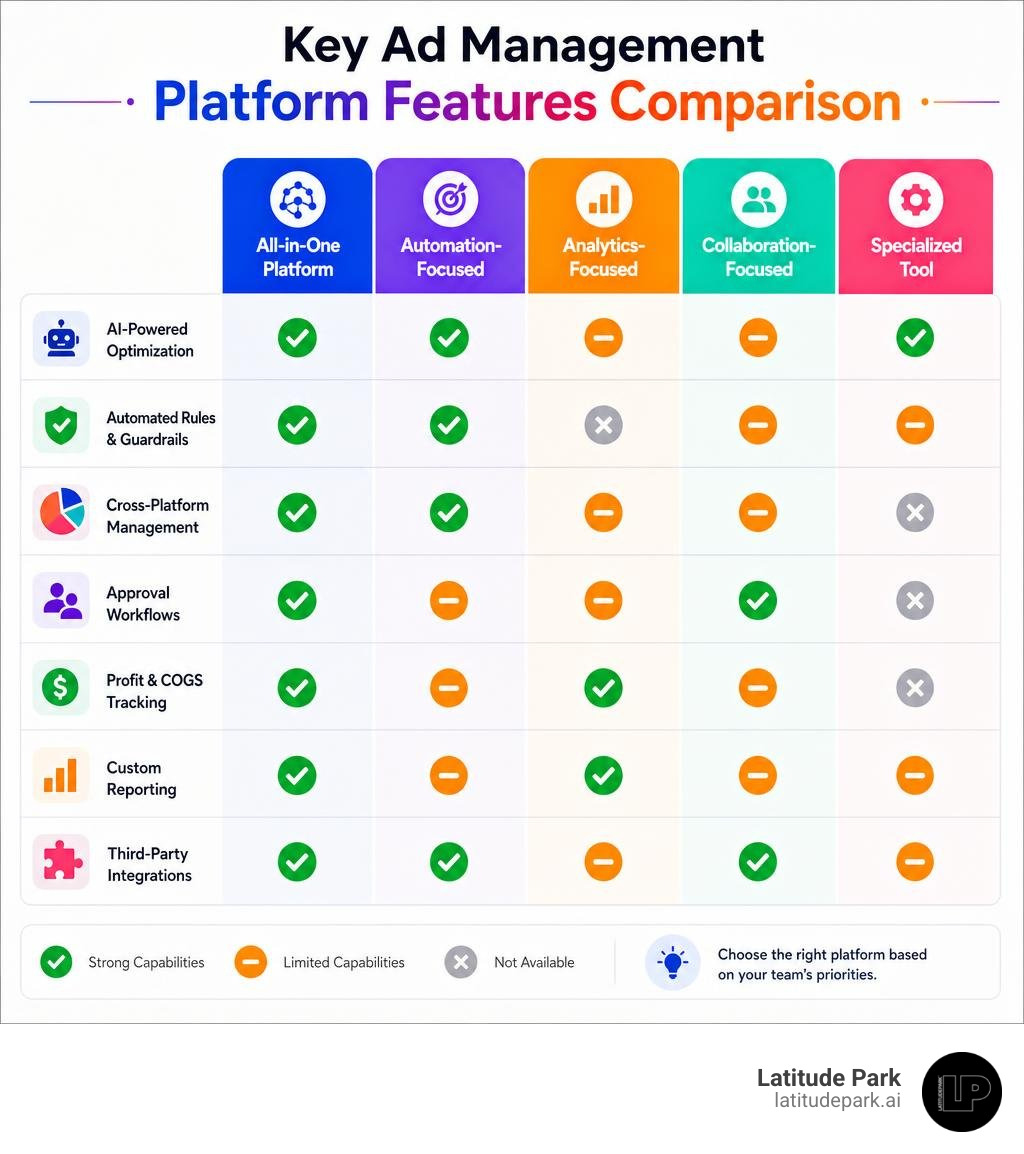
A robust advertising system offers actionable efficiency through automated optimization recommendations and automated rule triggers that react immediately to market changes. Approval-based workflows ensure team alignment before significant adjustments take effect, while net profit tracking and COGS integration evaluate genuine business profitability rather than superficial metrics. Evaluating all-in-one ad software against specialized single-purpose tools helps organizations select the exact architectural setup required for their operating scale.
Advanced AI Automation and Optimization
Integrating machine learning capabilities into daily campaign execution enables predictive bidding algorithms that optimize ad placement in real time. Today’s AI capabilities extend beyond basic automated rules to agentic AI workflows that recommend or execute complex cross-platform adjustments.

When deploying AI-driven optimizations, best practices emphasize keeping a human in the loop:
- Confidence Scoring: Machine learning models evaluate ad performance history and assign a confidence score to proposed bid or budget modifications.
- Approval-Based Controls: Rather than executing dark autonomous writes, AI assistants present actionable recommendations for human review.
- Guardrails & Audit Trails: Every automated change is logged with a specific hypothesis and timestamp, allowing media buyers to audit adjustments or revert changes if market conditions shift.
Specialized Tools vs All-in-One Digital Ad Management Systems
Organizations must evaluate whether to build custom stacks around script management and budget control using specific Google Ads script management tools—such as chiliad or custom JavaScript loaders—or to implement unified software platforms with robust API integrations and centralized asset libraries.
Specialized tools excel at niche tasks. For example, Google Ads scripts can automatically pause campaigns when spend reaches 90% of a monthly threshold or conduct automated GAQL query inspections to clear out low-intent search terms. Software solutions like Pace offer dedicated budget pacing across multiple networks to prevent overspending.
On the other hand, multi-platform management layers like Wevion or centralized platforms like Spotz aggregate data across Meta, TikTok, Google, and LinkedIn simultaneously. While standalone scripts offer granular utility for a single channel, unified systems streamline team coordination, eliminate data silos, and enable cross-platform budget reallocations based on total business impact.
Overcoming Key Challenges: Budget Pacing, Creative Alignment, and Security
Achieving consistent results requires close coordination between creative teams and media buyers to proactively prevent budget overspend and combat creative fatigue. When creative producers work in a silo separate from performance media buyers, campaigns frequently suffer from messaging mismatch and rapid creative exhaustion. Synchronizing creative asset creation with real-time performance analytics can drive a +21% increase in producing high-performing ad creative at scale.
Furthermore, ensuring brand safety, protecting user privacy, and maintaining regulatory compliance across regions are critical components of long-term stability. Strategic preparation is detailed in Digital Advertising Planning: Stop Throwing Spaghetti at the Wall, which outlines systematic strategies to mitigate risk and boost media execution performance. To avoid common agency selection traps when scaling external help, review The No-Nonsense Guide to Hiring Online Advertising Companies.
Multi-Account Centralization for High-Scale Operations
For complex agency workflows and multi-unit businesses, multi-account dashboards are non-negotiable. Manually logging into dozens of individual account portals increases operational friction and invites human error.
Centralized operating hubs address these high-scale challenges by providing:
- Unified Account Access: Manage multiple client or regional sub-accounts without sharing sensitive native platform passwords or exposing business access tokens.
- Role-Based Access Control (RBAC): Scope team member permissions strictly to the specific accounts and budget thresholds they manage.
- Bulk Deployment: Launch campaigns, creative assets, and targeting parameters across multiple account structures at once using streamlined bulk tools.
- Cross-Account Anomaly Alerts: Receive real-time push notifications (via Slack, Telegram, or email) the moment an account experiences an unexpected spend spike or script execution failure.
Navigating Platform Pricing Models and Software Evaluation
When selecting ad management software, organizations encounter three primary pricing structures:
| Pricing Model | How It Works | Best Used By |
|---|---|---|
| Tiered / Flat Monthly Fee | Fixed cost based on feature sets or user seats (e.g., plans starting from $49/mo). | Growth teams and agencies seeking predictable software expenses. |
| Spend-Based Pricing | Software fee scales as a percentage of total monthly ad spend managed. | Enterprise brands with large spend, though it can penalize high-volume efficiency. |
| Free / Freemium Tiers | Limited feature access capped by low monthly spend caps (e.g., under €500/mo) or connected account limits. | Lean startups testing basic cross-account monitoring features. |
Choosing the correct model requires an accurate ROI evaluation to confirm that platform costs are outweighed by saved operational hours, eliminated budget waste, and reduced cost per acquisition. Discover more about structured media administration through The Benefits of Campaign Management Services.
Frequently Asked Questions About Digital Ad Management
How do AI tools improve ad campaign performance?
AI tools enhance ad performance through real-time monitoring and automated bid adjustments, allowing instantaneous responses to market demand changes. Machine learning algorithms analyze historical performance data across millions of impressions to identify high-converting targeting patterns faster than humanly possible. By combining human approval controls with machine precision, businesses achieve consistent CPA reduction without forfeiting strategic direction.
What is the difference between ROAS and true net profit tracking?
Traditional Return on Ad Spend (ROAS) only calculates top-line revenue generated relative to ad spend (Revenue ÷ Ad Spend). True net profit tracking goes beyond “ROAS theater” by incorporating Cost of Goods Sold (COGS), shipping fees, credit card processing rates, and local taxes directly into the campaign dashboard:
$$\text{Net Profit} = \text{Revenue} – (\text{Ad Spend} + \text{COGS} + \text{Shipping} + \text{Transaction Fees})$$
Evaluating performance through real net profit ensures that campaigns do not scale volume on high-cost products that actually lose money on every order.
How do centralized dashboards benefit multi-account teams?
Centralized management hubs offer single sign-on security, cross-account visibility, and unified reporting metrics. Instead of jumping between disconnected dashboards with changing reporting logic, team members monitor overall performance from a single operating screen. This setup provides major workflow simplification, reducing management overhead, eliminating spreadsheet tracking errors, and streamlining client reporting across complex account portfolios.
Scaling Your Ad Strategy to Maximize Profit
Scaling digital advertising efficiently requires a tailored strategy, particularly for complex business structures. Latitude Park specializes in franchise ad strategy and multi-location marketing, helping businesses grow through effective Meta advertising strategies and tailored campaign structures that address multi-unit operations.

Managing advertising across multiple franchise locations or distributed business units presents unique hurdles—from preserving brand consistency to avoiding local audience overlap. By deploying structured account architectures, localized campaign settings, and unified management workflows, multi-location businesses can scale seamlessly across regions.
By combining expert performance scaling with ongoing campaign optimization, brands can capture higher market share without compromising margin health. Explore our comprehensive resources in the Digital Advertising Services Complete Guide and partner with experts to Scale Your Growth with Digital Ads Management Services.