The No-Nonsense Guide to Hiring Online Advertising Companies
Why Choosing the Right Online Advertising Companies Can Make or Break Your Growth
The online advertising companies you partner with will directly shape how fast — and how profitably — your business grows across every location you operate.
Here’s a quick breakdown of the top platforms and company types to know:
| Company / Platform | Best For | Key Strength |
|---|---|---|
| Google Ads | Search intent, app installs, leads | Reaches users across Search, Maps, YouTube, and Play |
| LinkedIn Ads | B2B, professional audiences | Targets by job title, industry, seniority, and skills |
| Google AdMob | Mobile app monetization | 81% of top 1,000 Android apps; 200+ countries |
| Moloco | Performance marketing, retail media | CARA AI increased ROAS by 27% in 2025 |
| Agency Holding Companies | Large-scale multi-channel campaigns | Combined quarterly revenues exceeded $16 billion in Q3 2021 |
| Ads MCP (AI-managed) | Multi-platform campaign management | Controls Google, Meta, TikTok, LinkedIn, and more via AI agents |
The digital ad market is crowded, complex, and moving fast. Franchise marketing managers in particular face a real challenge: coordinating campaigns across dozens of locations while keeping brand messaging consistent and budgets under control.
The good news? Once you understand how these platforms differ — and what each type of advertising company actually does — making the right call gets a lot simpler.
I’m Rusty Rich, founder and President of Latitude Park, a full-service digital advertising agency based in St. Petersburg, Florida, where since 2009 I’ve helped small businesses and growing franchises navigate the increasingly complex world of online advertising companies across Google, social media, and beyond. In the sections below, I’ll walk you through everything you need to compare your options and make a confident decision.
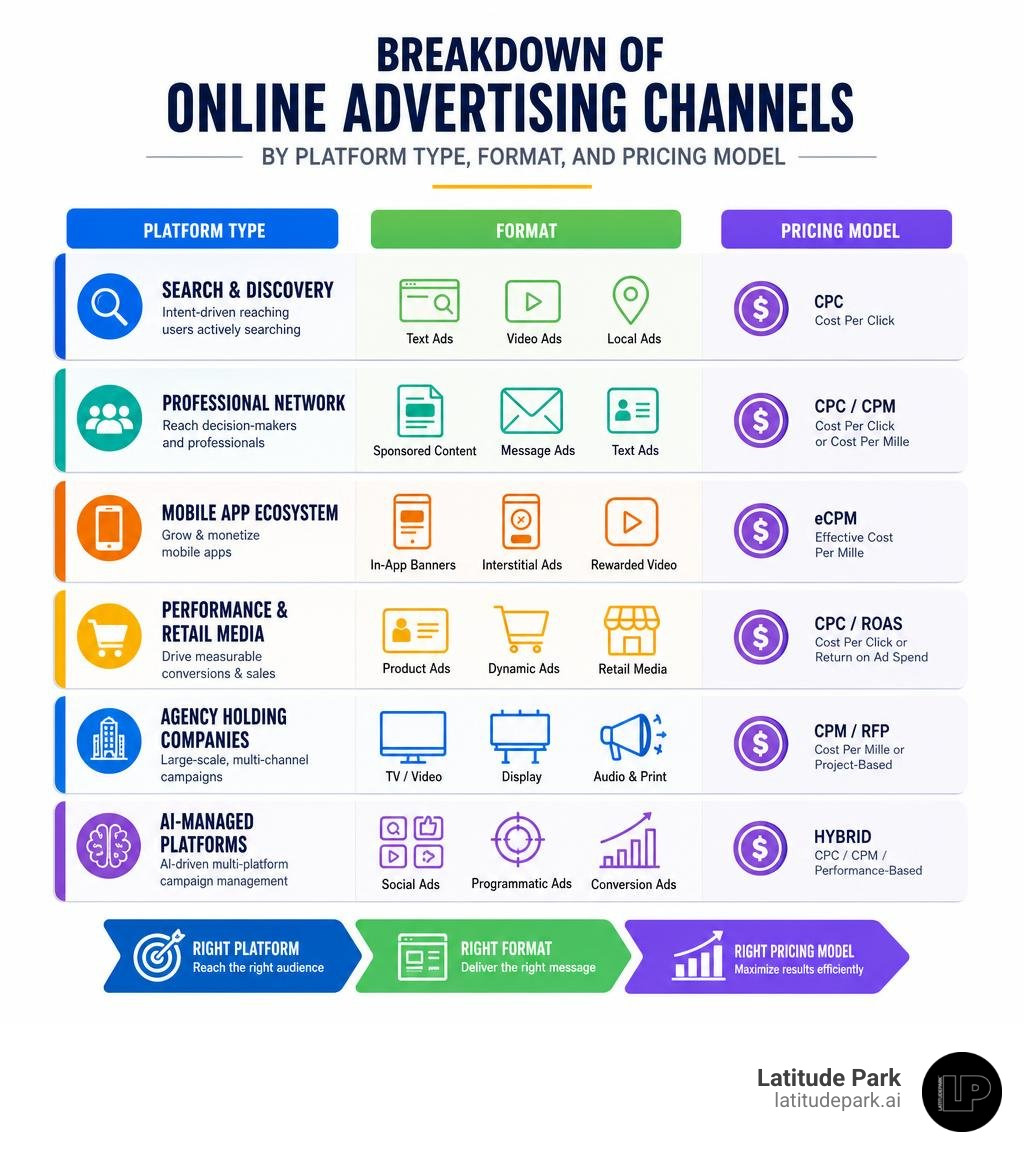
Simple online advertising companies glossary:
Core Types of Online Advertising Platforms and Networks
To navigate the digital ecosystem effectively, we need to distinguish between the primary channels driving global ad spend. While search platforms capture high-intent users actively looking for solutions, social networks excel at targeted discovery, and programmatic networks extend reach into mobile apps and publisher sites across the web. To dive deeper into media distribution channels, explore our Digital Advertising Media Complete Guide.

Search and Social Ad Ecosystems
Search platforms like Google allow businesses to intercept potential buyers at the exact moment of commercial intent. Through tools like Reach Customers Across YouTube & Search – Google Ads, brands leverage real-time behavioral signals across Search, Google Maps, YouTube, and Google Play. For example, financial services provider PensionBee achieved a 400% increase in app downloads in just 6 months by executing targeted campaigns across Google channels.
On the social media side, platforms utilize rich demographic and behavioral profiles. LinkedIn Ads stands out as the premier B2B environment, reaching over 1 billion professionals worldwide. Businesses can leverage four major ad formats to engage decision-makers:
- Sponsored Content: Native feed placements (images, video, carousels) that appear directly in user feeds.
- Sponsored Messaging: Direct-to-inbox messaging assets delivering personalized content to targeted professionals.
- Dynamic Ads: Hyper-personalized sidebar placements that incorporate profile imagery and job titles automatically.
- Text Ads: Direct desktop banner and rail ads designed for cost-effective brand visibility.
By combining granular targeting attributes such as job title, industry vertical, company size, and seniority, social ecosystems complement search by generating new demand before a search query is even typed.
Programmatic and Mobile Ad Networks
Beyond main search and social networks, programmatic advertising networks dynamically buy and sell ad inventory across millions of mobile apps and websites using automated auctions.
In the mobile app monetization space, platforms like Google AdMob – Earn More With Mobile App Monetization connect app developers with over 1 million Google advertisers across more than 200 countries. AdMob is used by 81% of the top 1,000 Android apps and trusted by 97% of AdAge 100 advertisers.
Key ad formats in programmatic mobile environments include:
- Rewarded Ads: User-initiated formats where app users watch a short video or engage with an ad in exchange for in-app rewards (e.g., extra lives, virtual currency).
- Interstitial Ads: Full-screen ad placements that appear during natural transition points, such as between game levels or article loads.
- In-App Bidding: Real-time auction mechanisms where multiple demand sources compete simultaneously for ad space at equal priority, ensuring publishers maximize yield while advertisers access premium placements.
Market Dynamics: Holding Companies, Data Sharing, and Power Structures
The balance of power among online advertising companies isn’t governed solely by platform technology; it is heavily influenced by agency holding groups and how audience data is shared across networks. Businesses evaluating ad partners should review our overview on working with a modern Ad Agency and understand strategies behind Selling Digital Advertising Space.
How Agency Bid Coordination Impacts Yields
Massive ad agency holding companies — specifically the major global agency conglomerates — exert incredible influence over market dynamics. In Q3 2021 alone, the top six holding companies generated over $16 billion in combined global quarterly revenue.
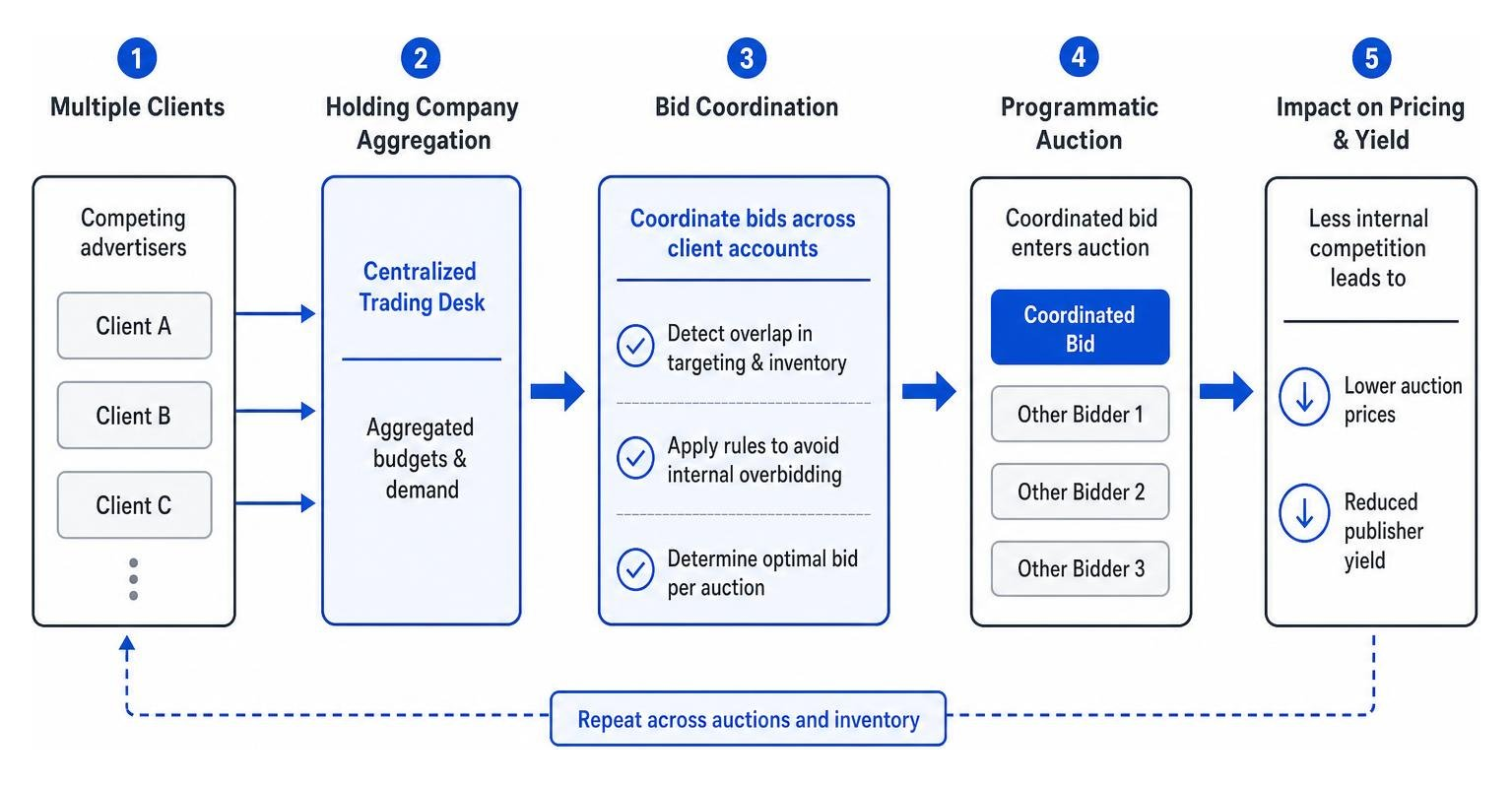
These conglomerates pool multi-million dollar client budgets through centralized trading desks. By deploying automated bid coordination across competing client accounts (such as two rival retail brands managed by the same holding group), trading desks can strategically avoid outbidding each other in programmatic auctions. Academic research indicates that bid coordination by agency holding groups can suppress auction prices and reduce publisher ad revenues by over 10%.
Privacy Regulations and Audience Data Practices
To counter agency bid coordination and maintain competitive yield, major ad platforms and publishers strategically adjust how much granular data they share. By restricting access to detailed audience profile attributes and withholding specific context signals, platforms force agency trading desks back into open auction competition.

At the same time, evolving privacy regulations and the phase-out of third-party tracking have made first-party data collection critical. Platforms that aggregate verified first-party user data retain superior pricing power and delivery precision. Publishers looking to understand inventory valuation can consult our Digital Advertising Space Complete Guide.
How Online Advertising Companies Structure Pricing and Campaign Budgets
Understanding ad pricing structures is fundamental to choosing the right partner and keeping media spend efficient. Read our guide on Demystifying Digital Advertising Pricing Without Losing Your Mind or Wallet for full strategic context.
| Pricing Model | Description | Primary Use Case | Key Advantage |
|---|---|---|---|
| Cost-Per-Click (CPC) | Charged only when a user clicks an ad | Direct response, search campaigns | High intent; pays for active engagement |
| Cost-Per-Impression (CPM) | Charged per 1,000 ad impressions served | Brand awareness, video reach | Maximizes visibility across large audiences |
| Real-Time Bidding (RTB) | Dynamic programmatic auction pricing | Mobile, display, retargeting | Efficient price discovery based on real-time value |
Evaluating Campaign Performance Across Online Advertising Companies
Most major ad networks operate on auction-based bidding models, where factors like bid amount, ad quality scores, and estimated action rates determine which ad wins placement.
Starting budget requirements vary across platforms:
- LinkedIn Ads: Offers flexible daily spend management with minimum daily budgets starting at just $10.
- Google Ads: Has no strict platform minimums, allowing small businesses to start testing with modest spend while controlling max CPC bids.
- Programmatic DSPs: Enterprise platforms often require higher monthly spend commitments or minimum monthly spend thresholds to unlock advanced targeting.
Aligning Budgets with ROAS and Performance Metrics
Evaluating campaign performance requires establishing clear metrics tied directly to business outcomes rather than surface-level impressions. Return on Ad Spend (ROAS) remains the north star metric for performance campaigns:
$$\text{ROAS} = \frac{\text{Revenue Generated from Ads}}{\text{Total Ad Cost}}$$
To optimize ROAS effectively, businesses must:
- Implement robust conversion tracking using platform tags (such as Google Tag Manager and the LinkedIn Insight Tag).
- Connect customer relationship management (CRM) systems to feed offline conversions back to ad networks.
- Continuously reallocate spend toward high-performing audience segments and creative variations.
To build a unified growth framework around these metrics, review Your Company’s Advertising Blueprint for Growth.
AI Innovation and Next-Generation Advertising Infrastructure
Artificial intelligence has transformed digital advertising from manual optimization into dynamic, predictive decision engines operating at global scale.
AI-Powered Targeting Solutions from Online Advertising Companies
Modern AI advertising systems process billions of signals in real time to optimize ad delivery, audience matching, and creative selection. Enterprise solutions like AI-powered Performance Advertising at Global Scale | Moloco demonstrate the potential of advanced machine learning.
Moloco’s proprietary system, CARA (Compound Ad Recommendation Architecture), organizes specialized AI models and software agents to optimize ad delivery across a global network reaching over 2 billion daily active mobile users outside traditional walled gardens. In 2025, CARA boosted campaign ROAS by an average of 27%. During initial testing with e-commerce platform Wayfair, Moloco’s AI drove a 30% increase in display ad click-through rate (CTR).
Key capabilities of AI-driven ad platforms include:
- Frequent Model Updates: Top AI platforms retrain recommendation algorithms as often as every two hours to adjust to shifting user intent.
- Automated Creative Generation: Machine learning dynamic creative optimization (DCO) tools automatically iterate ad copy, images, and formats for specific user segments.
- Retail Media Integration: Retailers can run closed-loop ad networks where machine learning matches product listings directly with customer buying history.
Automated Multi-Platform Management via MCP Servers
Managing advertising across multiple ad accounts can be time-consuming. Emerging infrastructure standardizations like the Model Context Protocol (MCP) enable conversational AI agents (such as Claude, ChatGPT, or Cursor) to manage multi-platform campaigns directly.
Using open-source tools like GitHub – adkit/ads-mcp: Ads MCP – manage Google, Meta, TikTok, LinkedIn, Microsoft, Reddit & X Ads campaigns from Claude, ChatGPT, Cursor & any MCP client. · GitHub, marketers can execute commands across Google, Meta, TikTok, LinkedIn, Microsoft, Reddit, and X Ads.
To maintain complete control, MCP implementations use a draft-first workflow:
- The AI agent generates proposed campaign structures, targeting edits, or keyword adjustments as a draft.
- The human marketer reviews the changes for brand safety and strategic alignment.
- The campaign edits are published to platform APIs only after explicit human approval.
To avoid disorganized testing when using AI management tools, review our strategic guide Digital Advertising Planning Stop Throwing Spaghetti at the Wall.
Frequently Asked Questions About Online Advertising
How do major online advertising platforms differ in targeting and ad formats?
Google Ads targets high intent through active search keywords, location queries, and video context. LinkedIn Ads focuses on professional demographics, enabling B2B targeting by job title, company size, seniority, and industry across native feeds, direct messaging, and personal rail formats. Programmatic mobile networks like AdMob use rewarded videos and interstitials inside over 1 million mobile apps globally.
What strategies do publishers use against large agency holding companies?
Because holding company trading desks aggregate client spend to coordinate programmatic bids and reduce publisher revenues (by over 10% according to industry studies), publishers counter this influence by restricting granular audience profile access. By withholding detailed user attributes, established publishers force agencies to compete in open real-time auctions based on context, preserving ad yield and pricing power.
How does AI improve return on ad spend across modern ad networks?
AI systems improve ROAS by analyzing real-time behavioral signals, predicting conversion probability, and automatically shifting budgets toward high-converting user segments. Systems utilizing compound AI architectures, such as Moloco’s CARA platform (which boosted ROAS by 27% in 2025), retrain recommendation models as frequently as every two hours to optimize campaign performance at scale.
Conclusion
Choosing among online advertising companies requires evaluating targeting capabilities, pricing models, agency dynamics, and AI innovation. Whether you are running B2B lead generation on LinkedIn, capturing search traffic on Google Ads, or scaling mobile monetization with AdMob, selecting the right mix of technology and agency execution is key.
For multi-location brands and growing franchises, managing campaign consistency across markets presents unique operational challenges. At Latitude Park, we specialize in franchise marketing and high-performing Meta (Facebook) advertising strategies. We build tailored campaign structures designed specifically for multi-location businesses, ensuring local ad budgets deliver consistent brand growth and measurable ROI.
Ready to take your digital campaigns to the next level? Explore our comprehensive resources:
- Digital Advertising Services Complete Guide
- Digital Advertising Sales Guide 2026
- Franchise Digital Marketing Agency Services
Contact our team at Latitude Park today to discover how our custom advertising blueprints can accelerate your growth across every location.