Demystifying Digital Advertising Pricing Without Losing Your Mind or Wallet
What You’re Actually Paying for Digital Advertising in 2026
Digital advertising pricing can feel like a black box — but the core numbers are simpler than most people expect.
Here’s a quick snapshot of what businesses typically pay in 2026:
| Metric | Typical Range |
|---|---|
| Monthly digital ad spend (most businesses) | $301 – $5,000/month |
| PPC ads monthly spend | $100 – $100,000/month |
| Social media ads annual spend | $100 – $25,000/year |
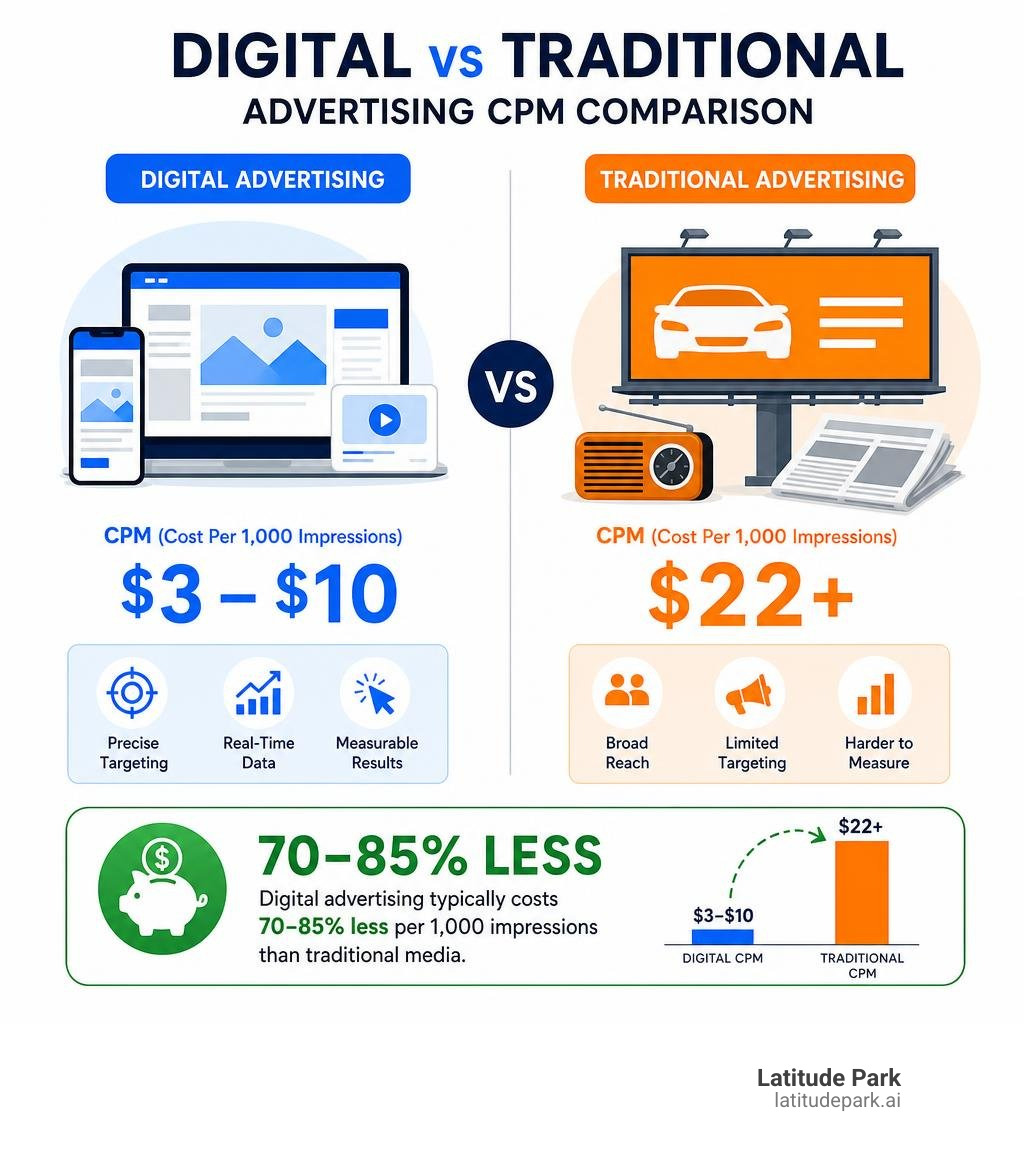
| Digital CPM (cost per 1,000 impressions) | $3 – $10 |
| Traditional media CPM (billboards, radio) | $22+ |
| % of total budget most businesses allocate | 5 – 10% |
The short answer: digital advertising costs significantly less than traditional media — often 70–85% less per 1,000 impressions — while giving you real-time data and precise audience targeting that print and broadcast simply can’t match.
And yet, many franchise marketing managers still struggle to know if they’re spending the right amount, on the right platforms, in the right way.
That’s exactly what this guide breaks down.
I’m Rusty Rich, founder of Latitude Park and a digital advertising practitioner since 2009, and I’ve spent over 15 years helping businesses — from small local shops to growing franchises — navigate digital advertising pricing across Google, Meta, and beyond. Whether you’re coordinating campaigns across five locations or fifty, understanding what drives ad costs is the foundation of every smart budget decision we’ll cover below.
Quick digital advertising pricing terms:
Understanding the Benchmarks of Digital Advertising Pricing in 2026
When we look at the macro landscape of digital advertising pricing in June 2026, we see a marketplace defined by data-driven precision, automated bidding, and platform shifts. Over 80% of digital advertising campaigns are now run through managed, automated bidding algorithms. This shift means that platforms are constantly adjusting live auctions based on user behavior and advertiser signals.
Data from across the industry shows that 64% of businesses spend between $301 and $5,000 per month on Digital Advertising. If we look at broader digital marketing services (which include SEO, content creation, and website design alongside paid media), most businesses land in the range of $500 to $10,000 per month.

But why does this range vary so wildly? The variance isn’t random. Ad costs are dictated by how platforms match consumer intent with your message. According to academic research on how digital advertising platforms interact with product markets, modern data-augmented auctions allow platforms to personalize ad delivery. This means that while raw costs can fluctuate, the efficiency of reaching a high-intent buyer has actually improved if your campaign architecture is set up correctly.
Small Business vs Enterprise Digital Advertising Pricing
The scale of your business dictates both your overall budget and your cost efficiency.
- Small to Medium-Sized Businesses (SMBs): Typically spend between $301 and $5,000 per month. For local franchises operating in single territories, we often see local search and localized Meta campaigns running on $1,000 to $2,000 per month to maintain a steady flow of local leads.
- Mid-Market and Enterprises: Larger enterprises (often with 501+ employees) or multi-location franchise brands routinely scale their spend from $5,000 to $100,000+ per month across multiple networks.
When you scale your budget, you aren’t just buying more of the same. Enterprise-level budgets require structured multi-location campaigns to avoid bidding against yourself across territories. To map this out effectively, we recommend establishing a clear framework like the one outlined in Your Company’s Advertising Blueprint for Growth.
How to Allocate Your Total Budget to Digital Channels
As a general rule, most businesses allocate 5% to 10% of their total revenue to marketing, with the majority of that allocation going directly into digital advertising channels. However, this percentage changes significantly depending on your specific industry’s margins and customer acquisition dynamics:
- Consumer Services: Often allocate up to 19% of their revenue to aggressive digital customer acquisition.
- Insurance and Financial Services: Typically allocate around 9% of revenue.
- Construction and Home Improvement: Hover around 3% of revenue.
- Manufacturing and B2B Industrial: Generally allocate 2% of revenue.
To make sure you aren’t wasting these dollars, you need a structured plan. We always tell our franchise partners that starting without a clear budget structure is a recipe for failure. You can read more about avoiding this in Digital Advertising Planning Stop Throwing Spaghetti at the Wall.
Platform Cost Breakdown: PPC vs. Social Media Advertising
Different platforms serve different stages of the customer journey. A search ad on Google captures immediate, high-intent demand (“plumber near me”), while a social ad on Meta or TikTok introduces your franchise to a user who fits your buyer persona but isn’t actively searching for you at that exact second.
To help you compare, here is the 2026 platform cost matrix:
| Platform | Average CPC (Cost-Per-Click) | Average CPM (Cost Per 1,000 Impressions) | Primary Intent Level |
|---|---|---|---|
| Google Search | $1.50 – $5.00+ | $30.00 – $40.00+ | Very High (Active Search) |
| Google Display | $0.11 – $0.50 | $0.50 – $2.00 | Low (Awareness/Retargeting) |
| Meta (Facebook/Instagram) | $0.80 – $2.00 | $6.00 – $15.00 | Medium (Interest/Demographics) |
| TikTok | $0.30 – $1.00 | $10.00 – $20.00 | Medium-Low (Discovery/Creative) |
| $5.00 – $12.00 | $30.00 – $60.00 | High (B2B/Professional Seniority) | |
| YouTube | $0.10 (Per View) / $3.21 (CPC) | $5.00 – $15.00 | Medium-High (Video Engagement) |
| $0.10 – $0.50 | $2.00 – $5.00 | Medium (Lifestyle/Visual Search) | |
| ChatGPT Ads | $2.60 – $4.35 | $22.00 – $52.00 | High (Conversational Search) |
This matrix illustrates that there is no single “cheapest” platform. Evaluating platform value requires looking at the balance between cost and intent, which we dive into deeply in the Ad Cost Benchmarks 2026: What Paid Ads Cost by Platform guide. Choosing the right mix is essential to building a cohesive Digital Advertising Media Complete Guide.
Google Ads and Search Engine Marketing Costs
Google Search is the gold standard for high-intent advertising. In 2026, the average CPC on Google Search is $2.32, with CPMs averaging around $38.40.
However, Google doesn’t charge everyone the same price for the same keyword. Google uses a system called Quality Score (rated 1 to 10) to determine your actual CPC. If your ad copy is highly relevant to the search query and your landing page provides an exceptional, fast-loading user experience, Google rewards you with a lower CPC. Conversely, low-quality ads with poor landing pages are penalized with higher CPCs.
For top-of-funnel brand awareness, Google Display Ads offer a much cheaper alternative, with CPMs ranging from $0.50 to $2.00. However, as we discuss in our analysis of the Average Price Per Click 2026: Benchmarks & Better Metrics, evaluating search vs. display purely on CPC is a mistake. A $3.00 search click with a 5% conversion rate is far more profitable than a $0.20 display click that never converts.
Meta, LinkedIn, and TikTok Social Ad Costs
Social media platforms charge primarily on a CPM basis, meaning you pay for eyeballs, and your creative quality determines your actual CPC.
- Meta (Facebook & Instagram): Meta remains the powerhouse for social prospecting. The average Meta CPC ranges from $0.80 to $2.00, with conversion-focused campaigns carrying a CPM of $10.00 to $20.00. To optimize these costs, we highly recommend reading our Facebook Ads Cost Ultimate Guide and our breakdown of How Much Are Instagram Ads. We also cover why these dynamics are shifting in Why Meta Advertising Costs Are Increasing in 2025.
- LinkedIn: Because of its hyper-precise professional targeting (by job title, company size, and seniority), LinkedIn commands a premium. Average CPCs run from $5.00 to $12.00, and CPMs range from $30.00 to $60.00. While this sounds expensive, if your franchise is targeting B2B buyers with a high average contract value, a $10.00 click that leads to a decision-maker is incredibly cost-effective.
- TikTok: TikTok offers lower CPCs ($0.30 to $1.00) and highly competitive CPMs ($10.00 to $20.00). However, TikTok is highly creative-dependent; you must produce native-feeling, short-form video content to see strong conversion rates.
Key Factors That Influence Your Actual Ad Costs
Your actual digital advertising pricing will rarely match the broad industry averages perfectly. Several real-world variables push your costs up or down.

- Audience Targeting Precision: Broad audiences (1M+ users) are generally cheaper to reach because there is less auction competition for any single user. If you target a highly specific custom list or a tiny geographic radius around a single franchise location, your CPMs will rise because you are forcing the algorithm to compete in a highly crowded, narrow auction.
- Ad Quality and Creative Diversity: Modern ad algorithms penalize creative fatigue. If you run the same static image ad for months, your click-through rate (CTR) will drop, and platforms like Meta will raise your CPM as a penalty. Spreading your budget across multiple diverse creatives (videos, carousels, and stories) keeps your costs down.
- Placement Optimization: On Meta, placements like Stories and Reels are often 15% to 30% cheaper than the standard desktop News Feed. Utilizing automatic placements allows the platform’s AI to find the cheapest conversion opportunities across its network.
- Seasonality: The fourth quarter (Q4) brings massive holiday retail competition. On average, CPMs spike by 30% to 50% across all major platforms in November due to Black Friday and Cyber Monday auction crowding.
Understanding these platform-specific nuances is key to keeping your acquisition costs stable, a topic we explore in the CPM Benchmarks by Platform 2026: Meta, TikTok, LinkedIn, YouTube | Prooflytics guide. For a deeper look at how ad inventory works, check out our Digital Advertising Space Complete Guide.
How Industry Competition Drives Up Digital Advertising Pricing
Your industry’s average Customer Lifetime Value (LTV) directly dictates how much competitors are willing to bid in the ad auction.
- Legal and Financial Services: A single new client for a personal injury lawyer or a financial advisor can be worth tens of thousands of dollars. Because of this massive return, these industries experience intense bidding wars, driving Google Search CPCs up to $15.00 to $75.00 (and sometimes over $100.00 for highly competitive terms).
- E-commerce and Retail: With lower average order values, these brands cannot afford high click costs. Consequently, retail CPCs are much lower, typically ranging from $0.11 to $1.00.
Navigating these competitive auctions requires a clear understanding of how ad inventory is valued, which we cover in Selling Digital Advertising Space.
Digital vs. Traditional Advertising: Cost and ROI Tracking
The debate between digital and traditional offline advertising (billboards, print, radio, TV) isn’t just about cost — it’s about control and measurement.
- Cost-per-Thousand (CPM) Comparison: Digital platforms charge an average CPM of $3.00 to $10.00. Traditional media, such as billboards, radio, or magazines, typically starts at a CPM of $22.00 and can easily exceed $100.00 depending on the market and publication. On average, online advertising costs 70% to 85% less than offline advertising.
- Flexibility and Real-Time Optimization: If you print a billboard or run a magazine ad with a typo or an underperforming offer, you are stuck with it for the duration of the contract. With digital ads, we can log in, spot an underperforming creative, pause it, and launch a new version in under five minutes.
- ROI Tracking Capabilities: Traditional media suffers from the “showrooming” effect and severe tracking limitations. You can guess how many people drove past a billboard, but you can’t verify how many of them actually bought your product because of it. Digital ads allow you to track the exact path from the first ad impression to the final click, lead form fill, or e-commerce purchase.
To understand how to leverage these digital advantages for your business, take a look at our Digital Advertising Services Complete Guide.
Frequently Asked Questions About Digital Ad Costs
What are the primary digital advertising pricing models?
There are two layers of pricing models: how platforms charge you, and how agencies charge to manage them.
Platform Pricing Models:
- CPC (Cost-Per-Click): You only pay when a user clicks your ad. Ideal for search campaigns.
- CPM (Cost Per Mille): You pay per 1,000 impressions. Best for brand awareness and broad social prospecting.
- CPA (Cost-Per-Acquisition): You optimize your bidding to pay when a user completes a specific action (like a lead form or purchase).
Agency Management Models:
- Monthly Retainer: A flat fee per month (often starting around $650 to $5,000+ depending on scope).
- Percentage of Ad Spend: Typically 10% to 20% of your monthly ad budget, aligning the agency’s management with your scaling efforts.
- Hourly or Project-Based: Best for one-time setups or audits.
Why are digital advertising costs rising in 2026?
Ad costs have risen 12% to 25% year-over-year primarily due to signal loss.
With privacy updates like Apple’s iOS 14+ restrictions, browser consent banners, and the deprecation of third-party cookies, traditional browser-based tracking pixels now miss 30% to 60% of conversion events. When platform algorithms have incomplete data, they bid less efficiently, which drives up costs for everyone.
The solution we implement for our clients is server-side tracking (such as Meta’s Conversions API). By feeding clean, first-party data directly from your server to the ad platform, we bypass browser blockers, restore algorithmic efficiency, and bring down your effective customer acquisition costs.
How much do digital marketing agencies charge?
Depending on the size of your franchise and the complexity of your campaigns, marketing agencies charge anywhere from $650 to over $20,000 per month.
For multi-location franchises, standard single-location agency templates don’t work. You need structured, localized campaigns that respect territorial boundaries while maintaining consistent brand messaging.
Conclusion
Navigating digital advertising pricing doesn’t have to be overwhelming. By understanding the core benchmarks, choosing the right platform based on user intent rather than just the lowest cost, and constantly optimizing your creative assets, you can scale your franchise’s customer acquisition predictably and profitably.
At Latitude Park, we specialize in franchise marketing, helping multi-location businesses grow through highly structured Meta (Facebook and Instagram) advertising strategies. We build tailored campaign architectures designed specifically for the unique, complex geographic needs of franchise systems — ensuring you get maximum ROI out of every single dollar spent.
Ready to stop guessing and start scaling? Let us build your custom advertising blueprint. Latitude Park Digital Ads Management is here to help you take control of your ad spend and unlock real growth.