
Best Content Marketing Agencies: The Ultimate 2026 Guide
Why Hiring a Content Marketing Agency Is One of the Smartest Growth Moves in 2026
A content marketing agency helps businesses plan, create, and distribute content that attracts the right audience and turns them into customers. If you’re evaluating agencies right now, here’s a quick snapshot of what they do and what to look for:
What a content marketing agency does:
- Builds a content strategy tied to your business goals
- Creates blogs, videos, guides, case studies, and more
- Optimizes content for search engines (SEO) and AI answer engines (AEO)
- Distributes content across channels — search, social, email, and communities
- Tracks performance using real metrics like pipeline, leads, and conversions
Top factors to look for when choosing one:
- Does their strategy focus on leads and sales — not just traffic?
- Do they have a process for learning your product deeply?
- Can they show detailed case studies with real numbers?
- Do they actively promote content, not just publish it?
- Do they integrate modern channels like YouTube, Reddit, and AI search?
Content is no longer just blog posts. In 2026, the landscape includes AI Overviews, LLM-powered search, zero-click results, and multi-platform distribution. Brands that treat content as a system — not a publishing calendar — are the ones seeing compounding growth.
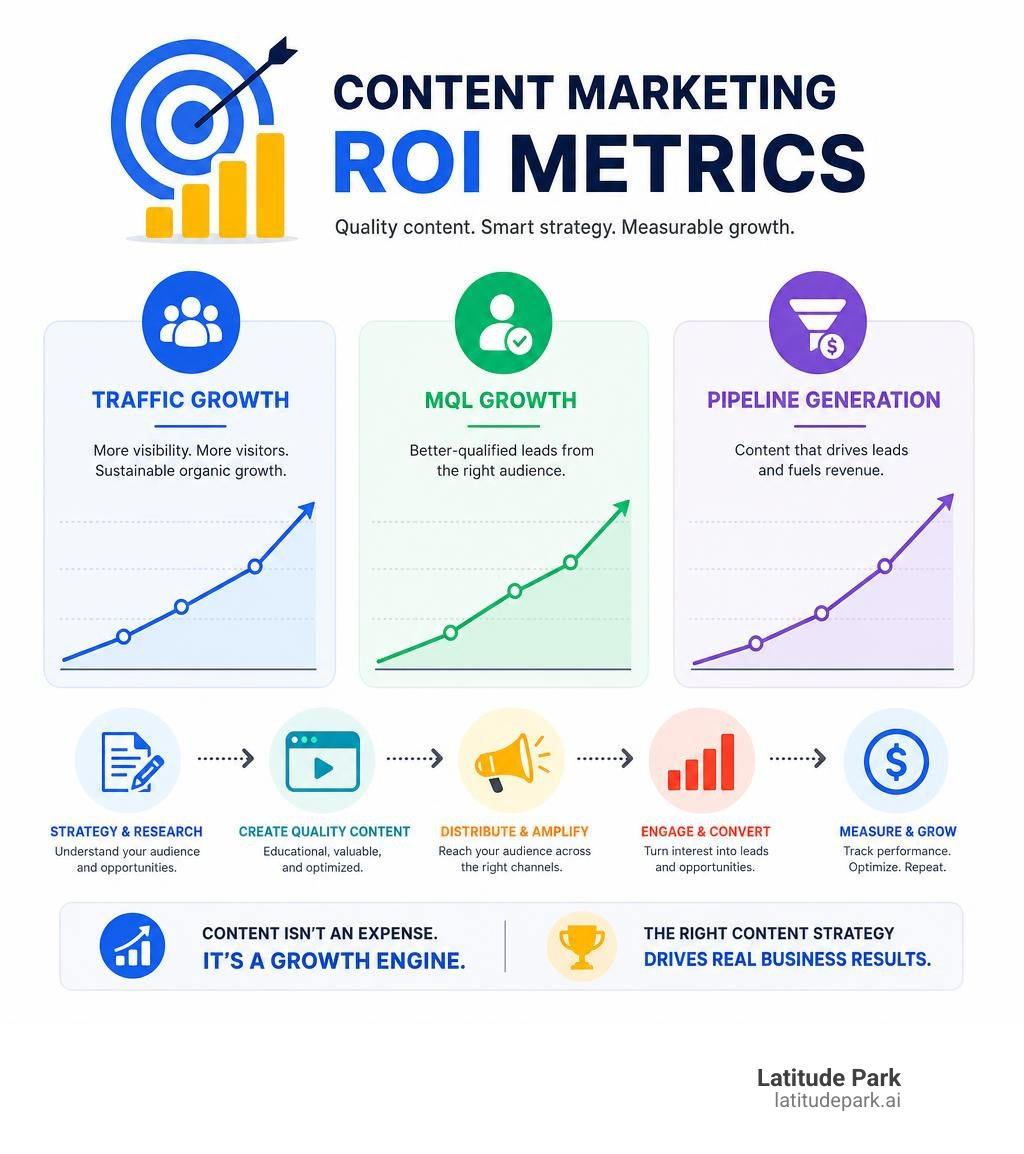
The agencies that win for their clients are doing more than writing. They’re combining research, SEO, AEO, and distribution into one unified engine. Some clients have seen results like 5x organic traffic in 12 months, 172% MQL growth year-over-year, and 409% increases in conversions — but only when strategy and execution are tightly aligned.
I’m Rusty Rich, President of Latitude Park, a full-service digital advertising agency I’ve grown since 2009, with deep experience helping businesses and franchises build scalable content marketing agency partnerships that drive real, measurable growth. In this guide, I’ll walk you through the agencies worth knowing, what sets them apart, and exactly how to choose the right one for your goals.
Simple content marketing agency glossary:
What to Expect When Hiring a Content Marketing Agency
When you sign a contract with a professional content marketing agency, you aren’t just paying for a batch of articles to fill your blog. You are investing in a system designed to build authority, capture search demand, and generate qualified leads. Understanding how can content marketing campaigns benefit your business starts with knowing what services these agencies typically provide.
A full-service agency manages the entire lifecycle of your content. This starts with a deep dive into your business context—learning about your product, your target personas, and your go-to-market strategy. From there, they formulate a customized strategy, mapping out keyword clusters and defining which formats will move the needle.
A modern agency handles a wide range of content formats depending on your goals. When exploring what are the different types of content marketing, you will find that agencies build out comprehensive ecosystems. This includes search-focused blog posts, in-depth white papers, high-converting case studies, email newsletters, graphic design, and video production.
Once assets are created, the agency handles performance analysis. Instead of looking at simple vanity metrics like impressions, leading agencies build customized dashboards to track actual business outcomes: conversion rates, marketing qualified leads (MQLs), and sales pipeline. Knowing why you should hire a content marketing agency in 2022 and beyond comes down to this: they bring a complete squad of strategists, writers, SEO specialists, designers, and analysts to your brand for a fraction of the cost of building an equivalent in-house team.
Evolving Strategies: Traditional vs. Modern AI-Assisted Content
The content landscape has shifted dramatically. The “old way” of doing content marketing—focusing solely on high-volume production, targeting high-volume keywords with generic articles, and relying on keyword stuffing—is dead.

In 2026, modern strategies are built around AI-assisted workflows, zero-click search behavior, and Answer Engine Optimization (AEO). AI tools like large language models are no longer a threat to creative agencies; instead, they are integrated into production to scale research, automate formatting, and structure content efficiently. This allows human writers to spend less time on basic formatting and more time interviewing subject matter experts to inject real-world authority into every piece.
Furthermore, search behavior has changed. With Google expanding AI Overviews and users relying on LLMs for answers, click-through rates on traditional search engine results pages (SERPs) have declined. Users often find the answers they need directly on the search page without clicking through to a website. To combat this, agencies have shifted from purely traffic-based metrics to a multi-channel approach. Knowing how to structure your content marketing campaign in 2022 and beyond requires building content that serves both human buyers and AI models simultaneously.
How a Modern Content Marketing Agency Integrates SEO and AEO
Search engine optimization is no longer just about Google’s blue links. Today, it is tightly integrated with Answer Engine Optimization (AEO) and Generative Engine Optimization (GEO). Since over 90% of B2B buying groups use LLMs during their purchase journey, your brand must be visible where these models pull their answers.
A modern content marketing agency targets search intent and entity consistency. AI engines look for structured data, clear semantic relationships, and authoritative coverage of topics. This means your agency must build out robust cluster architectures, ensuring that your site covers a topic so thoroughly that search models view your brand as the primary authority.
When creating seo-friendly content: tips & best practices in 2026, agencies focus on:
- Entity Consistency: Ensuring your brand name, product definitions, and core messaging remain identical across all digital surfaces.
- Narrative Clarity: Writing clear, jargon-free explanations that AI models can easily parse and summarize.
- Deep Search Intent Match: Designing pages specifically to answer the exact question a user (or an AI engine) is asking.
Evolving Playbooks for Multi-Channel Distribution
Creating great content is only half the battle; distributing it effectively is where the real ROI is generated. Modern agencies do not treat social media or community platforms as dumping grounds for blog links. Instead, they build platform-native campaigns.
This involves repurposing a single high-quality asset into multiple formats:
- Reddit & Quora SEO: Engaging in community discussions and optimizing answers so they rank in both search engines and platform feeds.
- LinkedIn Pulse: Writing native, thought-leadership articles directly on the platform to build personal brands for key executives.
- YouTube SEO: Creating optimized video content that captures the massive search volume on the world’s second-largest search engine.
- Zero-Click Content: Designing social posts and email newsletters that provide complete value within the platform itself, building brand trust and recall even when users do not click through to your site.
How Specialized Agencies Differentiate and How to Choose
With thousands of agencies listed on platforms like Clutch, finding the right partner requires looking beyond generic service lists. The best agencies differentiate themselves through industry specialization, custom playbooks, and how they extract domain expertise.
When choosing an agency, look for those that build interconnected content ecosystems rather than isolated, one-off campaigns. You should also pay close attention to their writing process. Agencies that rely on basic Google research to write their pieces will only produce generic, low-value content. On the other hand, top-tier agencies use an interview-based writing process, interviewing your internal engineers, product managers, and executives to capture unique insights that cannot be found anywhere else online.
Technical and Regulated Industry Specialization
If your business operates in a complex or highly regulated space, a generalist agency will struggle to write content that resonates with your audience.
For example, B2B SaaS and developer-focused brands require deep technical accuracy. If you are selling to software architects or DevOps engineers, your content needs to speak their language, utilizing sequence diagrams, APIs, and real code examples. Specialized technical agencies bring development and product leadership experience to ensure drafts read like they were written by actual software engineers.
Similarly, regulated industries like financial services and healthcare have strict compliance standards. In finance, every piece of content must respect compliance constraints while still engaging the reader. A specialized compliance-focused team understands how to build a compliance-first evergreen content flywheel that satisfies legal teams while driving compounding organic growth.
Creative Storytelling vs. Pure SEO Playbooks
Another critical differentiator is the balance between search-engine-first content and creative brand storytelling.
Some agencies focus purely on the numbers, running structured SEO playbooks designed to capture traffic. While this is highly effective for lead generation, it can sometimes dilute your unique brand voice. Other agencies position themselves as creative studios focused on narrative depth and brand storytelling. They believe that speed and volume matter less than narrative clarity, helping brands build deep emotional connections through beautiful design and high-quality writing.
For brands that want a mixture of both, the ideal partner builds adaptive, ROI-driven content ecosystems that align creative campaigns with performance data, ensuring your brand story converts readers into buyers.
Evaluating a Content Marketing Agency on Real Business ROI
The ultimate test of any agency partnership is how they measure and report on success. You should avoid agencies that only report on vanity metrics like impressions or keyword rankings. Instead, look for partners that track pipeline generation, MQL growth, and SQL conversions.
Top-tier partners focus on building full-funnel systems that turn search visibility into a predictable sales pipeline. They focus heavily on conversion rate optimization (CRO) and backlink acquisition to maximize the monetary value of your organic traffic.
When evaluating agencies, use this simple comparison to understand their operational model:
| Metric / Focus | Traffic-Focused Agency Model | Lead-Focused Agency Model |
|---|---|---|
| Primary Goal | Maximizing pageviews and organic search traffic | Generating qualified leads, signups, and sales pipeline |
| Keyword Strategy | Targeting high-volume, top-of-funnel keywords | Targeting high-intent, decision-stage keywords |
| Writing Process | Google-research and generic SEO templates | Interview-based writing with domain experts |
| Reporting Metrics | Impressions, organic sessions, keyword rankings | Conversions, cost-per-lead (CPL), pipeline value |
| Content Promotion | Basic social sharing and automated syndication | Native distribution, manual digital PR, and link-building |
Frequently Asked Questions about Content Marketing
What services does a content marketing agency typically provide?
A full-service content marketing agency provides end-to-end management of your content strategy. This includes technical SEO audits, keyword research, content gap analysis, writing and editing, graphic design, video production, email copy creation, multi-channel distribution, and monthly performance reporting.
How long does it take to see results from content marketing?
While technical SEO fixes and content refreshes can yield quick wins within a few weeks, a brand-new content campaign typically takes 2 to 4 months to show significant organic traction. Content marketing is a compounding investment; the assets you build today will continue to drive traffic and leads years down the line.
How do agencies measure content marketing ROI?
Leading agencies measure ROI by tracking metrics tied directly to revenue. This includes tracking conversion rates on landing pages, monitoring marketing-qualified leads (MQLs) and sales-qualified leads (SQLs), calculating customer acquisition cost (CAC) reductions, and attributing closed-won deals directly to specific content assets.
Conclusion
Choosing the right content marketing agency is all about finding a partner that understands your business goals, speaks your industry’s language, and focuses on driving real revenue rather than vanity metrics. Whether you need a compliance-first framework for financial services, technical depth for a developer-focused SaaS, or a high-impact creative campaign to build brand authority, the right agency can turn your organic channels into a predictable pipeline engine.
At Latitude Park, we understand how critical tailored campaign structures are for complex businesses. While specialized content agencies build your organic foundation, we help multi-location franchise brands scale their growth rapidly through highly targeted Meta (Facebook) advertising strategies.
If you are ready to combine your organic authority with high-converting paid campaigns, explore our Strategic Content Marketing for Franchise Growth playbook or learn more about our specialized franchise digital marketing services. Let’s work together to build a multi-channel growth engine that keeps your brand ahead of the curve in 2026.