
The Complete Guide to Hotel Reputation Management
Why Hotel Reputation Management Determines Whether Guests Book You or Your Competitor
Hotel reputation management is the process of monitoring, responding to, and improving how your property is perceived online — across review platforms, OTAs, and social media — to drive more bookings and protect revenue.
Quick answer: What does hotel reputation management involve?
| Activity | What It Means |
|---|---|
| Monitor reviews | Track guest feedback across Google, TripAdvisor, Booking.com, Expedia, and social media |
| Respond to reviews | Reply to both positive and negative feedback promptly and professionally |
| Generate reviews | Encourage satisfied guests to share their experiences through post-stay outreach |
| Analyze feedback | Identify recurring themes to improve operations and guest experience |
| Integrate with systems | Connect reputation data with your PMS and marketing tools for smarter decisions |
Here’s what the numbers tell us: 81% of travelers always or frequently read reviews before booking a hotel. A single star decrease in your rating can trigger a 5–9% drop in revenue. And 63% of travelers say they’re more likely to book when they see an owner responding to reviews.
Your online reputation isn’t just a reflection of your service — it’s an active driver of occupancy, pricing power, and long-term growth.
Think about this scenario: two hotels sit on the same block, offer similar amenities, and charge comparable rates. One runs at 85% occupancy year-round. The other struggles to fill rooms. The difference often comes down to one thing — how proactively each property manages its online reputation.
Whether you’re running a single boutique property or coordinating reputation strategy across a multi-location hotel brand, the fundamentals are the same. You need a consistent, scalable system for gathering feedback, engaging guests, and turning reviews into a commercial asset.
I’m Rusty Rich, President of Latitude Park, and over the past 15+ years helping businesses build powerful digital presences, I’ve seen how hotel reputation management can be the single highest-ROI marketing activity a hospitality brand can invest in. In this guide, I’ll walk you through the strategies, tools, and frameworks that actually move the needle.
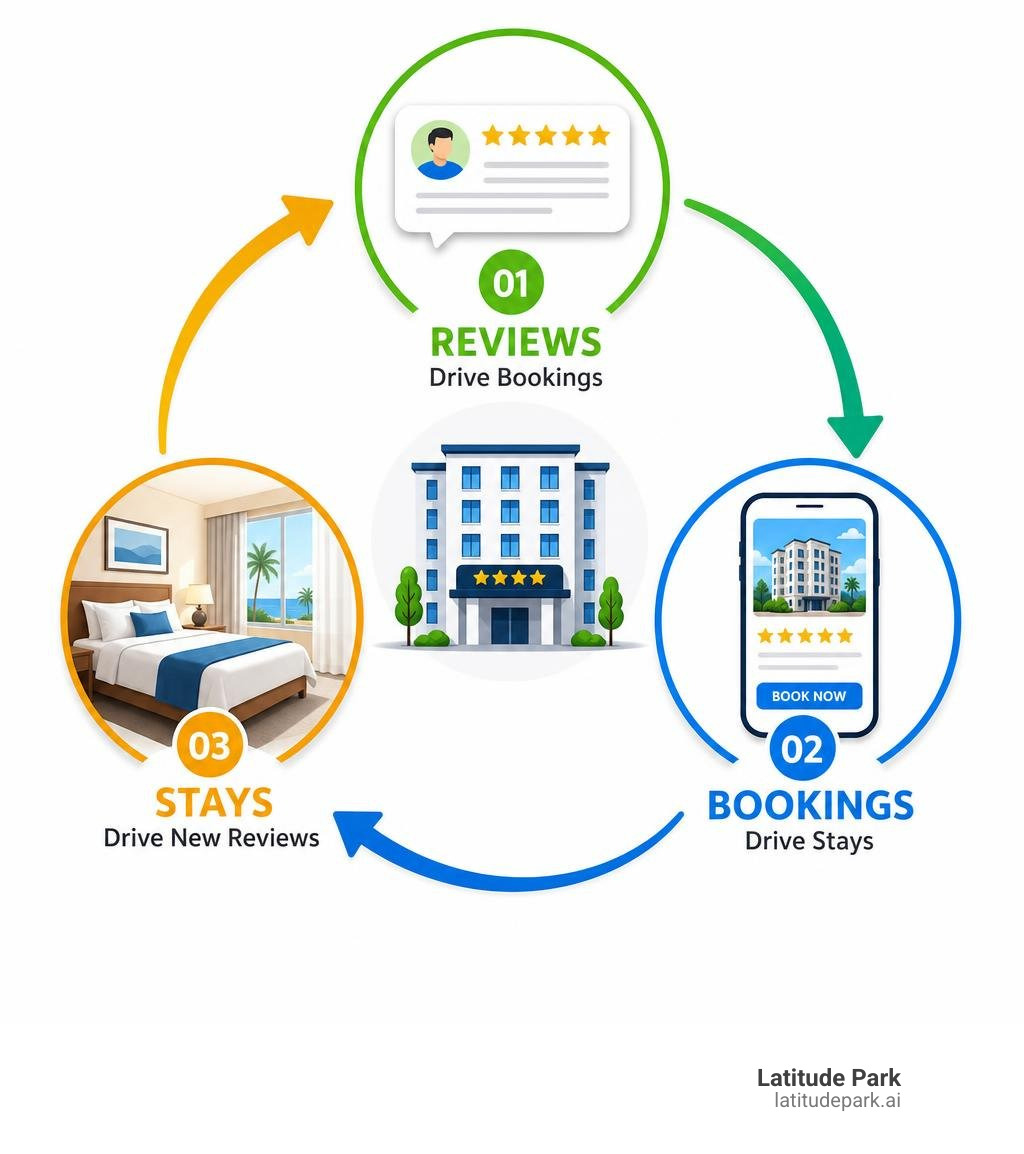
Hotel reputation management basics:
The Commercial Impact of Hotel Reputation Management
In the hospitality sector, guest perception is directly tied to the bottom line. Unlike physical retail where customers can inspect a product before purchasing, travelers buy a promise. They pay upfront for an experience they will not realize until check-in. Because of this inherent risk, travelers rely heavily on the experiences of those who came before them.
When we look at the data in 2026, 70.9% of travelers say a hotel’s online reputation directly influences where they choose to stay. A property’s digital presence functions as its most powerful 24/7 salesperson. If that salesperson is silent, or worse, has a history of unaddressed complaints, booking probability plummets.
This dynamic is exactly why understanding Why Review Management is the Secret Weapon for Small Business is critical for independent hoteliers and multi-location hospitality groups alike.
How Online Reviews Shape Hotel Pricing Power
The relationship between your online reviews and your average daily rate (ADR) is governed by clear economic data. Landmark research from Cornell University revealed that a one-point increase in a hotel’s review score (on a 5-point scale) can allow a hotel to raise its prices by over 11% without losing occupancy.
For midscale properties, a mere 1% reputation boost correlates with a 1.42% increase in revenue per available room (RevPAR). For luxury properties, where brand standards are exceptionally high, a 1% reputation boost delivers a .49% RevPAR increase. Conversely, the cost of neglect is steep: a single star decrease in a hotel’s rating can trigger a immediate 5% to 9% drop in overall revenue.
When your online rating sits comfortably above your immediate set of competitors, you gain the pricing power to command a premium. To dive deeper into how to structure these systems, check out our Online Review Management Complete Guide.
The Direct Link Between Guest Ratings and Booking Conversions
Ratings act as the ultimate tiebreaker. When travelers compare multiple hotels in the same destination with similar amenities, there is a 72% chance they will prioritize a higher guest rating over a well-known brand name.
This behavior significantly impacts booking conversions on online travel agencies (OTAs) and direct brand websites. Travelers are risk-averse; 49% of travelers will refuse to book a hotel that has zero reviews.
By actively managing your reputation, you build a protective moat around your booking engine. For a deep statistical analysis of this revenue loop, read The Impact of Online Reviews on Revenue: A Complete Guide to Hotel Reputation Management (2026) .
Core Strategies for Monitoring and Responding to Guest Feedback
An effective hotel reputation management strategy requires a balance of active listening and rapid, empathetic engagement. You cannot afford to check your reviews once a week and respond with generic, copy-pasted templates. Modern travelers see right through automated apathy.

To build a system that turns passive readers into active bookers, we recommend following the frameworks outlined in our Review Management Ultimate Guide.
Implementing Proactive Hotel Reputation Management Workflows
Proactive reputation management starts long before a guest sits down to write a review. It begins during their stay and continues through structured post-departure workflows.
- Mid-Stay Pulse Checks: Send an automated SMS or email 12 to 24 hours after check-in. Ask a simple question: “How has your stay been so far?” This allows your on-property team to catch and resolve issues before they turn into permanent online complaints.
- The 24-Hour Post-Departure Loop: Within 24 hours of checkout, send a personalized thank-you email with direct, clickable links to your primary review channels (Google, TripAdvisor, and booking channels).
- Sentiment Alerts: Set up real-time notifications for any review that falls below a 3-star threshold so your management team can address it immediately.
For a comprehensive look at how to build these automated review generation funnels, see Online Reputation Management Hotels Use to Improve Reviews and Bookings – ReputationPrime .
Turning Negative Reviews into Service Recovery Opportunities
A negative review is not a death sentence; it is a second chance. In hospitality, we refer to this as the Service Recovery Paradox — a phenomenon where a customer thinks more highly of a business after they successfully correct a service failure than if the failure had never occurred in the first place.
When responding to negative reviews, use the 4 R’s Framework:
- Receive: Read the feedback objectively without getting defensive.
- Responsibility: Apologize sincerely for the experience, even if the issue was out of your direct control (e.g., a local power outage).
- Resolve: Explain the concrete steps you are taking to fix the issue so it doesn’t happen to future guests.
- Recover: Invite the guest to contact you directly offline to resolve any remaining issues and rebuild the relationship.
89% of travelers say that when they see a thoughtful response to a negative review, it improves their overall impression of the hotel. For more strategies on leveraging guest feedback as a marketing asset, refer to our Online Review Marketing Complete Guide.
Leveraging Technology and Software Integrations
Managing reviews across dozens of channels manually is a recipe for operational burnout. In 2026, successful hotels rely on integrated tech stacks to streamline operations and ensure no guest feedback slips through the cracks.
| Metric / Feature | Manual Review Tracking | Automated Reputation Software |
|---|---|---|
| Time Spent Per Week | 6 to 10 hours | 1 to 2 hours |
| Response Rates | Average of 40% | 95%+ |
| Average Response Time | 3 to 7 days | Under 24 hours |
| Sentiment Analysis | Subjective / Guessed | AI-Powered Theme Tagging |
| Crisis Detection | Delayed (Post-Facto) | Real-Time Notifications |
By transitioning from manual workflows to automated systems, hotels save an average of $1,500 per month in labor costs while simultaneously increasing their review volume and search rankings. You can explore these software capabilities in detail via Hotel Reputation Management Software .
Selecting the Best Hotel Reputation Management Tools
When evaluating software solutions for your property or multi-location franchise, you should look for tools that offer centralized dashboards, real-time alerts, and competitive benchmarking.
- Centralized Dashboards: The software must automatically pull reviews from Google, TripAdvisor, Booking.com, Expedia, and niche OTAs into a single workspace.
- AI-Powered Response Drafts: Look for platforms that use advanced AI to draft unique, context-aware responses that match your hotel’s distinct brand voice.
- Sentiment Analysis: The tool should automatically tag emotions and categorize feedback into operational themes (e.g., “cleanliness,” “WiFi speed,” or “staff friendliness”) so you can easily spot systemic issues.
To compare the top platforms on the market today, read our breakdown of the Top Sites for Managing Your Online Reputation Without Losing Your Mind. For properties seeking specialized, high-touch luxury solutions, Hotel reputation management | RateGain SoHo and AI Review Management for Hotels | Boost Ratings & Revenue | Hotel Systems provide excellent options.
Integrating Reputation Data with Property Management Systems
The true magic happens when you connect your reputation management platform directly to your Property Management System (PMS) and channel manager.
This integration allows you to enrich guest profiles with historical feedback data. If a returning guest previously complained about being near the elevator, your PMS can flag this, allowing your front desk team to proactively assign them a quiet room at check-in.
Furthermore, integrating these systems allows you to tie guest feedback directly to operational KPIs and staff training programs, turning abstract reviews into concrete action plans. To learn more about setting up these data ecosystems, consult our Business Online Reputation Management Guide.
Frequently Asked Questions About Hotel Reputation Management
How does a hotel’s online rating directly affect its room pricing?
As demonstrated by Cornell University studies, your online rating is directly linked to your pricing power. A one-point increase on a five-star rating scale allows a hotel to raise room rates by up to 11.2% without experiencing a drop in occupancy.
This occurs because higher ratings increase guest trust and lower the perceived risk of booking. When travelers trust that they will receive an exceptional experience, their price sensitivity decreases, allowing you to optimize your ADR and maximize your overall RevPAR.
Can hotels remove negative reviews from platforms like Google or TripAdvisor?
In most cases, you cannot delete a negative review simply because a guest had a poor experience. Platforms like Google and TripAdvisor will only remove reviews that violate their strict terms of service. This includes reviews that contain hate speech, spam, promotional content, personal contact information, or reviews left by employees or direct competitors (which are flagged as conflicts of interest).
If you believe a review is fake or malicious, you can flag it for moderation. While you wait for the platform to investigate, the best approach is to respond professionally and calmly to show future travelers that you take all feedback seriously.
To learn how to protect your brand from malicious online attacks, explore Your Business’s Digital Shield: Picking the Perfect Online Reputation Partner.
How quickly should hotel management respond to guest reviews?
Ideally, your team should respond to all reviews within a 24 to 48-hour window. Top-performing hospitality brands maintain an average response time of 1.2 days. Speed is especially critical when dealing with negative feedback: research shows that 33% of guests are highly likely to upgrade their negative review or post a positive follow-up if they receive a personalized response within 24 hours.
Maintaining a fast, consistent response cadence signals to both potential guests and search algorithms that your property is active, engaged, and deeply committed to guest satisfaction. For a detailed guide on structuring your response workflows, check out our Online Review Management Agency Complete Guide.
Conclusion
In the hyper-competitive hospitality landscape of 2026, hotel reputation management is no longer a passive administrative task. It is an active, revenue-generating commercial discipline. The hotels that actively listen to their guests, respond with speed and empathy, and use feedback to drive real operational improvements are the ones that enjoy higher occupancy, premium pricing, and a steady stream of direct bookings.
Whether you operate an independent boutique hotel or manage marketing and reputation across a complex, multi-location franchise network, we can help you build a robust digital presence that turns guest feedback into your greatest competitive advantage.
To learn more about mastering your online presence, read The Essential Guide to Winning Local Reputation Marketing and our Social Marketing Online Reputation Management Guide.
Ready to unlock your property’s true revenue potential and build a flawless online reputation? Partner with Latitude Park for Expert Review Management today, and let’s start turning your guest feedback into five-star growth.