For multi-location brands, the most effective model is centralized review visibility paired with a hybrid governance model that lets local staff personalize responses. Start by aggregating every location’s reviews into one dashboard and setting an escalation rule for negative-review spikes. Compliance with FTC and Google Business Profile rules, plus a real measurement cadence, are the follow-ups that keep this from falling apart at scale.
Table of Contents
- What Makes Multi Location Review Management Different?
- Centralized Visibility vs. Local Ownership: Choosing a Governance Model
- The Operational Playbook for Reviews Across Every Location
- Building a Review Management Tech Stack That Scales
- What Should Your Multi-Location Reputation Scorecard Track?
- How Do You Roll Out Review Management Without Losing Authenticity?
- Staying Compliant: FTC and Google Rules for Multi-Location Brands
- Legal Considerations Beyond the FTC: Privacy and Data Handling
- What Realistic Timelines and Pitfalls Look Like
- Latitude Park: Managed Review Management and Next Steps
- Sources
- FAQ
What Makes Multi Location Review Management Different?
Managing reviews for one storefront is a communication task. Managing them across 40 locations is an operations problem wearing a marketing costume, and treating it like the former is why most franchise reputation programs stall out by month three.
The volume alone changes the math. BrightLocal’s 2025 research shows most consumers concentrate their trust in a small handful of review sites, with Google carrying an outsized share of that attention. A five-location brand might handle that manually. A 50-location brand generating hundreds of new reviews a month across Google, Yelp, Facebook, and industry-specific platforms cannot, not without a system.
Multiply that volume by inconsistent execution and you get real damage. One location’s manager responds to every review within hours; another hasn’t logged into their Google Business Profile in six weeks. That inconsistency doesn’t stay contained. It shows up in local search rankings, in customer trust signals, and eventually in corporate’s inbox when a regional director asks why one market is underperforming.
The tension every brand wrestles with:
- Brand voice vs. local authenticity — a response that sounds like corporate legal wrote it kills the personal touch that made the location good in the first place.
- Speed vs. accuracy — fast responses build trust, but rushed responses to health, safety, or legal complaints create liability.
- Local knowledge gaps — a corporate social media manager doesn’t know that the Tuesday shift lead caused the wait-time complaint, but the location manager does.
- Contagion risk — a single bad review that goes unanswered at one location can shape perception of the entire chain, especially on social media where screenshots travel fast.
Handling reviews across locations well means solving all four simultaneously, not picking your favorite.
Centralized Visibility vs. Local Ownership: Choosing a Governance Model
Pure centralization looks efficient on paper. One team, one policy, one dashboard. It also produces responses that read like they were generated by committee, because in most cases they were. Pure local autonomy solves the authenticity problem and creates a compliance and consistency nightmare instead. Neither extreme survives contact with 20+ locations.
The model that actually works is hybrid: corporate owns the infrastructure, policy, and monitoring; local teams own the voice. InMoment’s research on multi-site reputation programs backs this up, and it maps cleanly onto three role tiers.
- Corporate sets the response policy, maintains the template library, monitors sentiment trends across the portfolio, and owns platform relationships (Google, Yelp, industry sites). Corporate also runs the audit trail that keeps every location’s activity reviewable.
- Regional managers handle escalations that a single location can’t resolve alone, coach underperforming locations on response quality, and translate corporate policy into market-specific nuance.
- Location staff draft and send the actual responses using approved templates as a starting point, not a script to copy verbatim, and flag anything that smells like legal risk.
Escalation triggers need real thresholds, not vague “use your judgment” guidance. A workable starting point: any location logging more than three negative reviews in 48 hours triggers an automatic ops notification and a 24-hour response service level agreement, a threshold InMoment’s operational guidance treats as standard practice. Reviews mentioning safety, discrimination, or legal threats escalate to corporate immediately, regardless of star rating. Everything else stays with the location, with a 48-hour response SLA that regional managers audit weekly.
The Operational Playbook for Reviews Across Every Location
This is the sequence that turns review management from a reactive scramble into a repeatable process.
- Aggregate everything into one dashboard. Every platform, every location, one login. Configure alerts for new reviews under three stars and for any review mentioning safety or legal terms, so nothing sits unanswered for days.
- Build a unified response policy with editable tokens. Write templates for the ten most common review scenarios (great experience, slow service, billing dispute, staff praise, cleanliness complaint), each with placeholder tokens like [LOCATION_NAME] and [MANAGER_NAME] that local staff fill in, not rewrite from scratch.
- Set escalation and remediation workflows tied to operations, not just marketing. A review complaining about a broken door lock needs to reach facilities, not just get a polite reply. Route reviews to the team that can actually fix the underlying problem.
- Design a compliant solicitation process. Ask for reviews within 24 to 48 hours of a positive interaction, when memory is fresh. Mix channels: post-visit email, SMS for high-intent transactions, and QR codes at the point of sale. Never condition a discount, refund, or incentive on leaving a positive review; that is one of the practices that the FTC’s final rule on review manipulation explicitly bans.
- Showcase positive reviews correctly. Feature them on location pages and social proof widgets, but don’t cherry-pick so aggressively that your public rating diverges from your platform rating. That gap gets noticed.
- Close the loop. Feed review themes back into operations. If four locations get dinged for slow drive-through times in the same month, that’s not a coincidence, it’s a training or staffing gap that needs a fix, then a re-measurement.
Pro Tip: Keep a “forbidden phrases” list in your template library, things like admitting fault on a safety issue or promising a specific refund amount, so no location accidentally creates a legal liability while trying to be helpful.
Automation genuinely earns its keep in step one and step two; tools like BabyLoveGrowth’s automation platform help get Google and ChatGPT traffic on autopilot, scaling local review management efficiently. Birdeye’s 2025 industry research found AI-assisted drafting now handles a meaningful share of review responses industry-wide, which frees local staff to focus on personalization rather than starting from a blank page. Human review still belongs on anything flagged as sensitive.
Building a Review Management Tech Stack That Scales
Multi-site reputation management runs on five tool categories, and most brands only buy one or two before wondering why the program stalls.
- Aggregators pull reviews from every platform into one feed, so nobody is manually checking a dozen dashboards.
- Response management tools hold your template library, route reviews to the right person, and log response times.
- Automation and AI assist tools draft first-pass responses and flag high-risk reviews for human review before anything goes live.
- CX integration tools connect review data to your CRM or point-of-sale system, so a complaint about a specific transaction gets matched to the actual order.
- Reporting and BI tools turn raw review data into the scorecard your regional managers actually look at.
The features that separate a tool built for one location from one built for a portfolio: multi-location tagging (so a search for “downtown Chicago” doesn’t return every Chicago-area store), role-based access control, SLA tracking with automatic alerts, and API integrations that don’t require manual export/import.
| Selection Criterion | What to Verify Before Signing |
|---|---|
| Platform integration | Direct connection to Google Business Profile and your top two secondary review sites |
| CRM/POS integration | API or native connector, not a manual CSV workaround |
| Governance controls | Role-based permissions separating corporate, regional, and location access |
| Localization support | Location-specific tagging and reporting, not just a filtered master list |
| Pricing model | Per-location vs. flat enterprise pricing, and what happens when you add or close a location |
Prioritize Google Business Profile integration first. Google’s own guidelines require one profile per real-world location with accurate, verified details, and any tool that doesn’t respect that structure will create duplicate-listing headaches down the line. This connects directly to how local SEO for multiple locations affects your visibility in map results, since review signals and listing accuracy work together.
What Should Your Multi-Location Reputation Scorecard Track?
A scorecard that tries to track everything gets ignored. One that tracks the right handful of numbers gets used every week.
At the location level, track average rating, review velocity (new reviews per week), response rate, average response time, and sentiment trend over the trailing 30 days. At the portfolio level, roll those up into rating distribution across all locations, share of reviews rated four stars or higher, and a simple risk score.
- A workable risk formula weights three factors: rating trend (dropping, flat, or rising), response rate (below 80% flags a location), and negative-review velocity (three or more in 48 hours triggers the escalation path).
- Locations scoring in the bottom 10% of the portfolio get a weekly check-in from their regional manager, not a quarterly review.
- Everyone else gets a monthly cadence: a dashboard summary, a short list of themes, and one action item per location.
The point of the scorecard isn’t the numbers themselves, it’s catching a problem while it’s still one bad month, not a six-month slide that shows up in foot traffic before anyone in corporate notices.
How Do You Roll Out Review Management Without Losing Authenticity?
The train-the-trainer model works better than corporate trying to onboard 60 location managers directly. Train regional managers thoroughly, give them a two-week onboarding schedule for new locations, and schedule quarterly refreshers so the policy doesn’t drift as staff turns over.
Templates need real structure: editable tokens for name and location, a short list of forbidden language (admissions of fault, specific refund promises, anything that could read as discriminatory), and a clear escalation note field so a location manager can flag “this needs regional eyes” without guessing.
- Run quarterly quality audits on a sample of responses from every location, not just the ones with visible problems.
- Tie audit results back to the KPI scorecard so coaching conversations have data behind them, not just a manager’s gut feeling.
- Build in a lightweight incentive, recognition in a monthly regional call works as well as a bonus for most teams, tied to response rate and response time, not just star rating (which staff can’t fully control).
Pro Tip: Ask new location managers to draft five sample responses during onboarding, to real archived reviews, before they go live. It surfaces voice and judgment gaps in a low-stakes setting instead of on a public review that’s already visible to customers.
Change management fails most often when corporate treats the rollout as a one-time training session instead of an ongoing feedback loop with regional managers reporting up and corrective action flowing back down.

Staying Compliant: FTC and Google Rules for Multi-Location Brands
The FTC’s final rule under 16 CFR Part 465 bans buying or selling fake reviews, offering incentives conditioned on positive sentiment, standing up fake review websites, and suppressing genuine negative reviews through deceptive means. The full Federal Register text spells out the specific prohibited practices and the recordkeeping expectations that go with them. Violations carry civil penalties, and “the local franchisee did it, not corporate” is not a defense that holds up.
- Never condition a discount, refund, or gift on a customer leaving a positive review, only on leaving a review at all.
- Keep records of your solicitation process (what was sent, when, to whom) in case you ever need to demonstrate compliance.
- On Google specifically, maintain one profile per real location, keep verification current, and know that flagging a review through the Reviews Management Tool doesn’t guarantee removal. Evaluation can take several days, and the appeal is typically a one-time shot per review.
- If a location relocates, merges, or closes, review Google’s guidance on profile changes before making edits. Some changes affect whether existing reviews transfer to the updated listing.
Escalate to legal counsel the moment a review alleges discrimination, a safety incident, or threatens litigation, and preserve the original review text and screenshots before doing anything else.
Legal Considerations Beyond the FTC: Privacy and Data Handling
FTC compliance covers the review content itself. It doesn’t cover what happens to the customer data your solicitation process collects, and that’s a separate legal exposure multi-location brands routinely overlook.
If you’re collecting emails, phone numbers, or purchase history to trigger review requests, that data falls under privacy frameworks depending on where your customers live. Businesses serving California residents need to account for the California Consumer Privacy Act (CCPA), which gives consumers rights to know what data you’ve collected and to request its deletion. If any of your locations or customer base touch the European Union, GDPR imposes stricter consent requirements before you can email or text someone a review request at all.
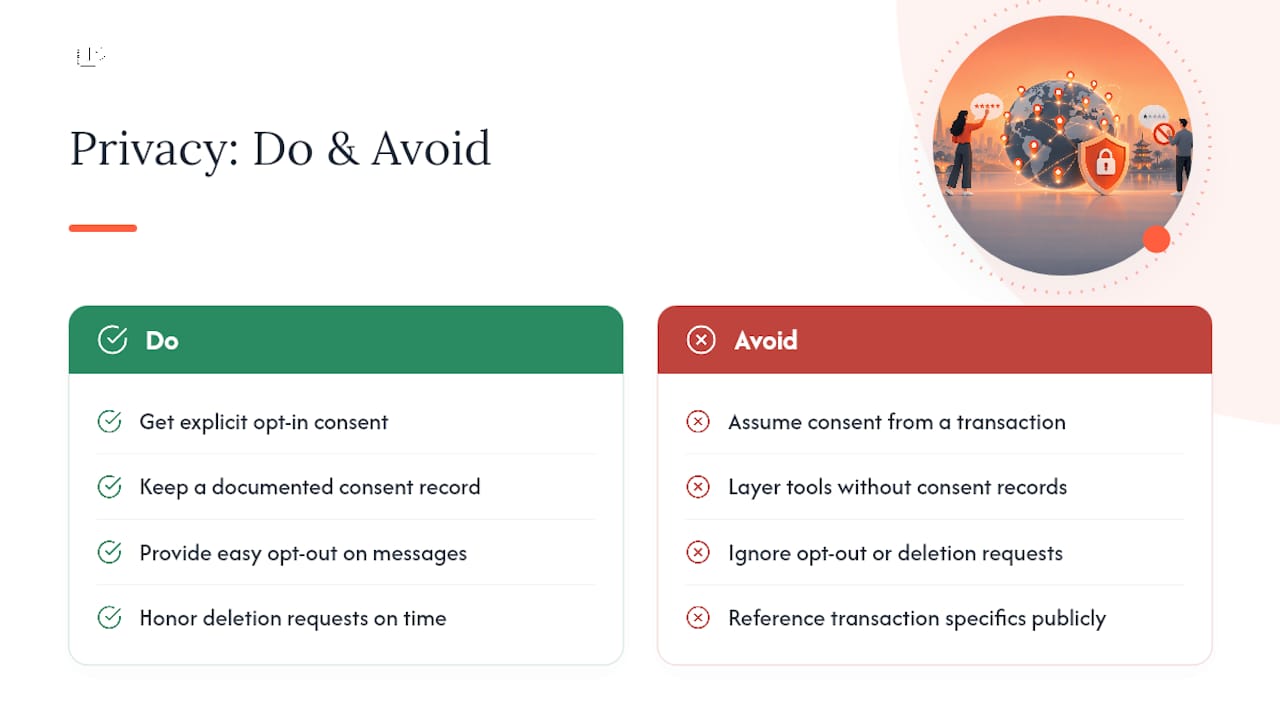
Practical steps that reduce exposure: get explicit opt-in consent before adding a customer to a review solicitation list, not just an assumed opt-in from a transaction. Keep a documented record of consent, especially if a solicitation tool is layered on top of your point-of-sale system. Give customers an easy opt-out on every solicitation message, and honor deletion requests within the timeframe your applicable law requires.
There’s also a quieter risk: local staff responding to reviews sometimes reference specifics from a customer’s visit (their order, a complaint detail, an employee’s name) in a public reply. That can inadvertently expose personal information the customer didn’t intend to make public. Template training should include a rule against restating identifying transaction details in a public response, full stop.
What Realistic Timelines and Pitfalls Look Like
At 30 days, expect a working dashboard and a documented escalation policy, not perfect response rates. At 90 days, response times should tighten and templates should feel natural rather than robotic. At 180 days, the scorecard should be catching problems before they become patterns.
The most common failure is over-centralizing, killing local voice in the name of consistency. The second is skipping training and assuming templates alone create quality. The third is building the dashboard and never actually looking at the scorecard. Fix all three by keeping local ownership real, not nominal.
— Rusty
Latitude Park: Managed Review Management and Next Steps
Building all of this in-house, the dashboard, the escalation rules, the template library, the compliance guardrails, takes real headcount and months of iteration most marketing teams don’t have sitting around. A managed service option combines centralized dashboards with AI-assisted response drafting and location-level personalization, backed by a weekly-communication model and transparent, revenue-tied reporting.

That means faster response SLAs across every location without corporate playing whack-a-mole with individual reviews, and reporting that ties review performance back to actual leads and sales rather than a vanity star-rating chart nobody reads. If your brand is weighing an in-house build against a managed option, the deciding factor is usually bandwidth: can your team maintain templates, audits, and escalation monitoring every single week, indefinitely? If the honest answer is no, explore Latitude Park’s Reviews Management and Google Profile Optimization services and request an audit of your current review coverage across locations as the next step.
Sources
- Federal Trade Commission announces final rule banning fake reviews, testimonials
- Trade Regulation Rule on the Use of Consumer Reviews and Testimonials (Federal Register)
- Guidelines for representing your business on Google – Google Business Profile Help
- Local Consumer Review Survey 2025 – BrightLocal
FAQ
What Is Multi Location Review Management?
Multi location review management is the process of monitoring, responding to, and improving customer reviews across every branch, franchise, or store a brand operates, usually through a centralized dashboard paired with local response ownership. It combines review monitoring for multiple locations with governance rules that keep responses consistent without erasing local voice.
How Many Negative Reviews Should Trigger an Escalation?
A common operational threshold is several negative reviews within a short period at a single location, which should trigger an immediate operations notification and a prompt response commitment, a standard InMoment’s guidance on multi-site programs recommends. Reviews mentioning safety or legal issues should escalate immediately regardless of volume.
Can You Offer Discounts for Leaving Reviews?
You can ask customers to leave a review and offer an incentive for leaving one at all, but you cannot condition that incentive on the review being positive. The FTC’s final rule explicitly bans sentiment-conditioned incentives as a deceptive practice.
Does Latitude Park Handle Review Management for Multiple Locations?
Yes, Latitude Park offers Reviews Management and Google Profile Optimization as part of its managed digital marketing services, combining centralized monitoring with AI-assisted response drafting. Current pricing details are available directly on the Latitude Park site.
How Long Does It Take to Get a Review Removed on Google?
Flagging a review through Google’s Reviews Management Tool does not guarantee removal, and Google’s own guidance notes evaluation can take several days. Appeals are typically limited to one attempt per flagged review, so documenting the violation clearly the first time matters.