
Order in the Court: Why Your Law Firm Needs Legal Public Relations
Why Legal Public Relations Is the Case Your Law Firm Can’t Afford to Lose
Legal public relations is the strategic practice of managing how a law firm — or a party in a legal dispute — is perceived by the public, media, and key stakeholders.
Here’s a quick breakdown of what it involves:
- What it is: Using media relations, thought leadership, and crisis communications to shape public perception of a law firm or legal matter
- Who it’s for: Law firms, individual attorneys, corporations involved in litigation, and anyone whose reputation is on the line in a legal dispute
- Why it matters: More than 95% of civil cases settle before trial — meaning the court of public opinion is often the only place where public liability gets decided
- What it covers: Press releases, bylined articles, litigation PR, crisis management, social media, awards, and media training
- The core goal: Build credibility and trust before a crisis hits — and protect your reputation when it does
Even the sharpest legal mind can lose in the court of public opinion. As one industry observer put it plainly: if you win your case but the media narrative has spun so far out of control that your client’s reputation is permanently damaged, have you really won at all?
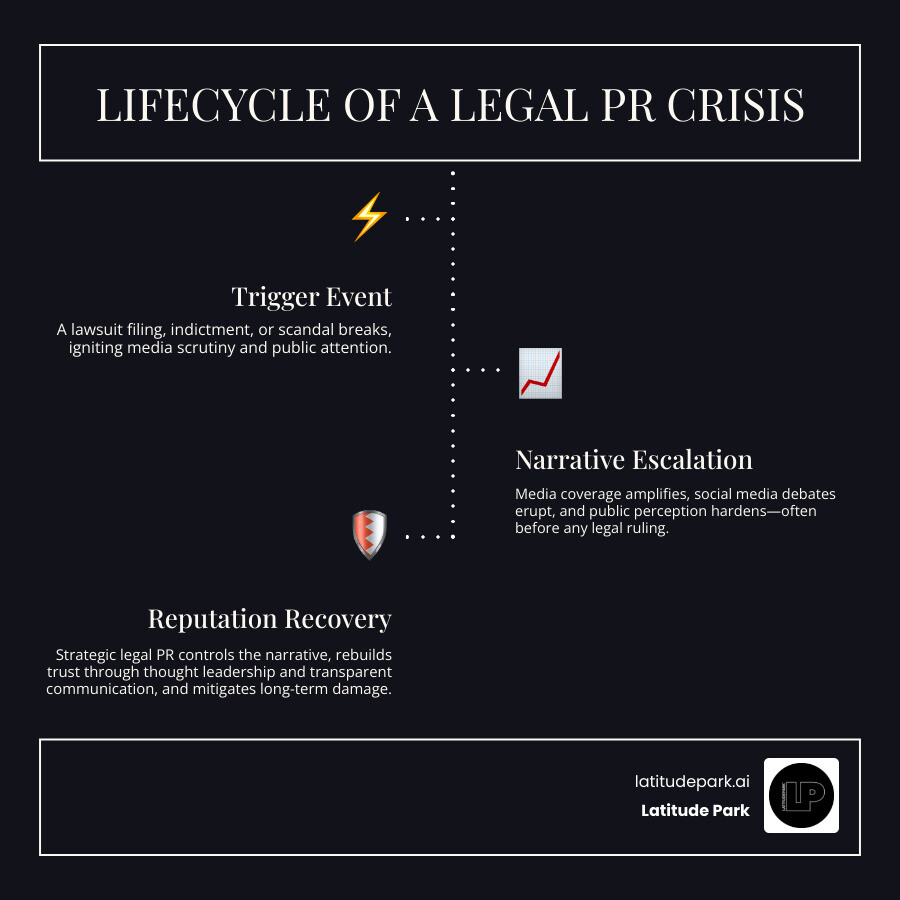
The answer, increasingly, is no. In today’s media-saturated environment, legal disputes don’t just unfold in courtrooms. They play out on news sites, social media feeds, and podcast episodes — often before a judge has read a single filing.
That’s what makes legal PR so critical for modern law firms. It’s not just about getting press. It’s about controlling your narrative, protecting your reputation, and making sure the public story of your firm or your case is one you helped write.
I’m Rusty Rich, founder of Latitude Park — a full-service digital marketing agency with over 15 years of experience helping businesses build strong, measurable online presences — and in this guide, I’ll walk you through everything you need to know about legal public relations, from core strategy to execution. Let’s get into it.
Handy legal public relations terms:
What is Legal Public Relations and Why Does It Matter?
At its core, legal public relations (often referred to simply as legal PR) is the strategic intersection of law, communications, and media relations. It is the art and science of shaping how a law firm, its partners, and its active cases are perceived by the outside world. Whether we are talking about securing a profile in a prestigious legal trade publication or managing the fallout of a high-profile class-action suit, legal PR is the engine that drives a firm’s reputation.
But why does it matter so much in July 2026?
The legal landscape is more crowded and competitive than ever before. With thousands of firms vying for the same high-value corporate clients and individual cases, simply being a technically brilliant lawyer is no longer enough. If potential clients do not know you exist, or if they cannot find third-party validation of your expertise, they will simply walk across the street to a competitor who has built a louder, more credible public presence.
Legal PR acts as a force multiplier for your firm’s growth by focusing on three core pillars:
- Credibility: Unlike paid advertising, which everyone knows you purchased, PR relies on earned media. When a respected journalist quotes you as an expert, or when a major business publication prints your bylined article, that third-party endorsement carries immense weight.
- Visibility & Brand Awareness: Consistent PR efforts keep your firm top-of-mind. When corporate counsel or prospective clients face a legal challenge, your firm should be the first name that occurs to them.
- Reputation Protection: A firm’s reputation can take decades to build and only minutes to destroy. Proactive legal PR establishes a buffer of goodwill and creates a framework to handle negative situations before they spiral out of control.
By actively managing public relations, law firms can transition from being the industry’s best-kept secret to becoming recognized market leaders.
Litigation PR vs. Traditional Public Relations: Understanding the Divide
Many lawyers assume that any standard public relations agency can handle their communications needs. This is a dangerous misconception. Traditional PR and litigation PR are entirely different animals, operating under different rules, timelines, and stakes.
To illustrate this divide, let’s look at how they compare across key operational areas:
| Operational Area | Traditional Public Relations | Litigation Public Relations (Legal PR) |
|---|---|---|
| Primary Goal | Build brand awareness, promote products/services, and drive general consumer engagement. | Protect legal standing, control the case narrative, and manage reputation during disputes. |
| Target Audience | Broad consumer base, industry partners, and general public. | Judges, potential jurors, regulators, opposing counsel, and key client stakeholders. |
| Key Constraints | Creative freedom; limited legal or regulatory boundaries. | Strict ethical rules (e.g., ABA Model Rule 3.6), attorney-client privilege, and litigation-sensitive messaging. |
| Timeline | Proactive, planned campaigns with flexible schedules. | Highly reactive, , and tied directly to court dockets and rapid filing cycles. |
| Core Tactics | Product launches, influencer partnerships, and lifestyle features. | Court filing amplification, targeted media briefings, and crisis response protocols. |
Traditional PR agencies are built to generate excitement. They want to get people talking. However, in a legal context, saying the wrong thing to the press can waive attorney-client privilege, violate state bar ethics rules, or compromise an active trial strategy.
Litigation PR requires a deep, nuanced understanding of the legal system. It is about litigation support and highly disciplined media relations. Every press release, statement, or background briefing must be filtered through both a communications lens and a strict legal lens to ensure it advances—rather than undermines—the courtroom strategy. For a broader look at how these specialized services fit into the wider communications landscape, you can explore our complete guide to PR services.
The Court of Public Opinion in Legal Public Relations
We often hear the phrase “the court of public opinion,” but in legal PR, this is not just a metaphor—it is a parallel venue that directly impacts the physical courtroom.
Because more than 95% of civil cases settle before they ever reach trial, the public narrative is often the only forum where liability is assigned in the minds of the public, investors, and clients. If a corporate client is dragged through the mud in the media, winning a dismissal two years later will not recover their lost market share or restore their shattered brand.
Furthermore, public perception heavily influences settlement leverage. A defendant who is being battered daily in the press enters settlement negotiations from a position of weakness, fundamentally changing the economics of the resolution. Conversely, a strong, proactive litigation PR strategy can level the playing field.
For high-profile cases, managing this dynamic is critical. As detailed in the resource Five Ways to Manage PR In High-Profile Litigation | Law.com, legal teams must treat the public docket itself as a storytelling vehicle. Every motion, answer, and filing should be written not just for the judge, but to clearly convey a compelling, understandable narrative to the journalists who are monitoring the docket.
Key Benefits of a Strategic Legal PR Campaign

When executed correctly, a strategic legal PR campaign provides a wide range of tangible benefits that go far beyond simply getting your name in the paper.
- Third-Party Validation: Anyone can buy an ad claiming they are the “best litigation attorney in town.” But when a neutral journalist at a respected publication interviews you as an expert, that is third-party validation. It builds a level of trust and authority that paid advertising simply cannot buy.
- Thought Leadership: By consistently publishing bylined articles, participating in podcast interviews, and providing expert commentary on breaking news, your partners become recognized thought leaders. This makes your firm the go-to resource for corporate decision-makers facing complex legal hurdles.
- SEO Rankings and Digital Footprint: Modern legal PR is highly digital. When your firm is featured in reputable online news outlets, those articles often contain high-quality backlinks to your website. These backlinks, combined with relevant keywords, signal to search engines that your site is an authority, boosting your organic search rankings. To maximize this benefit, it is vital to understand how to optimize your website for better PR results so that the traffic generated by your PR campaigns actually converts into qualified leads.
- Attracting Top Talent: The best young lawyers and lateral partners want to work for prestigious, highly visible firms. A strong public relations presence showcases your firm’s success, culture, and high-profile victories, making you an attractive destination for top-tier legal talent.
Integrating PR with Litigation Strategy to Shape Public Perception
The most successful legal PR campaigns are not run in a vacuum; they are integrated directly into the overall litigation strategy from day one. This integration requires trial counsel and communications counsel to work in lockstep, establishing a unified approach to narrative control.
This integration model relies on three key phases:
- Threat Assessment: Before a complaint is even filed, both teams must conduct a joint assessment to identify both legal and reputational risks. What are the potential media triggers? How will the opposing side attempt to frame the narrative?
- Pleadings as PR Tools: Key public messages should be drafted directly into formal court pleadings (such as the Answer or a Motion to Dismiss). This ensures that when journalists pull the documents from the public docket, your core narrative is presented in a legally safe, structured format.
- Rapid Response Protocol: High-profile cases move at lightning speed. Your legal and PR teams must have an established protocol to review, approve, and distribute statements within minutes of a major development or filing.
Establishing this operational framework ensures that public messaging aligns perfectly with courtroom strategy, protecting the client on both fronts.
Balancing Transparency and Confidentiality in Legal Public Relations
One of the greatest challenges in legal PR is balancing the public’s desire for transparency with the absolute necessity of maintaining client confidentiality and protecting attorney-client privilege.
To navigate this delicate balance, we must adhere to several strict guidelines:
- Involve Legal Counsel in PR Review: Every public statement, press release, or media pitch must be reviewed by legal counsel. This ensures that the communication does not inadvertently waive privilege or violate ethical rules such as ABA Model Rule 3.6 (which governs extrajudicial statements that could prejudice a proceeding).
- Extend Privilege Where Possible: When crisis communications work is conducted directly under the direction and supervision of legal counsel, attorney-client privilege can sometimes extend to those communications, providing an extra layer of protection. This dynamic is a primary reason why many organizations choose specialized legal PR support to navigate high-stakes disputes safely.
- Strategic Redaction: When releasing documents or statements to the press, sensitive, proprietary, or highly confidential information must be carefully redacted. You can still tell a compelling, transparent story while keeping your client’s most sensitive data completely protected.
- Point to the Public Record: Rather than drafting entirely new statements that could introduce fresh legal liabilities, direct reporters to specific paragraphs, exhibits, or arguments already established in the public court record.
Effective Channels, Tactics, and Crisis Management for Law Firms
To build a robust brand and protect your clients, your firm must utilize a diverse mix of PR channels and tactics.
- Newsjacking: This is the practice of aligning your attorneys with ongoing, high-profile news events. When a major legal development hits the headlines, a specialized agency can immediately pitch your partners to journalists as expert commentators who can explain the complex legal implications in simple terms.
- Bylined Articles: Writing and placing deep-dive articles in respected legal and business publications allows your attorneys to showcase their technical expertise while maintaining total control over the messaging.
- Crisis Management: When a crisis hits—whether it is a data breach, a regulatory investigation, or a high-profile lawsuit—how you respond in the first few hours will define your reputation for years. A specialized legal PR strategy helps firms prepare crisis roadmaps, draft pre-approved response templates, and conduct rapid-response media relations to mitigate damage.
- Social Media: Platforms like LinkedIn are incredibly powerful for humanizing your attorneys and sharing your firm’s successes. However, social media also carries significant reputational risk. To navigate this channel safely, it is crucial to master brand reputation management on social media to ensure your online interactions protect—rather than harm—your firm’s image.
Frequently Asked Questions about Legal PR
When should a law firm hire a specialized legal PR agency?
Law firms should consider hiring a specialized legal PR agency when they find themselves handling high-profile cases, navigating a reputational crisis, or simply realizing that their partners do not have the time to manage media relations.
According to industry data, the average attorney completes less than three hours of billable work each day. Expecting busy partners to spend their remaining hours drafting press releases, pitching journalists, and managing social media is highly inefficient. Partnering with a specialized agency allows your lawyers to focus on what they do best—practicing law—while ensuring your firm’s public reputation is managed by professionals.
To understand what to expect when partnering with an agency, we recommend you check out our transparent guide to PR agency pricing.
How do law firms measure the success of their PR campaigns?
Measuring the ROI of public relations requires looking at a mix of qualitative and quantitative metrics:
- Share of Voice (SOV): How often is your firm mentioned in the media compared to your direct competitors?
- Media Impressions: What is the total potential audience reached by the publications and programs where your firm or cases were featured?
- Website Traffic & Conversion Rates: Are your media placements driving referral traffic to your website, and are those visitors converting into qualified leads?
- Sentiment Analysis: Is the public and media narrative surrounding your firm or active cases shifting in a positive, more sympathetic direction?
To ensure your firm’s digital reputation remains pristine across all channels, it is also highly beneficial to implement a comprehensive review strategy. You can learn more about this by reading our online review management complete guide.
What are the most common media mistakes lawyers make?
Without professional PR guidance, even highly experienced lawyers frequently make critical media mistakes:
- Overusing “No Comment”: To the public, “no comment” is almost always interpreted as an admission of guilt or a lack of transparency. A skilled legal PR professional can help you craft a thoughtful, legally safe statement that protects confidentiality while still demonstrating accountability.
- Speaking “Off the Record” Without a Strategy: Many attorneys mistakenly believe that telling a reporter something “off the record” guarantees it won’t be published. Without a clear, pre-determined media strategy and a trusted relationship with the journalist, this is an incredibly risky gamble.
- Failing to Coordinate with Counsel: PR efforts that are not fully aligned with the active legal defense team can lead to conflicting public statements, which opposing counsel can easily weaponize in court. Professional media training is essential to ensure every spokesperson stays strictly on-message.
Conclusion
In the modern legal market of July 2026, a law firm’s ultimate success hinges just as heavily on its reputation in the public eye as it does on its victories in the courtroom. By implementing a proactive, highly integrated legal public relations strategy, your firm can build unmatched credibility, control critical case narratives, and drive sustainable business growth.
At Latitude Park, we specialize in high-impact digital marketing and reputation management. While we are widely recognized for helping businesses and multi-location franchises scale through tailored advertising and brand strategy, we understand the immense power that a well-executed PR campaign holds for professional service firms.
Whether you are looking to amplify your firm’s landmark victories, establish your partners as industry thought leaders, or safeguard your brand during a high-stakes dispute, we are here to help you navigate the media landscape with confidence.
Ready to elevate your firm’s public reputation and secure the visibility you deserve? Get started with our professional PR and press release services today.