Mastering Online Reputation Mgmt Before Reddit Does It For You
The Core Principles of Online Reputation Mgmt
Every business has an online reputation whether they choose to actively manage it or not. When potential customers search for your name, they synthesize information across search results, social media mentions, review platforms, and news articles to form an immediate opinion about your corporate credibility.
Modern consumers trust unstructured peer feedback over company advertisements. Studies reveal that 84% of consumers do not trust traditional advertising and sales messaging. Instead, 54% put their trust in online reviews above personal recommendations and direct brand claims. Because 81% of shoppers gather information online before purchasing, your digital touchpoints directly dictate your growth.
Essential Components of Your Digital Footprint
Your digital footprint is the collection of all public data points that form your brand perception across the web. Managing this footprint requires oversight across several key areas:
- Review Platform Profiles: Verified profiles on platforms such as Google Business Profile, Yelp, and specialized industry review sites drive local discovery.
- Social Media & Forum Chatter: Unfiltered consumer conversations across Reddit, Facebook, X, and vertical forums shape public sentiment.
- Directory Listings and Citations: Ensuring consistent Name, Address, and Phone number (NAP) data across web directories reinforces search authority.
- Entity Authority and News: Articles, press releases, and blog mentions establish whether search engines and AI answer engines view your brand as a trusted industry authority.
Failing to clean up outdated or inaccurate business listings hurts both search visibility and customer trust. To master these foundational elements, explore our Online Review Management Complete Guide.
How Online Reputation Mgmt Differs From Traditional SEO
While Search Engine Optimization (SEO) and online reputation mgmt share similar technical mechanics, their underlying goals and operational approaches are fundamentally distinct. SEO focuses on ranking a single domain at the top of search engine results pages (SERPs) to drive organic web traffic. In contrast, online reputation management aims to control the entire first page of search results to protect conversion velocity and brand sentiment.
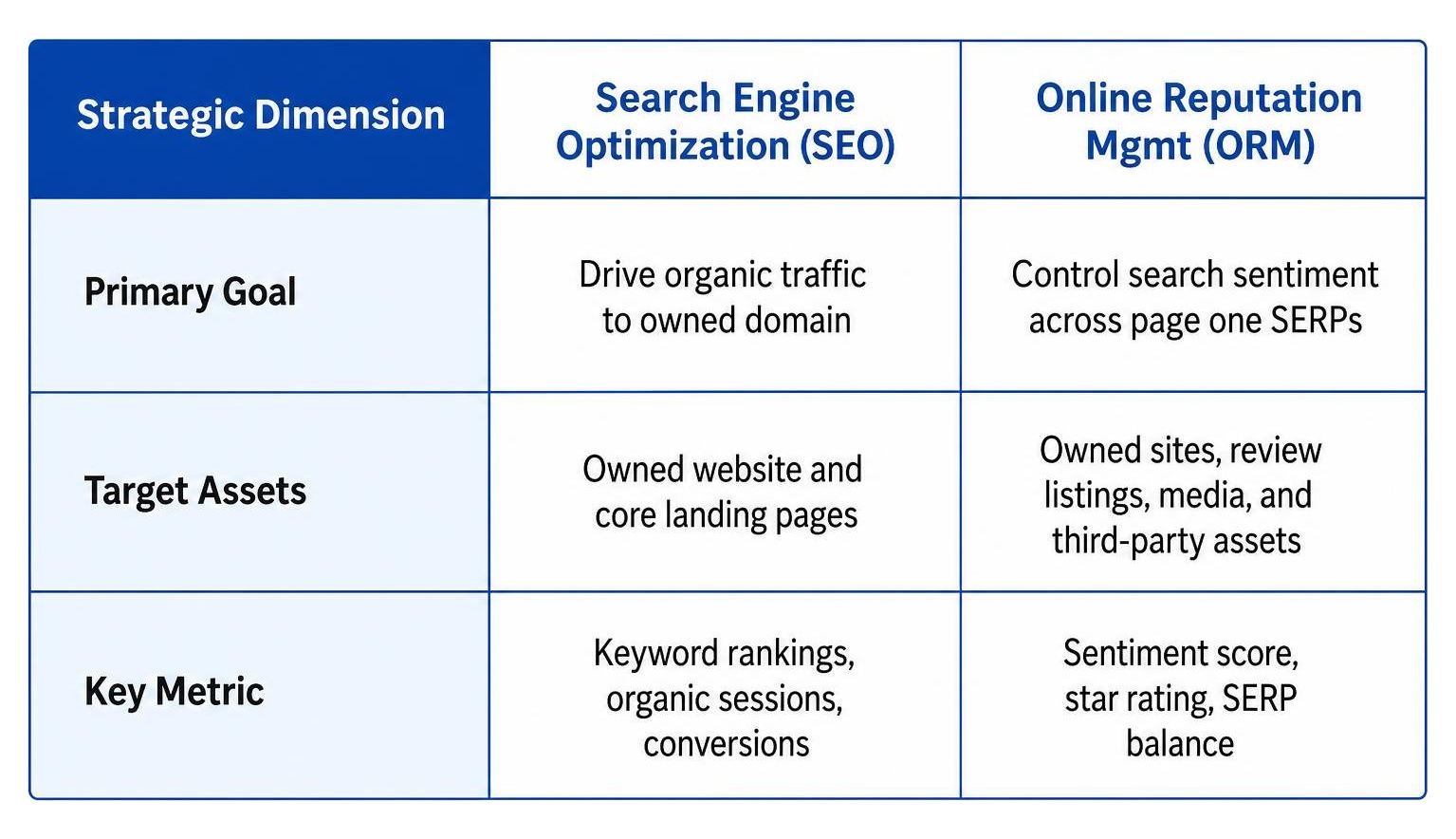
| Strategic Dimension | Search Engine Optimization (SEO) | Online Reputation Mgmt (ORM) |
|---|---|---|
| Primary Goal | Drive organic traffic to owned domain | Control search sentiment across page one SERPs |
| Target Assets | Owned website and core landing pages | Owned sites, review listings, media, and third-party assets |
| Key Metric | Keyword rankings, organic sessions, conversions | Sentiment score, star rating, SERP balance |
| Tactical Focus | Technical audits, keyword targeting, link building | Review acquisition, sentiment control, SERP suppression |
| Risk Focus | Algorithm penalties and traffic drops | PR crises, viral complaints, false reviews |
In practice, a company can achieve the number one ranking on Google for its primary keyword but still lose revenue if the second and third search results feature negative news articles or low review scores. Effective reputation management neutralizes those external risks by creating positive digital assets that suppress harmful content off the first page.
Proactive Brand Monitoring and Key Business Benefits

Waiting until a negative story or widespread customer complaint surfaces before taking action is a costly mistake. Industry data shows that addressing a reputation signal immediately upon emergence costs up to ten times less than attempting to resolve it 72 hours later after it has spread across social media.
Proactive brand monitoring allows businesses to listen to digital chatter across forums, social networks, and news outlets in real time. Beyond avoiding public relations crises, executing a structured monitoring strategy delivers major commercial advantages:
- Elevated Brand Credibility: Maintaining an overall average rating above 4 stars builds instant trust. Research shows that 57% of consumers will only buy from a business that has four or more stars.
- Higher Conversion Rates: Positive reviews make 74% of consumers trust a local business more, directly speeding up sales cycles.
- Recruitment Advantages: Brand reputation is equally critical for acquiring top talent. 84% of job seekers say employer brand reputation is important when choosing where to apply, and approximately 79% of job candidates have been rejected based on their own digital footprint audits.
- Enhanced Local Search Rankings: Search engines like Google utilize review volume, review velocity, and overall rating scores as explicit local search ranking signals. High-rated listings appear more frequently in the Google Local 3-Pack.
To track your progress, monitor these core performance metrics:
- Average Star Rating: The aggregate rating across primary review platforms.
- Review Velocity: The frequency and consistency of incoming customer reviews.
- Net Brand Sentiment: The ratio of positive to negative mentions across web forums and social media.
- SERP Sentiment Balance: The percentage of positive vs. negative search links on page one for branded queries.
- Response Rate & Time: The percentage of customer reviews and social complaints answered within target timeframes.
For a detailed look at setting up social listening structures, check out Whos Saying What The Guide to Brand Monitoring.
Automated Monitoring and Alert Setup
Manual web searches are insufficient for modern brand protection. Organizations need automated monitoring tools to track digital mentions as they occur.
Start by setting up real-time web alerts using your brand name, executive names, product lines, and common misspellings. Assign a dedicated community manager or customer support specialist to review automated alert feeds daily. Integrating sentiment analytics tools allows your team to flag negative posts automatically, ensuring immediate intervention before minor customer complaints escalate into widespread online issues.
Strategies to Build Positive Sentiment and Manage Feedback

Building a strong digital reputation requires a continuous stream of authentic positive feedback. Because 40% of consumers only take into account reviews written within the past two weeks, maintaining high review velocity is essential.
The most effective way to generate positive reviews is simply to ask. Statistics show that 70% of customers will leave a review if a business directly asks them to do so. However, timing and friction dictate your success rate. Request feedback immediately following a positive milestone—such as a completed service, product delivery, or successful support resolution—via automated email or SMS notifications containing direct review links.
To learn more about optimizing review flows, read our guide on How to Manage Online Reviews.
Responding Constructively to Positive and Negative Reviews
How you respond to public feedback is just as important as the reviews you receive. Consumers pay close attention to brand responses; over a third of customers expect a response within three days or less, and 53% expect replies to negative reviews within a week. Furthermore, 42% of consumers complaining on social media expect a response within one hour.
Developing a strict response protocol ensures consistent, professional communication:
- Handling Positive Reviews: Always thank the reviewer promptly. Personalize your response by mentioning specific details from their comment to demonstrate genuine appreciation and reinforce positive brand values.
- Handling Negative Reviews: Never argue or act defensively in a public thread. Thank the reviewer for bringing the issue to your attention, apologize constructively for their poor experience, and provide a direct offline contact channel (such as an email or direct phone line) to resolve the matter privately.
Businesses that ignore complaints suffer a 37% decline in customer advocacy. Conversely, addressing feedback constructively can turn dissatisfied customers into loyal brand advocates—39% of negative review writers state that they posted simply because they wanted an apology and a resolution. If managing high review volumes becomes overwhelming, utilizing a specialized Google review response service can keep your communications timely and professional.
Crisis Response Frameworks and Pitfalls to Avoid

When a full-blown reputational crisis hits—whether from a viral customer dispute, product recall, or negative media exposure—the first 72 hours determine long-term impact. Having a pre-approved crisis communications framework allows your team to respond swiftly and decisively.
To navigate crises successfully while protecting long-term credibility, avoid these critical reputation management pitfalls:
- Buying Fake Reviews: Purchasing artificial reviews violates search engine guidelines and FTC regulations, risking severe search suppression penalties and public embarrassment.
- Deleting Genuine Critical Feedback: Suppressing authentic customer complaints on social media often backfires, angering customers and provoking them to post on external forums like Reddit or Ripoff Report where you lack administrative control.
- Using Generic Automated Responses: Copy-pasting template answers makes your company appear indifferent to customer concerns.
- Ignoring Complaints: Neglecting online feedback directly damages sales—a single unaddressed negative review can turn away up to 30 potential customers.
To safeguard your brand against these costly missteps, select a trusted online reputation partner to establish proactive governance and pre-approved response playbooks.
Selecting Tools and Resources for Effective Online Reputation Mgmt
Managing your brand across dozens of review directories, social media networks, and search engines requires dedicated software infrastructure. Enterprise-grade tools consolidate feedback channels into centralized management dashboards, enabling streamlined workflows and automated analytics.
When evaluating reputation platforms, prioritize solutions that offer:
- Multi-Channel Review Aggregation: Unifies feedback from Google, Facebook, Yelp, and industry-specific sites into a single inbox.
- Automated Review Generation: Sends automated SMS and email review invitations based on customer triggers within your CRM.
- Real-Time Sentiment Monitoring: Uses AI natural language processing to track brand mentions and categorize customer sentiment across web channels.
- Local Listing Management: Syncs company Name, Address, and Phone number (NAP) data across web directories to protect local SEO authority.
Deploying a robust customer review management platform streamlines monitoring, protects star ratings, and frees up internal operational resources.
Frequently Asked Questions About Reputation Management
How long does it take to see online reputation management results?
Implementation timeframes depend on the complexity of your situation. Initial improvements from responding to reviews and optimizing local listings can yield visible conversion gains within 30 days. However, building durable brand authority, suppressing deeply embedded negative search engine results, or elevating average ratings across high-volume platforms typically requires 3 to 6 months of consistent execution.
Can negative search results or fake online reviews be removed completely?
Complete removal of online content is restricted to specific circumstances. Reviews that directly violate platform terms of service (such as spam, hate speech, explicit conflicts of interest, or fake reviews) can be successfully flagged and removed by platform moderators. Harmful web pages containing illegal content or copyright violations may be removed through DMCA takedowns or court orders. For standard negative reviews or bad press, the primary approach is search suppression—building high-authority positive assets that naturally push unwanted links off the first page of search results.
How much should a business budget for online reputation services?
Budgets vary based on software requirements and organizational scale. Basic do-it-yourself review software typically costs between $20 and $100 per month for small businesses. Comprehensive managed services from professional agencies—covering multi-location review growth, crisis monitoring, and SERP suppression—generally range from $800 to $5,000+ per month depending on keyword competition and search complexity.
Conclusion
At Latitude Park, we specialize in helping multi-location businesses and franchises scale through targeted digital strategies, social media campaigns, and structured reputation governance. Modern consumers evaluate your business across multiple digital touchpoints before ever filling out a contact form or making a purchase. Leaving your brand’s digital presence to chance—or letting external forums dictate your narrative—exposes your revenue to unnecessary risk.
By implementing proactive brand monitoring, automated review generation, and disciplined crisis frameworks, you cultivate long-term authority and turn online trust into a sustainable growth engine. To learn how our team can help protect and grow your brand authority across all locations, explore our Review Management Solutions.