
Who’s Saying What? The Guide to Brand Monitoring
What Is an Online Reputation Monitor — and Why Does It Matter?
An online reputation monitor is a tool or system that tracks what people are saying about your brand across the web — including review sites, social media, news, forums, and increasingly, AI search engines like ChatGPT and Google’s AI Mode.
Here’s a quick overview of how it works and why it matters:
| What It Does | Why It Matters |
|---|---|
| Tracks brand mentions in real time | Catch problems before they escalate |
| Monitors reviews across 50+ platforms | Respond faster, build customer trust |
| Analyzes sentiment (positive, neutral, negative) | Understand how your brand is actually perceived |
| Alerts you to sudden spikes in negative feedback | Prevent small issues from becoming PR crises |
| Tracks competitor activity and market trends | Stay ahead of the competition |
Over 90% of consumers read online reviews before making a purchase decision. And yet, most businesses have no system in place to consistently track what’s being said about them.
That gap is expensive.
A single unaddressed negative review — or a wave of complaints that goes unnoticed for days — can quietly erode trust, tank local search rankings, and cost you customers you never knew you lost.
For franchise brands managing multiple locations, the challenge is even bigger. Conversations about your brand are happening across dozens of platforms, in multiple markets, at the same time. Manual monitoring simply doesn’t scale.
That’s where reputation monitoring becomes a strategic asset, not just a defensive tool.
I’m Rusty Rich, President of Latitude Park and a digital marketing strategist with over 15 years of experience helping franchises and growing businesses build strong, measurable online presences — including implementing online reputation monitor systems that protect brand equity across multiple locations. In this guide, I’ll walk you through everything you need to know to track, manage, and strengthen your brand’s digital reputation.
Key terms for online reputation monitor:
- online reputation management sites
- online review management
- social marketing and online reputation management
Why Your Business Needs an Online Reputation Monitor
In the digital landscape of June 2026, your brand’s reputation isn’t defined by what you say it is. It is defined by what the collective internet says it is. Whether you are running a single-location boutique or managing a complex multi-location franchise network, a positive digital footprint is directly tied to your bottom line. Research shows that actively managing and protecting your brand image can improve search engine rankings and increase brand visibility by up to 80%.
When you implement a dedicated online reputation monitor, you are not just watching the internet; you are actively building brand credibility, boosting local SEO visibility, and driving customer retention. In fact, brands that actively manage their online presence experience a 25% higher customer retention rate. For a deeper dive into the foundational structures of this practice, take a look at our comprehensive Business Online Reputation Management Guide.
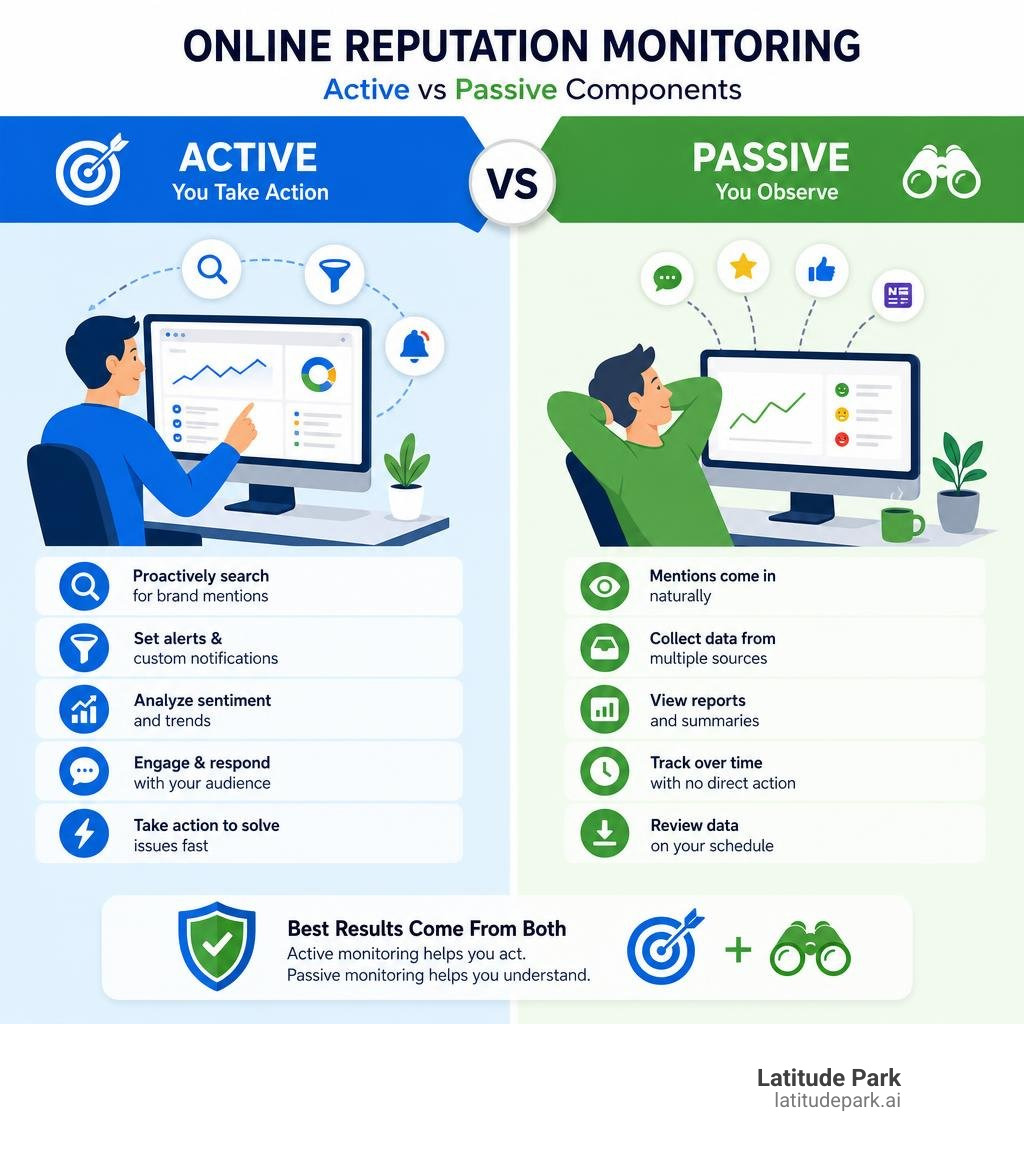
Active vs. Passive Components of Brand Perception
To build a robust digital shield, it helps to understand that online reputation is divided into two distinct dynamics: active and passive components.
- Active Components: These are the elements you directly control. They include your active public relations campaigns, your local community outreach, customer loyalty programs, and the baseline quality of your products and services. You create the narrative here.
- Passive Components: These are the elements shaped entirely by the public. They include public feedback on review portals, social media conversations on platforms like Reddit or X (formerly Twitter), search engine autocomplete suggestions, and organic search results.
While you cannot directly edit what a customer writes on a forum, tracking these passive signals with an online reputation monitor allows you to influence the narrative. By listening to passive conversations, you can adjust your active strategies to bridge any gaps in brand perception.
The Impact of AI Search on Modern Discovery
We have officially entered the era of Generative Engine Optimization (GEO). Today, customer discovery is no longer limited to scrolling through standard Google search result pages. Instead, customers are asking conversational AI platforms like ChatGPT, Gemini, Perplexity, and Grok where they should spend their money.
If a potential customer asks Gemini, “What’s the best franchise marketing agency near me?” or “Are there any major complaints about Brand X?”, the AI will scan historical web data, news articles, and public reviews to formulate an answer in real time. If your brand has unaddressed negative feedback or a lack of positive mentions, the AI might recommend a competitor instead.
Using advanced monitoring systems like Reptor — AI-Powered Reputation Monitoring helps you keep tabs on what AI engines say when asked about your business, closing the biggest modern blind spot in reputation management.
Core Features of Modern Reputation Tracking Software
Not all monitoring tools are created equal. Free tools like Google Alerts can track basic brand mentions, but they lack the depth, speed, and analytical capabilities required by modern businesses.

An enterprise-ready online reputation monitor must include these four core features:
- Full Market Access: The ability to scan beyond basic social media platforms. It must cover online news publishers, industry blogs, forums (like Reddit and Quora), public Telegram channels, and Wikipedia edits.
- Real-Time Alerts: Instant notifications when your brand name, key executives, or target keywords are mentioned, allowing you to react before a negative comment goes viral.
- AI-Powered Sentiment Analysis: Automatically classifying mentions as positive, neutral, or negative. Modern tools use advanced natural language processing to score sentiment instantly, removing the need for manual review sorting.
- Trend Identification: Tracking sentiment and mention volume over time to identify whether a sudden influx of comments is a temporary spike or a long-term shift in brand perception.
Selecting an Online Reputation Monitor for Multi-Location Brands
For multi-location and franchise businesses, selecting the right software is a major strategic decision. You need a platform that offers high scalability, seamless integration with your existing CRM and marketing tech stack, and sophisticated reporting analytics that can segment data by location, region, or nationwide.
If you are currently evaluating your options, our guide on Your Business’s Digital Shield Picking the Perfect Online Reputation Partner outlines the exact criteria you should look for to make an informed choice.
Platform-Specific Tools vs. Unified Enterprise Software
Many businesses make the mistake of relying on platform-specific tools like Meta Business Suite or Google Business Profile Manager. While these tools are great for basic, localized engagement, they create highly siloed data. You are forced to log into multiple dashboards, and you miss the broader conversations happening on forums, news sites, and blog networks.
Unified enterprise software consolidates all of these sources into a single dashboard. This centralized view ensures that your corporate team and local managers are looking at the exact same data, ensuring brand consistency and faster response times. For a structured look at the top platforms available today, explore the Top Sites for Managing Your Online Reputation Without Losing Your Mind.
Strategic Review Management and Customer Engagement
Reviews are the lifeblood of local search visibility and digital trust. When you actively monitor and respond to customer reviews, you aren’t just resolving individual issues — you are signaling to search engines and future customers that you care. In fact, businesses that regularly respond to online reviews see a 5x increase in customer trust and engagement.
For a comprehensive blueprint on setting up these workflows, refer to our Online Review Management Complete Guide.
To help your team manage feedback efficiently, we recommend utilizing a structured response matrix:
| Review Type | Strategic Goal | Key Action | Response Example |
|---|---|---|---|
| 5-Star Review | Build advocacy & social proof | Thank the customer, highlight a specific detail, and invite them back. | “Thank you for the fantastic feedback! We’re thrilled you loved our service, and we can’t wait to welcome you back soon.” |
| 3-Star Review | Identify friction points | Acknowledge the positive, address the neutral/negative, and offer a path to resolve. | “We appreciate your feedback. We’re glad you liked the product, but we apologize for the wait time. We’d love to make this right.” |
| 1-Star Review | De-escalate & move offline | Respond calmly and empathetically, apologize, and provide direct contact info. | “We are truly sorry your experience didn’t meet expectations. Please reach out to us directly at support@latitudepark.com so we can resolve this.” |
Best Practices for Addressing Negative Feedback
When addressing negative reviews, speed and empathy are everything. Using tools like Review Monitoring- Track Customer Feedback Across Platforms \| Reputeup allows you to consolidate reviews from over 50 platforms and use AI-powered reply assistants to draft professional, non-defensive responses in seconds.
Always remember: the response you write isn’t just for the unhappy customer — it is for the next 500 people who read that review. Keep it professional, take ownership of the issue, and never argue publicly.
Leveraging Positive Reviews for Marketing Success
A great review shouldn’t just sit on Google or Yelp. It is highly valuable user-generated content that should be integrated into your marketing campaigns.
Using an Online Review Marketing Complete Guide strategy, you can automatically stream positive reviews onto your website, feature them in your Meta ad campaigns, and display them on localized landing pages. This social proof acts as a natural trust booster, dramatically improving conversion rates.
Proactive Social Listening and Crisis Prevention
Waiting for a crisis to hit before you check your brand mentions is like buying home insurance while the kitchen is already on fire. Proactive social listening means monitoring the broader industry conversations, tracking untagged mentions of your brand, and keeping a close eye on competitor activity.

Using dual-source intelligence platforms like Prestige Shield — AI-Powered Brand Monitoring & Reputation Management , which pairs deep web scraping with real-time social search APIs, allows you to catch emerging trends and sentiment shifts before they escalate.
How an Online Reputation Monitor Prevents Public Relations Crises
Most public relations crises start as quiet whispers on a forum or a single negative post on social media. If left unaddressed, these whispers can quickly gain traction, get picked up by local news blogs, and eventually impact your main search results.
An online reputation monitor acts as an early warning system. By setting up smart alerts for negative sentiment spikes on high-authority domains, your PR and crisis management teams can deploy pre-approved response playbooks immediately, resolving the customer’s issue and correcting misinformation before it spreads.
Benchmarking Competitor Activity and Market Sentiment
Monitoring is not just about looking inward. By tracking your competitors’ brand mentions, you can identify their weaknesses and capitalize on their slip-ups. If a major competitor in your market is facing a wave of negative feedback due to a sudden drop in product quality or a customer service failure, your marketing team can adjust your local Meta campaigns to highlight your brand’s strengths in those exact areas.
For a deeper strategic look at how to build and safeguard your brand’s position in the market, check out our guide on Effective Strategies Building Managing Brand Online Reputation.
Frequently Asked Questions about Reputation Monitoring
What is the difference between brand monitoring and social listening?
While they are closely related, brand monitoring focuses on tracking specific, direct mentions of your brand name, products, or key personnel to manage immediate feedback. Social listening goes a step further by tracking broader industry keywords, competitor mentions, and general consumer discussions to understand the wider market sentiment and identify long-term trends.
How does AI improve the speed of reputation management?
AI has completely transformed the reputation management landscape. Modern AI tools can analyze sentiment instantly, classify feedback across dozens of platforms without manual tagging, and even draft tailored, professional responses to reviews. Companies using AI-powered reputation monitoring tools report a 40% faster response time to negative feedback, allowing them to de-escalate issues before they grow.
Why are platform-specific tools insufficient for enterprise brands?
Platform-specific tools only show you a tiny sliver of your digital footprint. They do not track forum discussions, news articles, blog posts, or AI search engine answers. For enterprise and multi-location brands, relying on siloed platforms leads to slow response times and missed conversations. A unified enterprise solution is necessary to maintain complete control. For more on this, read Five Star Secrets Top Solutions to Manage Online Reviews.
Conclusion
Your brand’s online reputation is its most valuable digital asset. In an era where customers consult both traditional search engines and advanced AI platforms before making a purchase, you cannot afford to leave your digital footprint to chance. Implementing a robust online reputation monitor is the key to protecting your brand, driving customer trust, and outperforming the competition.
At Latitude Park, we specialize in helping franchise networks and multi-location brands scale their digital presence. From tailored Meta advertising strategies to comprehensive localized marketing campaigns, we build structures that protect your reputation while driving measurable growth.
Ready to take control of your digital presence? Optimize your brand’s review strategy today and see how we can help your business thrive.