
Hospital Reputation Management: Shaping Patient Trust Before the Review
What Is Hospital Reputation Management and Why Is It Critical?
Hospital reputation management is the strategic process of tracking, influencing, and elevating how patients and the public perceive a healthcare organization. While traditional public relations focused heavily on press releases and crisis management, modern reputation management centers on digital channels—such as Google Business Profiles, specialized directories (like Healthgrades or Vitals), social platforms, and search engine results.
In 2026, digital discovery dominates patient acquisition. Research indicates that 84% of patients check online reviews before picking a healthcare provider, and 61.7% gather information about practices exclusively online. Patients no longer rely solely on primary care referrals; they actively research facilities and individual doctors on their smartphones. If a hospital’s listings are incomplete, inaccurate, or marred by unaddressed negative feedback, prospective patients will simply choose a competing health system down the road. For multi-location enterprise brands, maintaining consistent NAP (Name, Address, Phone) data and robust review scores across every location is foundational to local SEO and organic search engine visibility.
To dive deeper into the basics of managing public ratings online, explore our Online Review Management Complete Guide.
The Impact of Hospital Reputation Management on Financial Outcomes
A hospital’s public image directly shapes its bottom line. Nearly half of healthcare organizations report losing more than 10% of their annual revenue due to poor patient retention. Acquiring a new patient requires substantial marketing spend, whereas retaining existing patients maximizes lifetime value and stabilizes system revenue.
Beyond direct patient volume, reputation directly dictates federal reimbursement models:
- HCAHPS & Medicare Incentives: Programs like Medicare’s Value-Based Purchasing (VBP) put up to 2% of hospital inpatient payments at risk based on HCAHPS (Hospital Consumer Assessment of Healthcare Providers and Systems) survey scores.
- The Memory Drift Effect: Mailed HCAHPS surveys face severe delays, often taking up to 40 days to receive feedback. Over that window, positive sentiment naturally drifts downward from roughly 80% to 71% due to memory fade. Catching feedback early preserves patient affinity.
- Operational ROI: Proactive service recovery keeps patients within your network, protecting patient lifetime value and ensuring high capacity across key specialty departments.
Physician Online Image vs. Facility Branding
When choosing medical care, who do patients care about more—the hospital building or the doctor?
Data reveals that 76.6% of patients prioritize an individual doctor’s online image, compared to just 23.4% who prioritize the facility’s overall brand. While hospital brand trust matters, patients select specialists based on specific bios, bedside manner, verified patient ratings, and credentials.
This emphasis shifts based on procedure difficulty and travel distance. When a patient requires routine outpatient bloodwork, facility convenience dominates. However, as medical procedure complexity increases—or as patients travel greater distances for specialized care—the reputation of both the physician and the facility undergoes rigorous online scrutiny. To capture this search intent, multi-location health systems must optimize individual practitioner profiles alongside official hospital landing pages.
Building Trust Before the Review: Proactive Experience Management

A five-star review isn’t created when a patient opens their phone at home; it’s earned in the hallway when someone notices an appointment running late and offers a warm update.
Relying entirely on post-discharge review requests means you are managing your reputation reactively. If a patient experiences a long wait, confusing discharge instructions, or unhelpful administrative interactions, their frustration builds long before they write a public complaint. Proactive patient experience management focuses on capturing real-time feedback while the patient is still in your care—allowing care teams to perform service recovery before discharge.
For additional strategies on safeguarding your digital footprint, read our guide on Effective Online Reputation Management Proven Tips To Protect Your Brand.
| Strategy Element | Reactive Review Management | Proactive Patient Experience Management |
|---|---|---|
| Timing | Days or weeks after discharge | In real time, during care delivery |
| Primary Goal | Responding to public review stars | Fixing operational issues and saving trust |
| Feedback Capture | Third-party public platforms | Digital rounding, post-checkout SMS, room QR codes |
| Financial Impact | Damage control after public exposure | Protects retention, HCAHPS, and referral value |
| Team Involvement | Marketing & PR departments | Frontline staff, nursing leaders, operational teams |
Real-Time Feedback and Pre-Discharge Recovery
Implementing real-time digital rounding tools or point-of-care SMS check-ins gives patients a voice while care is underway.
When a negative rating or comment is submitted mid-stay, automated workflows immediately route alerts to unit nurse leaders or patient relations teams. A quick, empathetic in-person visit from a nurse manager to explain a delay or address a comfort issue can resolve frustration immediately. In fact, studies show that proactive outreach after a service alert can turn up to 71% of patient detractors into enthusiastic brand advocates. By removing operational friction before the patient leaves the facility, hospitals protect both public ratings and clinical trust.
Strategies for Generating, Publishing, and Managing Verified Reviews

If you only receive reviews from unprompted patients, your ratings will likely skew negative. Dissatisfied individuals naturally seek out public forums to vent, whereas satisfied patients simply go home and get on with their day.
To build an accurate public reputation, hospitals must systematically invite feedback from every verified patient. Organizations that implement automated review outreach frequently see massive shifts in review volume and star ratings. For example, UT Physicians expanded its Google review volume by 776% and raised its average rating from 2.9 to 4.6 stars simply by inviting feedback from real patients via automated workflows.
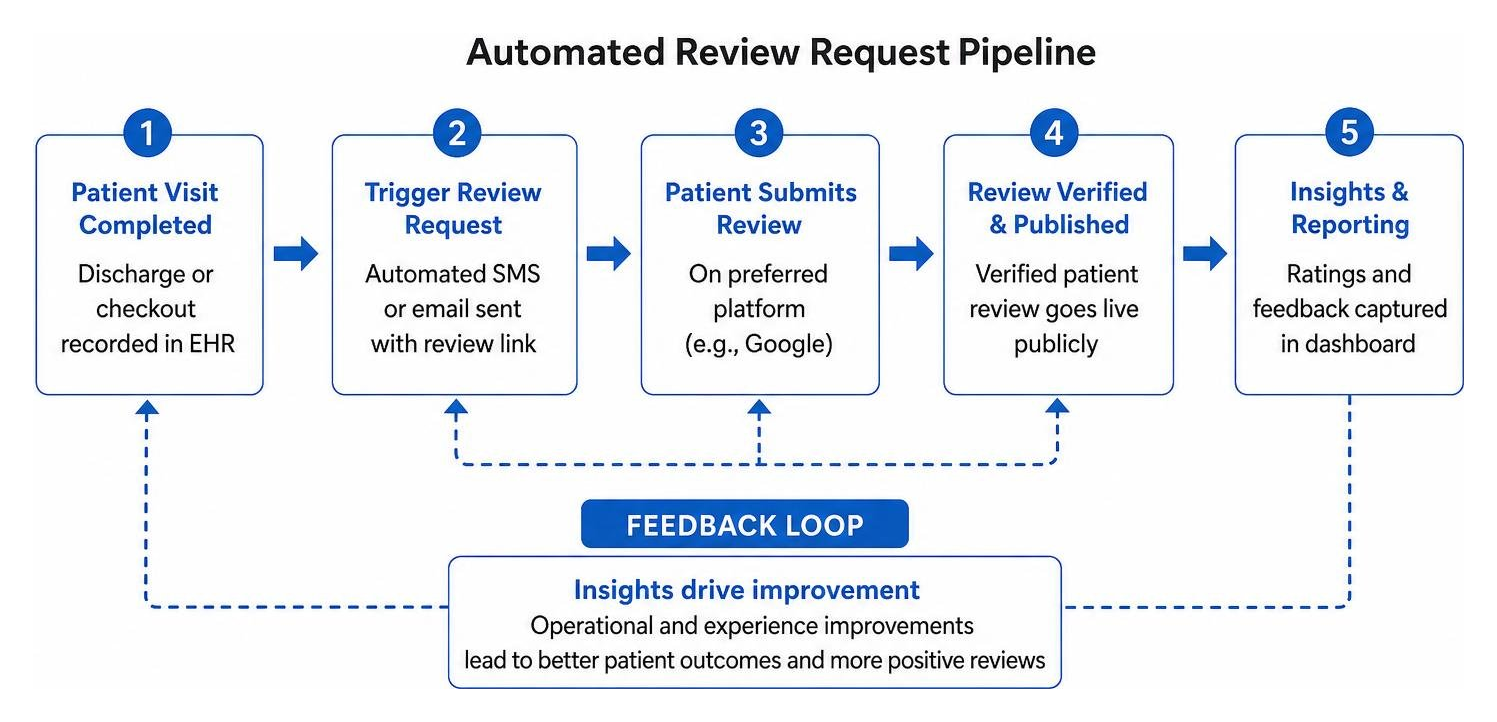
To scale review acquisition across your health system:
- Automate SMS & Email Requests: Trigger HIPAA-compliant text messages immediately post-discharge or post-checkout.
- Optimize Google Business Profiles: Ensure every hospital branch, urgent care center, and outpatient clinic has an updated Google profile linked to correct location pages.
- Publish Verified Feedback: Display aggregate patient ratings and verified testimonials directly on physician profile pages.
- Feed AI Search Engines: Modern search engines and AI assistants (like ChatGPT, Gemini, and Google AI Overviews) crawl verified review feeds and online directories to generate recommendations. High volume and strong sentiment improve visibility across these generative search interfaces.
For a deeper dive into scaling customer feedback, check out our Review Management Ultimate Guide.
Essential Features in Hospital Reputation Management Systems
Selecting the right software platform is crucial for health systems operating across dozens or hundreds of care sites. Enterprise reputation management solutions should include:
- EMR/PMS Integration: Real-time integration with Electronic Medical Record and Practice Management Systems to automate feedback triggers upon patient checkout.
- AI Sentiment Analysis: Natural language processing (NLP) to analyze thousands of review comments, identifying recurring operational bottlenecks (e.g., parking frustration, wait times, staff communication).
- Multi-Location Dashboards: Unified control centers that allow corporate marketing and local office staff to monitor multi-platform feedback across Google, Healthgrades, WebMD, and Vitals.
- Listing & Directory Management: Centralized management to update hours, addresses, and provider credentials across 100+ digital platforms simultaneously.
Navigating HIPAA Compliance and Negative Review Recovery

Managing hospital reviews comes with strict legal boundaries. Under Health Insurance Portability and Accountability Act (HIPAA) rules, health systems cannot disclose Protected Health Information (PHI) in public responses. Crucially, HIPAA prohibits even acknowledging that an individual was ever a patient at your facility—even if the reviewer explicitly describes their entire medical story in a public review.
Furthermore, healthcare organizations must follow Federal Trade Commission (FTC) rules prohibiting “review-gating” (filtering unhappy patients into private surveys while sending happy patients to Google) or offering financial incentives for reviews.
To handle public responses legally and effectively, follow these core practices:
- Use Vetted Response Templates: Prepare pre-approved template replies reviewed by legal and compliance officers.
- Never Confirm Patient Identity: Avoid stating terms like “During your visit” or “According to your medical records.”
- Acknowledge and Redirect: State your commitment to quality care broadly, and offer a private, secure offline channel (such as a patient relations phone number or email) to address specific concerns.
- Flag Policy Violations: Work with platform partners to remove reviews that violate platform terms, such as ex-employee rants, spam bots, or explicit threats.
For more advice on selecting partner platforms that safeguard your brand, see our article on Your Businesss Digital Shield Picking The Perfect Online Reputation Partner.
Frequently Asked Questions About Healthcare Perception
How do online provider reviews influence patient choices?
Studies show that 84% of patients check online reviews before booking a healthcare appointment. Furthermore, consumers rely on online provider reviews 2.75 times more than official CMS star ratings. High star ratings, recent review velocity, and clear physician profiles give prospective patients the confidence needed to choose your organization over competitors.
What is the difference between patient experience management and reputation management?
Patient experience management shapes the actual delivery of care inside the facility—focusing on clinical quality, communication, wait times, and bedside manner. Reputation management controls how those experiences are gathered, published, and communicated publicly across digital search platforms and review portals. Experience creates the story; reputation management ensures the public hears it.
How can hospitals handle negative online reviews without violating HIPAA?
Hospitals must never validate a reviewer’s identity, confirm care details, or disclose PHI in a public reply. The proper compliance protocol involves leaving a neutral, empathetic response acknowledging general commitment to patient care, followed by an invitation to discuss the matter privately via an official patient relations phone number or email address.
Building Lasting Patient Trust with Latitude Park
Hospital reputation management is not an administrative burden or a surface-level marketing tactic—it is a vital, cross-departmental strategy that links bedside care directly to organizational growth. By capturing patient feedback in real time, streamlining review acquisition across multi-location networks, and keeping compliance protocols watertight, health systems can turn real-time experiences into long-term brand equity.
At Latitude Park, we help enterprise brands and multi-location franchises navigate complex digital landscapes to capture local search visibility, drive customer acquisition, and scale reputation management systems effectively.
Ready to transform your digital strategy and build trust before the review is ever written? Explore our specialized Review Management Services today.