
Favor conversion-signal-led targeting like Advantage+ when you have reliable event volume, and reserve manual audiences for strict brand or niche constraints. Custom Audiences and lookalikes still carry the weight for remarketing and scaled prospecting, and no targeting decision should ship without an A/B test to confirm it actually moved the number you care about.
Table of Contents
- How Instagram Ad Targeting Works With the Meta Ads Platform
- Manual Targeting: Location, Demographics, Interests, and Behaviors
- Building Custom Audiences for Remarketing and Lookalike Seeds
- Lookalike Audiences: Seeding, Sizing, and Value-Based Scaling
- Advantage+ and Meta’s Targeting Consolidation: What Changed
- Testing and Measurement: How to Validate a Targeting Change
- Implementation Checklist: Setting Up a Targeted Campaign in Ads Manager
- Legal and Privacy Considerations for Instagram Ad Targeting
- Strategies for Layering and Segmenting Your Audiences
- Connecting Instagram Targeting to the Broader Marketing Funnel
- Common Pitfalls That Quietly Kill Instagram Targeting Performance
- Using Third-Party Data and Tools Beyond Meta’s Native Options
- What We’ve Learned Running Instagram Campaigns at Scale
- How We Set Up and Manage Instagram Ad Targeting for Clients
- FAQ
- Sources
How Instagram Ad Targeting Works With the Meta Ads Platform
Instagram targeting does not operate in isolation. Every Instagram campaign runs through the same delivery engine as Facebook, pulling from pixel data, the Conversions API, in-app behavior, and the optimization event you choose at the ad set level. Placements across Instagram feed, Stories, Reels, and Explore get allocated automatically based on where your optimization event is most likely to fire, not where you think your audience “hangs out.” That instinct, by the way, is usually wrong.
The practical implication: your targeting is only as good as the signals feeding it. A campaign optimized for “Purchase” with a clean, de-duplicated event setup will out-deliver a campaign stuffed with hand-picked interests but fed garbage data. Meta’s own advertising documentation confirms that advertisers choose between saved audiences, custom audiences, and lookalikes, all tied to an objective and an optimization event that tells the algorithm what “success” looks like.
Here are the signals that actually shape delivery:
- Pixel and Conversions API events: purchases, leads, add-to-cart, and custom conversions, reported with timestamps and parameters.
- In-app signals: likes, saves, video completions, profile visits, and Reels engagement.
- Device and platform data: operating system, connection type, and placement-level engagement patterns.
- Campaign objective: tells the system which outcome to chase, from awareness to catalog sales.
- Audience composition: the custom, lookalike, or saved audience you feed in as a starting boundary.
Prioritizing data accuracy here is not a nice-to-have. If your Conversions API and pixel are reporting duplicate or mismatched events, you are effectively asking the algorithm to optimize for noise, and it will.
Manual Targeting: Location, Demographics, Interests, and Behaviors
Manual controls still matter, but their job has shifted from “define the perfect audience” to “set the guardrails.” Think of them as the fence, not the field.
Location targeting works best as a precision tool rather than a blunt filter. Use radius targeting around physical storefronts, city-level targeting for regional promotions, and zip-code exclusions to avoid wasting spend in areas you cannot service. Brands running location-specific campaigns across several markets have seen outsized returns from this kind of geo-discipline, as shown in a multi-location social campaign that scaled results by tightening location logic rather than loosening it.
Demographics (age and gender) are worth constraining only when your product has a genuine, evidence-based skew. Retirement planning services probably should exclude 18 year olds. A unisex sneaker brand probably should not narrow by gender at all because doing so just starves the algorithm of eligible impressions without improving relevance.
Interests and behaviors are where overconfidence does the most damage. Stacking five interests to “layer in precision” often shrinks your eligible audience so much that delivery stalls or costs spike. According to a practical overview of Instagram targeting options, the smarter move is picking one or two strong signals and letting the algorithm’s own learning phase do the refining, rather than hand-assembling a Frankenstein audience that technically matches your buyer persona but has almost no one left in it.
- Use broad interest categories for top-of-funnel awareness campaigns.
- Reserve detailed behavioral targeting for mid-funnel retargeting where you already have engagement data.
- Treat exclusions (competitors, existing customers, irrelevant geographies) as your primary brand-safety lever.
- Expect fewer granular options than you had two years ago, since Meta has consolidated many detailed targeting fields it considered redundant or sensitive.
Pro Tip: When in doubt, cut an interest layer before you cut budget. A narrower audience rarely outperforms a cleaner optimization event.
Building Custom Audiences for Remarketing and Lookalike Seeds
Custom Audiences remain the backbone of reliable remarketing, and they are only as good as the data hygiene behind them. Three sources dominate: customer files, website/app activity, and engagement audiences.
- Customer file uploads: format emails and phone numbers consistently (lowercase, no extra spaces), let Meta’s hashing handle the matching, and expect match rates to improve when you include multiple identifiers (email plus phone) rather than just one.
- Pixel and Conversions API audiences: the pixel alone is vulnerable to browser tracking restrictions, so pairing it with server-side Conversions API events closes gaps and improves event reliability. Meta’s advertising documentation lists website activity as a native custom-audience source, and a 90-day lookback window is a reasonable default for most consideration-stage businesses.
- App activity and engagement audiences: segment by specific in-app actions (video viewers at 75%+, lead form openers, Instagram profile engagers) rather than lumping all “engaged users” into one bucket, since intent varies wildly across those actions.
Each source serves a different funnel stage. Customer file audiences work well for win-back campaigns. Pixel-based website audiences are the standard for cart abandoners. Engagement audiences are often the cheapest, warmest remarketing pool you have, and they get overlooked constantly.
Pro Tip: If your match rate on a customer file upload looks low, check for formatting inconsistencies before assuming the data is stale. It usually is not the data, it is the spreadsheet.
Lookalike Audiences: Seeding, Sizing, and Value-Based Scaling
Seed quality beats seed size almost every time. A lookalike built from your highest-LTV customers or most recent converters will consistently outperform one built from your entire email list, because the algorithm is modeling behavior patterns, not just matching demographics.
Value-based lookalikes take this further by weighting the seed audience based on purchase value rather than treating every converter equally. A $20 customer and a $2,000 customer should not count the same when you are asking Meta to find “more people like these.”
- Start with a 1% lookalike when your seed audience is strong and conversion volume is healthy, since tighter similarity usually means better early performance.
- Expand to 2 to 5% or layer in multiple country-based lookalikes once the 1% audience shows signs of saturation (rising frequency, flattening conversions).
- Combine lookalikes with exclusions, removing existing customers and recent converters so you are not paying to re-acquire people you already have.
- Pair lookalike audiences with creative variation, since a static creative running against a fresh audience tends to fatigue faster than expected.
Consolidating your best customers into a single, clean seed audience, rather than scattering value across five overlapping audiences, gives Advantage+ and lookalike modeling the clearest signal to work from.
Advantage+ and Meta’s Targeting Consolidation: What Changed
Meta has been steadily narrowing the manual targeting toolbox in favor of signal-driven automation, and 2026 campaign planning needs to account for that shift rather than fight it.
Meta said it removed or consolidated detailed targeting options that were “either not frequently used, overlapped with other targeting options, or were related to topics some people viewed as sensitive,” and reported that median cost per conversion improved after removing certain detailed targeting exclusions.
That framing comes from Meta’s own disclosure, reported by Social Media Today, which covered the consolidation and its stated performance impact.
A median cost-per-conversion improvement of 22.6% was reported by Meta in its own testing after removing detailed targeting exclusions, according to the same Social Media Today coverage. That is a vendor-reported figure from Meta’s internal testing, not an independent audit, so treat it as directional rather than a guarantee for your specific account.
The practical takeaway: prefer Advantage+ when you have steady conversion volume and a clean optimization event, because that is exactly the scenario the automation was built to exploit. Keep manual hard boundaries (geographic exclusions, competitor exclusions, age restrictions required by your category) as governance rails rather than as your primary targeting strategy. For a deeper look at how automated expansion interacts with manual controls, see our breakdown of Meta’s Advantage+ targeting precision.
Testing and Measurement: How to Validate a Targeting Change
A targeting change you cannot measure is just a guess with extra steps. Build every test the same way:
- Isolate one variable. Change only the targeting between ad sets, keep creative, copy, and offer identical, so any performance gap is attributable to the audience and nothing else.
- Set a primary KPI before launch. Cost per conversion, return on ad spend, or cost per lead, pick one and do not let secondary metrics override it mid-test.
- Run to a minimum conversion threshold, not a calendar deadline. A test that ends at 12 conversions per ad set is not a test, it is a coin flip.
- Use a holdout group when budget allows, so you can measure incremental lift rather than just comparing ad sets against each other.
Low-volume advertisers should be especially cautious about handing full control to automation. Meta’s delivery system needs a steady stream of conversion events to learn from, and an account generating a handful of conversions a week simply does not give Advantage+ enough signal to optimize reliably. In that scenario, tighter manual targeting and a longer lookback window buy you more stable results while volume builds.
Attribution windows and reporting lags also distort early reads. A 7-day click window will show different numbers than a 1-day click window, and neither will fully settle until a few days after spend stops.
Pro Tip: Resist the urge to judge a targeting test inside the first 48 hours. The learning phase alone can swing early numbers in either direction.
Implementation Checklist: Setting Up a Targeted Campaign in Ads Manager
- Pick the campaign objective that matches your optimization event (Sales, Leads, or Traffic), since objective and event misalignment is one of the most common setup errors.
- Select placements deliberately: include Instagram Feed, Stories, Reels, and Explore unless you have a specific creative or brand reason to exclude one.
- Build or select your audience: custom audience, lookalike, or saved audience, layered with any necessary exclusions.
- Choose budget type (daily or lifetime) and confirm the optimization event is correctly mapped to your pixel or Conversions API setup.
- Set the schedule and launch.
- Monitor the first 72 hours for delivery pacing, cost per result, and frequency; avoid editing the ad set during this window unless performance is clearly broken, since edits reset the learning phase.
- Scale gradually (20 to 30% budget increases) rather than doubling spend overnight, and pivot targeting or creative only after the learning phase has fully stabilized.
Legal and Privacy Considerations for Instagram Ad Targeting
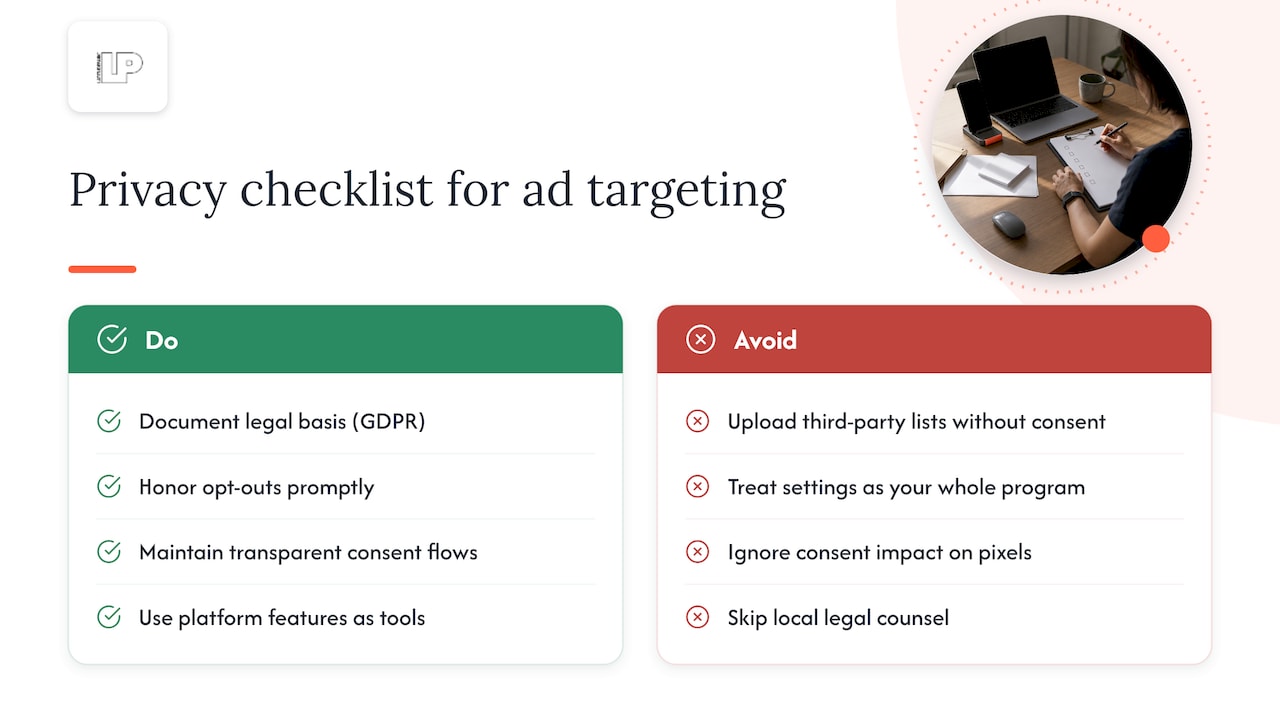
Targeting decisions are not purely a performance question anymore, they are a compliance question. If your audience includes people in the European Union, GDPR requires a documented legal basis for processing personal data used in custom audiences, including customer file uploads and pixel-based retargeting. California’s CCPA and its amendments give residents rights to opt out of the sale or sharing of personal information, which directly affects how you can use website and app data for ad targeting.
Consent banners and cookie preference tools are not just a legal checkbox, they directly affect your pixel’s data quality. A visitor who declines tracking consent will not generate pixel events, which shrinks your retargeting pool and degrades the signal quality Advantage+ depends on. This is one more reason event hygiene and transparent consent flows matter beyond the legal department.
Customer file audiences carry their own obligations: you generally need a lawful basis for having that contact data in the first place, and simply having an email address does not automatically grant permission to use it for ad matching. Document your data sources, honor opt-out requests promptly, and avoid uploading lists acquired from third parties without clear consent trails.
None of this is a substitute for legal counsel familiar with your specific markets and data flows. Treat platform compliance features (consent mode, limited data use settings) as tools that support a privacy program, not as the program itself.
Strategies for Layering and Segmenting Your Audiences
The strongest Instagram targeting strategies rarely rely on one audience type. They layer two or three complementary signals and let each do a specific job rather than asking one audience to carry the whole funnel.
A common structure: a broad or Advantage+ audience for top-of-funnel reach, a custom audience of website visitors for mid-funnel retargeting, and a value-based lookalike for prospecting that mimics your best customers. Each layer gets its own budget and its own success metric, rather than competing against the others inside a single ad set.
Segmentation also means resisting the urge to split audiences too finely. Five ad sets each targeting a slightly different age bracket usually just fragments your budget and starves each one of the volume needed to exit the learning phase efficiently. Two or three well-differentiated segments, each with a distinct value proposition in the creative, tend to outperform a dozen micro-segments chasing marginal relevance gains.
Exclusions tie the whole structure together. Excluding existing customers from prospecting campaigns, and excluding cold audiences from retargeting campaigns, keeps each layer clean and makes your reporting easier to interpret when you are deciding where to shift budget next.
Connecting Instagram Targeting to the Broader Marketing Funnel
Instagram targeting does not exist in a vacuum, and treating it as a standalone channel is one of the fastest ways to waste budget. Top-of-funnel Instagram campaigns should feed into the same data ecosystem as your Google Ads, email, and SEO efforts, since a prospect who sees a broad Instagram ad today might convert through a branded search next week.
Retargeting audiences built from Instagram engagement (video views, profile visits, Reels interactions) belong in your mid-funnel nurture sequence, often alongside email remarketing, rather than isolated in their own silo.
Bottom-funnel Instagram campaigns, built on pixel-based cart abandoners or customer file lookalikes, work best when the offer and landing page match what the shopper already saw earlier in the funnel. Consistency across touchpoints, not just targeting precision, is what actually closes the loop.
Common Pitfalls That Quietly Kill Instagram Targeting Performance
Over-segmentation tops the list. Splitting a modest budget across eight narrow ad sets guarantees each one struggles to reach the conversion volume needed to optimize, and you end up paying a “small audience tax” in the form of higher costs per result.
Ignoring event hygiene is a close second. Duplicate pixel and Conversions API events, missing purchase values, or inconsistent event naming all confuse the algorithm you are relying on to find more buyers.
Other recurring red flags include:
- Editing live ad sets constantly, which resets the learning phase and keeps performance perpetually unstable.
- Stacking too many interest or behavior layers, shrinking the eligible audience until delivery stalls.
- Skipping exclusions, so existing customers see prospecting ads and cold audiences see retargeting offers meant for warmer prospects.
- Judging a test before it reaches a minimum conversion threshold, mistaking normal variance for a real trend.
Most of these pitfalls share a root cause: treating targeting as a one-time setup task rather than an ongoing discipline tied to data quality and measurement.
Using Third-Party Data and Tools Beyond Meta’s Native Options
Meta’s native targeting and measurement tools cover most campaigns, but third-party analytics platforms fill a real gap around event instrumentation and cross-channel attribution. Product analytics tools help you define which in-app or on-site actions actually predict a purchase, which in turn sharpens the custom events you feed back into the pixel and Conversions API. A useful starting point for comparing event-tracking setups is this breakdown of Mixpanel versus Amplitude for event instrumentation, which walks through building a focused proof of concept around a handful of key events rather than instrumenting everything at once.
Customer data platforms (CDPs) can also unify offline and online conversion data before it reaches Meta, improving match rates on customer file audiences and giving value-based lookalikes a cleaner, more complete seed. For brands running complex funnels across paid social and other channels, a broader digital strategy framework, like the one outlined in this guide to digital strategy for modern brands, can help ensure third-party tooling supports a coherent plan rather than adding another disconnected dashboard.
The goal with any third-party tool is the same: better data going into Meta’s optimization engine, not a replacement for it.
What We’ve Learned Running Instagram Campaigns at Scale
We built our approach around a simple principle: let Advantage+ do what it is good at, and use manual controls where the business genuinely needs a hard boundary, not where instinct says to tighten the reins. That hybrid model shows up in how we structure pixel setups, exclusions, and lookalike seeds for clients across different verticals.
Running managed campaigns daily helps catch event-hygiene issues and over-segmentation traps that quietly erode performance before a dip is noticed, which is often the real difference between a campaign that scales and one that plateaus.
— Rusty
How We Set Up and Manage Instagram Ad Targeting for Clients
Getting Advantage+ governance right, customer file hygiene clean, and testing structured correctly takes real time, and most in-house teams are already stretched across a dozen other priorities. We handle full setup: campaign structure, pixel and Conversions API implementation, Advantage+ governance with proper exclusions, A/B test design, and transparent reporting tied to outcomes.
Typical implementations include:
- Pixel and Conversions API implementation with event de-duplication.
- Custom audience and lookalike construction.
- Campaign governance, including exclusions and boundaries.
- Structured A/B testing with KPIs and holdout measurement.
- Regular reporting calls.
If you want a second set of eyes on your current targeting setup, our Facebook and Instagram advertising services are built to start there.
FAQ
What is the difference between Advantage+ and manual targeting?
Advantage+ lets Meta’s algorithm find and prioritize likely converters using your conversion signals, while manual targeting relies on audiences you define by hand (location, demographics, interests). Advantage+ tends to perform best with steady conversion volume, while manual targeting works better for strict brand-safety or niche audience requirements.
How big should a lookalike audience be?
Seed quality, built from recent or high-value converters, matters more than the percentage you choose.
Why did Meta remove some detailed targeting options?
Meta stated it removed or consolidated options that were rarely used, overlapped with other categories, or touched on sensitive topics, as reported by Social Media Today. Meta also reported a median cost-per-conversion improvement in its own testing after removing certain detailed targeting exclusions.
Do I need consent for custom audience targeting?
Yes, using customer data or website activity for custom audiences generally requires a documented legal basis under frameworks like GDPR, and residents covered by CCPA have rights to opt out of data sharing used for ad targeting. Consent also directly affects pixel data quality, since declined tracking reduces the events available for retargeting.
How long should I run a targeting A/B test?
Run the test until each ad set reaches a minimum conversion threshold rather than stopping on a fixed calendar date, since low conversion counts make results unreliable. Keep creative and offer identical between ad sets so any performance difference comes from the targeting change itself.
Sources
- Meta Is Consolidating More of Its Detailed Ad Targeting Options | Social Media Today
- Advertise on Instagram | Instagram for Business
- Every Instagram Ad Targeting Option to Reach Your Audience | WordStream