
The Automation Business Case: How to Prove ROI Before Spending a Dime
Why Building a Business Case for Automation Is the First Step to Getting It Funded
Making a business case for automation means proving — with real numbers — that an automation investment will pay off before you spend a single dollar. Here is what a strong automation business case covers:
- Current state costs — what manual processes are costing you right now
- Financial ROI — payback period, net present value, and cost savings
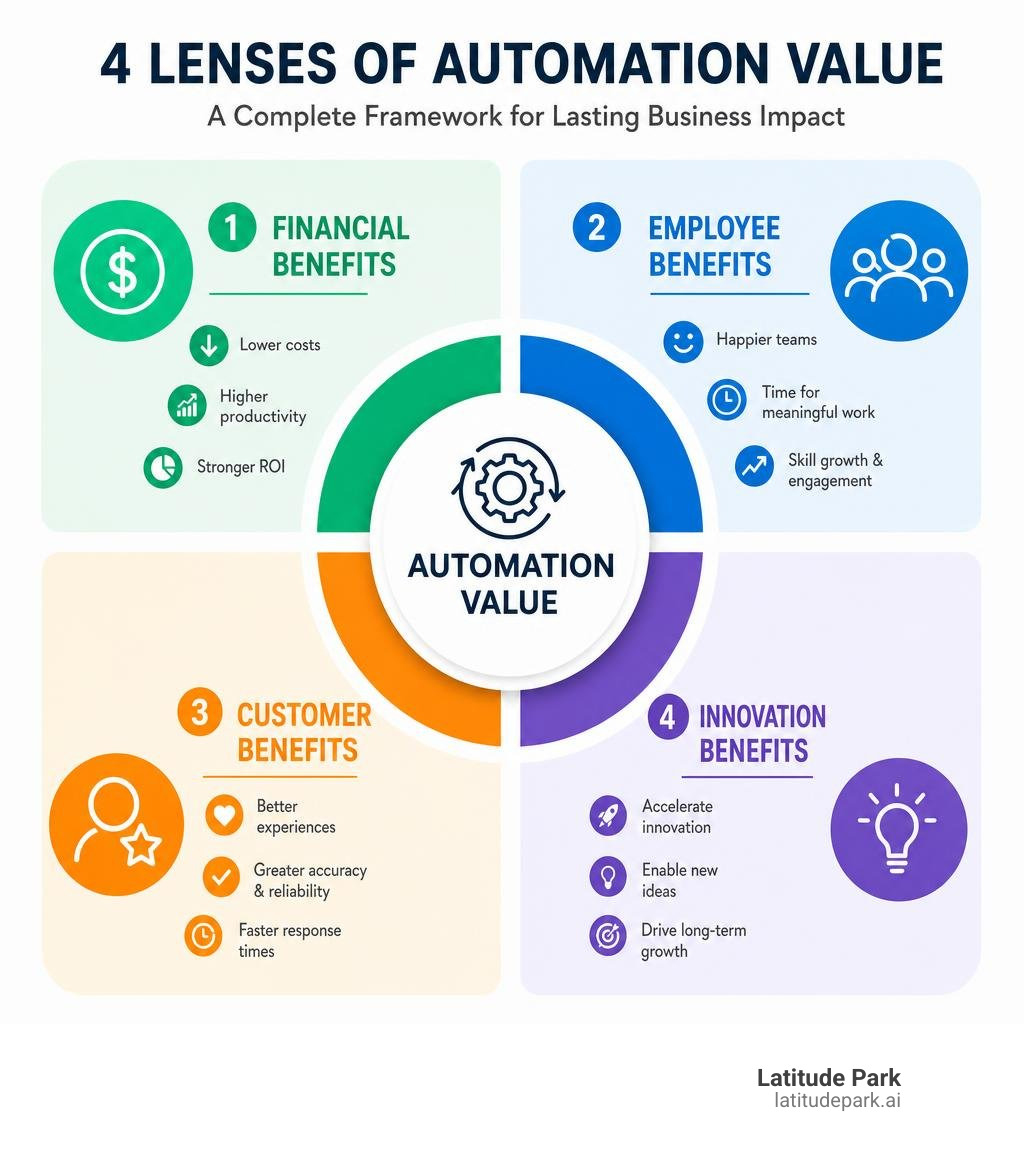
- Non-financial benefits — employee experience, error reduction, customer satisfaction
- Risk assessment — what could go wrong and how to prevent it
- Implementation roadmap — a phased plan with clear milestones
- Strategic alignment — how automation supports your broader business goals
Most organizations know automation could save them time and money. But knowing it and proving it are two very different things.
Finance leaders and executives are under more pressure than ever to justify every technology investment. And automation has a credibility problem — research shows only about 25% of intelligent automation initiatives actually meet their original ROI expectations. That track record makes approval harder to get.
The good news? The numbers, when calculated correctly, are hard to argue with. Companies with manual accounts payable processes spend up to $40 per invoice. With automation, that drops to as little as $1.45. A team processing 5,000 invoices per month could save over $55,000 a year — and typically see full payback within 6 to 12 months.
The challenge is building a business case that executives actually trust.
I’m Rusty Rich, President of Latitude Park, and I’ve spent years helping businesses — including multi-location franchises — cut through operational complexity and justify smart technology investments, including making the business case for automation that gets real budget approved. In this guide, I’ll walk you through exactly how to do it.
Relevant articles related to business case for automation:
- ai tools to automate your business tasks
- automation services for growing businesses
- business automation tools
Why You Need a Business Case for Automation in 2026
In June 2026, the economic landscape demands absolute financial discipline. We are no longer in an era where companies can throw technology at the wall to see what sticks. Executives and CFOs have grown highly skeptical of vague promises like “increased digital agility” or “future-proofing.” They want to see hard numbers, defensible baselines, and clear payback timelines before signing off on any budget.
If you do not build a rigorous, data-backed business case for automation, your project will likely join the pile of unfunded ideas. A well-crafted business case serves as your project’s roadmap, protecting you from common pitfalls while aligning your proposal with what decision-makers actually care about: bottom-line savings, risk mitigation, and scalable business growth.
Furthermore, the “cost of doing nothing” has never been higher. When we look at manual workflows through a modern lens, we realize that relying on manual labor for repetitive tasks is not just slow—it is incredibly expensive. Manual processes create invisible bottlenecks, increase employee burnout, and expose your business to costly transcription and compliance errors.
By failing to automate, you are choosing to absorb these inefficiencies while your competitors scale their operations smoothly. To dive deeper into how to structure these proposals so they survive intense financial scrutiny, check out The IPA ROI Roadmap: How to Build a Business Case That Actually Gets Funded (and Delivers) – ZonFlip.
At Latitude Park, we believe that understanding your operational cost structures is the foundation of growth. Transitioning your workflows from manual chaos to structured digital systems is a prerequisite for scaling. You can read more about how structured digital workflows lay the groundwork for long-term expansion in our guide on how automation services fuel business growth.
Key Elements of a Strong Automation Business Case
To win over skeptical stakeholders, your business case must be structured logically and cover all operational angles. It cannot just be a simple spreadsheet showing labor hours saved. You need a comprehensive framework that addresses the entire lifecycle of the technology.

A bulletproof business case for automation must include:
- A Clear Definition of Business Needs: What specific organizational bottleneck are you trying to solve?
- Strategic Alignment: How does this project support company-wide goals (e.g., growing revenue, improving customer retention, or scaling without adding headcount)?
- A Comprehensive Cost-Benefit Analysis: A detailed breakdown of the Total Cost of Ownership (TCO) compared to the projected lifetime benefits.
- A Realistic Implementation Roadmap: A phased timeline with clear milestones, starting with quick wins and scaling over time.
- Risk Assessment and Mitigation: Identifying potential bottlenecks—such as data quality issues or employee resistance—and explaining how you will manage them.
Defining the Business Case for Automation Objectives
The first step in building your business case is defining your objectives and selecting the right processes to automate. A common mistake is trying to automate highly complex, non-standardized workflows right out of the gate. This almost always leads to delayed timelines, ballooning budgets, and missed ROI targets.
Instead, we recommend starting with high-volume, low-complexity, rules-based processes. These are your “low-hanging fruit.” They allow you to prove the value of automation quickly, build organizational confidence, and secure momentum for larger initiatives.
Before you write a single line of your proposal, you must establish accurate baselines. Do not rely on employee estimates of how long a task takes. Spend a week or two tracking the actual time spent on manual steps, the frequency of errors, and the downstream costs of correcting those mistakes.
To understand the landscape of tools available for these initial workflows, explore our resource on essential automation tools. If you are looking to understand how software robots can mimic human actions to handle these repetitive tasks, check out the ultimate guide to RPA software for non-techies.
Quantifying the Financial ROI of Your Business Case for Automation
When presenting your business case for automation to the CFO, your financial model must be conservative, defensible, and comprehensive.
To calculate the true value of recovered labor, you must use the fully-loaded hourly rate of your employees, not just their base wage. The fully-loaded rate includes employer-side taxes, benefits, insurance, and overhead, which typically ranges from 1.25x to 1.4x of the base salary.
Consider this real-world operational scenario: An HR manager spends an average of 3 hours per day manually transcribing candidate records from an Applicant Tracking System (ATS) to an HRIS. Over 250 workdays a year, that equals 750 hours of highly repetitive manual data entry. By automating this workflow, the business can recover over $103,000 in annualized labor hours that can be redirected to higher-value strategic tasks.
But direct labor savings are only part of the equation. Manual data entry is prone to human error. In that same HR scenario, a single manual transcription error—entering a starting salary as $130,000 instead of $103,000—resulted in a $27,000 overpayment before it was caught. The value of error prevention often exceeds the direct labor savings themselves. You can read the full breakdown of this operational recovery in the case study by How One Ops Team Recovered $103K in Annual Labor Hours With Make Automation – 4Spot Consulting.
For larger enterprise initiatives, the financial returns scale dramatically. According to a commissioned study by Forrester, a composite organization deploying a unified business automation platform achieved a 395% ROI and a Net Present Value (NPV) of $18.66 million over three years, with a payback period of less than six months.
These returns were driven by massive reductions in paper-based documentation costs (which dropped by 95%), clerical automation, and developer productivity gains. You can examine the complete financial breakdown in The Total Economic Impact™ Of IBM Cloud Pak For Business Automation.
Measuring Non-Financial Benefits and Strategic Value
While CFOs focus on the hard financial metrics, other executive stakeholders care deeply about the qualitative, strategic benefits of automation. A truly compelling business case addresses these non-financial variables, which often have a massive compounding effect on the organization’s long-term health.

These strategic benefits include:
- Improved Employee Experience (EX): Forcing skilled employees to perform repetitive, mundane tasks leads to rapid burnout and high turnover. Automation frees your team to focus on creative, strategic, and customer-facing work, which directly boosts technology satisfaction (TSAT) and retention.
- Enhanced Customer Satisfaction (CX): Automated workflows eliminate human delays. Whether it is onboarding a new client, processing a refund, or responding to a support inquiry, automation slashes cycle times and ensures a consistent, high-quality customer experience.
- Operational Agility: Automated systems allow your business to scale up or down instantly to handle demand peaks without the need to scramble, hire, or restructure.
A long-term study on intelligent automation platforms demonstrated that when organizations combine robotic process automation (RPA) with business process management (BPM), the strategic benefits quickly outpace simple labor savings.
For instance, a composite enterprise achieved a 330% ROI and $53.40 million in Net Present Value over three years, with the single largest driver of value being business growth.
By streamlining customer onboarding from 17 days down to just 2 days, the organization improved customer retention by 7% to 8% and increased average order values by 3% to 5%. You can explore this strategic value framework in The Total Economic Impact™ Of SS&C Blue Prism Intelligent Automation Platform.
To see how these principles apply to customer-facing operations, read our guide on the top automated customer engagement tools for 2026.
Mitigating Risks and Choosing the Right Partners
Every technology project carries risk, and executive stakeholders will want to see that you have proactively identified potential failure points and established clear mitigation plans.
One of the most significant decisions you will make is whether to build custom automations in-house or partner with a managed automation provider.
| Factor | In-House Custom Builds | Managed Automation Platforms |
|---|---|---|
| Upfront Cost | Moderate to High (Internal salaries) | Predictable licensing / subscription fees |
| Speed to Value | Slow (Months of development & testing) | Rapid (Weeks, using pre-built integrations) |
| Maintenance & Upkeep | High (Internal team must fix broken APIs) | Low (Handled by the platform/partner) |
| Scalability | Complex (Requires constant recoding) | Seamless (Built to scale across units) |
| Total Cost of Ownership | High (Hidden maintenance over 3-5 years) | Low and highly predictable |
Beyond the build strategy, your business case must account for three common hidden risk factors:
- The Integration Tax: Connecting modern automation tools to legacy ERP or CRM systems can stress internal IT resources. This integration tax can add 20% to 30% to your initial implementation timelines if not planned for upfront.
- Model Drift and Maintenance: Automated workflows are not “set-it-and-forget-it.” When software applications update their user interfaces or APIs, automations can break. You must allocate roughly 15% to 20% of your initial development budget annually for ongoing maintenance and retraining.
- Change Management: Technology is only as good as its adoption. Up to 84% of automation failures stem from organizational and leadership issues rather than software glitches. You must include a structured training and transition plan to help your team embrace their new digital coworkers.
To mitigate these scaling risks, mature organizations establish a Center of Excellence (CoE). A CoE is a cross-functional team responsible for governing automation standards, identifying new opportunities, and ensuring consistent deployment across the business.
To explore the strategic steps required to scale automation safely at an enterprise level, read the resources available at the enterprise automation business case. For a deeper understanding of how modern process frameworks drive this kind of organizational innovation, check out our insights on digital process automation services.
Frequently Asked Questions About Building an Automation Business Case
How quickly can an organization expect to see ROI from automation?
Most well-scoped automation projects achieve a full payback period within 6 to 12 months.
For highly targeted, high-volume workflows, the return can be even faster. For example, deploying autonomous AI agents to handle repetitive enterprise resource planning (ERP) roles can reduce operating costs by 40% to 60% with a deployment time of just two weeks.
You can read about how a major manufacturer successfully replaced 23 manual SAP roles with an autonomous AI workforce by visiting Realbotics | AI Employees for Business & AI Voice Agents for Companies.
What are the most common hidden costs in an automation budget?
The most common hidden costs are data remediation (cleaning up messy, non-standardized manual data before the automation can read it), the integration tax of connecting legacy systems, and ongoing maintenance fees.
Without a realistic buffer—typically 10% to 30% of the project budget—these hidden costs can inflate your Total Cost of Ownership and delay your ROI timeline.
To see how leading organizations budget for and embrace these technologies successfully, read our article on companies embracing automation.
How does a Center of Excellence (CoE) support automation scaling?
A Center of Excellence (CoE) provides the governance, best practices, and technical guardrails needed to prevent “automation chaos.”
By centralizing the development and monitoring of your workflows, a CoE ensures that different business units do not build redundant tools, that security standards are strictly maintained, and that the organization can scale its automation footprint from a single pilot to hundreds of active processes smoothly.
To learn more about structuring these advanced operational workflows, check out our business automation workflow knowledge center.
Conclusion
Building a compelling business case for automation is not just about getting a budget approved—it is about setting your entire organization up for sustainable, scalable success. By defining clear baselines, calculating conservative financial returns using fully-loaded rates, accounting for hidden risks, and highlighting strategic non-financial benefits, you can present a proposal that even the most skeptical CFO will confidently support.
At Latitude Park, we understand how to translate complex operational strategies into measurable business growth. While we specialize in franchise marketing—helping multi-location franchises scale through highly tailored Meta (Facebook) advertising campaigns—we know that true business growth requires efficiency at every level of your organization. When your back-office operations are automated and streamlined, you free up the capital and focus needed to dominate your market.
If you are ready to stop wasting valuable hours on manual workflows and start scaling your business, explore our small business automation tools guide to find the right platforms for your business.
Let us help you turn your operational bottlenecks into your greatest competitive advantages. Reach out to us today at Latitude Park to learn how we can help you streamline your marketing and operations for multi-location success!