
Stop Chasing Followers and Start Building Real Brand Authority
Why Most Businesses Get Stuck Chasing Visibility Instead of Trust
To build brand authority means to become the name your target audience trusts most in your category — not just the name they recognize. It is the difference between being chosen and being considered.
Here is a quick breakdown of how to do it:
- Define your niche — stop trying to be everything to everyone
- Create original, expert-driven content — research, data, and real insights beat generic posts
- Establish entity recognition — make sure search engines and AI systems know who you are
- Earn third-party validation — editorial coverage, reviews, and backlinks from credible sources
- Stay consistent — same messaging, same voice, same visual identity across every channel
- Measure the right signals — track brand search volume, earned mentions, and AI citations, not just follower counts
You can rank on page one, flood LinkedIn with posts, and still lose deals to competitors who simply feel more credible. That gap between visibility and trust is what brand authority closes.
The challenge is especially real for franchise marketing managers. When you are running campaigns across dozens of locations, inconsistent messaging quietly erodes the trust your brand worked hard to earn. Every mismatched logo, off-tone ad, or unverified Google listing chips away at authority — location by location.
And in 2026, the stakes are higher than ever. AI search engines like ChatGPT, Perplexity, and Google’s AI Overviews now cite a mean of just 3.4 domains per answer, compared to 7.3 sources in traditional search results. The brands that get cited are not always the biggest — they are the ones that have built the clearest, most consistent, and most validated presence online.
Authority is not a vibe you wait for. It is a system you build.
I’m Rusty Rich, President and founder of Latitude Park, a full-service digital advertising agency I’ve grown since 2009 by helping small businesses and franchises build brand authority through strategic SEO, content, and multi-channel advertising. In this guide, I’ll walk you through the exact framework we use with clients to turn visibility into trust — and trust into revenue.
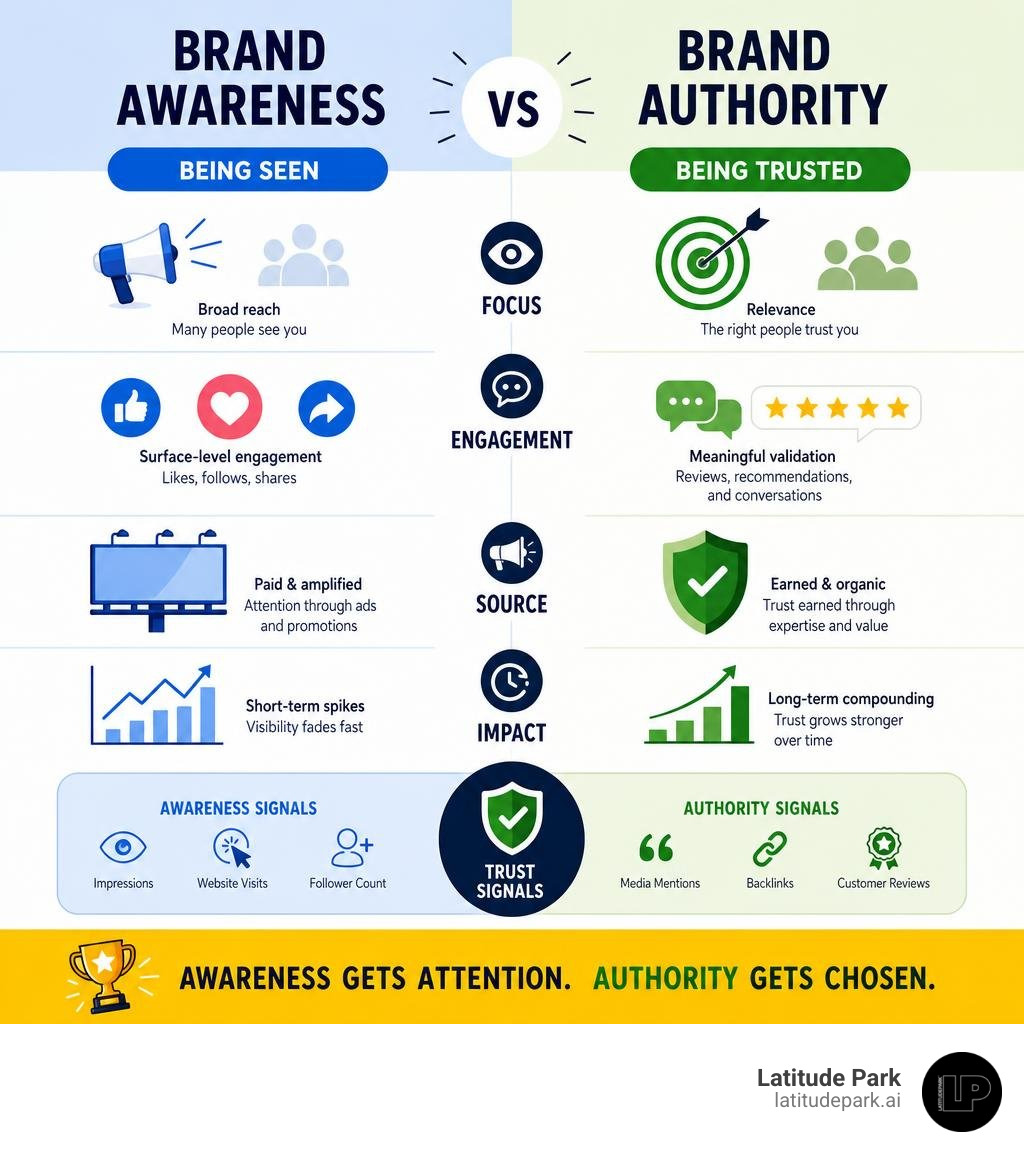
Build brand authority terms you need:
What is Brand Authority and Why Does It Matter in 2026?
Brand authority measures the level of trust, credibility, and influence that a business has established within its industry. It is the degree to which your target audience, industry peers, and search algorithms view your organization as a reliable and definitive source of information.
While it is easy to confuse this concept with other common digital marketing terms, brand authority is fundamentally different from both domain authority and topical authority:
- Domain Authority (DA): This is a proprietary search engine ranking score (developed by platforms like Moz) that predicts how likely a website is to rank on search engine result pages (SERPs). It is primarily a technical measure of a website’s backlink profile strength.
- Topical Authority: This refers to a website’s earned reputation for depth of knowledge on a specific subject. It is achieved when you publish a comprehensive, tightly linked cluster of content covering a topic from every angle. To understand how this works, you can explore How to Build Topical Authority in the AI Search Era (7 Steps).
- Brand Authority: This is the overarching commercial reality. It is not just about having a powerful website (DA) or writing deeply about a topic (Topical Authority). It is about whether human buyers and AI engines recognize your business as a trusted, verified entity that stands for a specific solution.
In 2026, building this level of trust is critical. As traditional search engines evolve into AI-powered answer engines, having a strong digital footprint is no longer optional. If you want to dive deeper into establishing this foundation, check out our Building Strong Online Presence 2024 Guide.
The Core Pillars of Brand Authority
True brand authority is built on three core pillars that work in tandem to establish market leadership:
- Expertise: The depth of knowledge, original insights, and unique intellectual property your brand possesses. This is demonstrated when you move away from regurgitating industry platitudes and instead share proprietary data, named frameworks, and contrarian perspectives backed by real-world evidence.
- Reputation: The external validation of your expertise. This is shaped by what independent third parties say about you. Customer reviews, industry awards, editorial coverage, and peer recommendations are the building blocks of a stellar market reputation.
- Influence: Your brand’s ability to drive action and shape conversations within your niche. When your insights are naturally quoted by journalists, shared on social media, or used as benchmarks by other businesses, you have achieved genuine influence.
For a detailed look at how these elements translate into digital signals, read more about Brand Authority Signals: What They Are and How to Build.
Brand Authority vs. Brand Awareness
Many businesses make the costly mistake of treating brand authority and brand awareness as the same thing.
- Brand Awareness is about reach. It answers the question, “Do people know we exist?” It is a metric measured in impressions, views, and follower counts. While awareness can be bought through massive ad spend, it does not guarantee that anyone actually trusts you.
- Brand Authority is about respect. It answers the question, “Do people trust us to solve their problem?” It is measured in trust-driven actions, such as direct inquiries, high-quality inbound leads, and shortened sales cycles.
When you focus on authority over mere awareness, your business gains immense pricing power. Customers are willing to pay a premium for a trusted expert, whereas they will haggle over price with a brand they only recognize. Furthermore, authoritative brands experience much faster sales cycles because the prospect has already resolved their trust issues before the first sales call even begins. For a deeper analysis of this commercial distinction, refer to How To Build Brand Authority: Ultimate Guide 2026.
How to Build Brand Authority in the Era of AI Search
The search landscape has fundamentally shifted. We are no longer just optimizing for blue links on a page; we are optimizing for Large Language Models (LLMs) like ChatGPT, Gemini, Claude, and Perplexity. This new discipline, known as Generative Engine Optimization (GEO), requires a completely different approach to content and technical optimization.
AI search engines do not just count backlinks; they look for entities. They crawl the web to find a consensus of trusted sources that validate your brand’s expertise. If your brand is not recognized as a distinct, verified entity, these systems will simply ignore you.
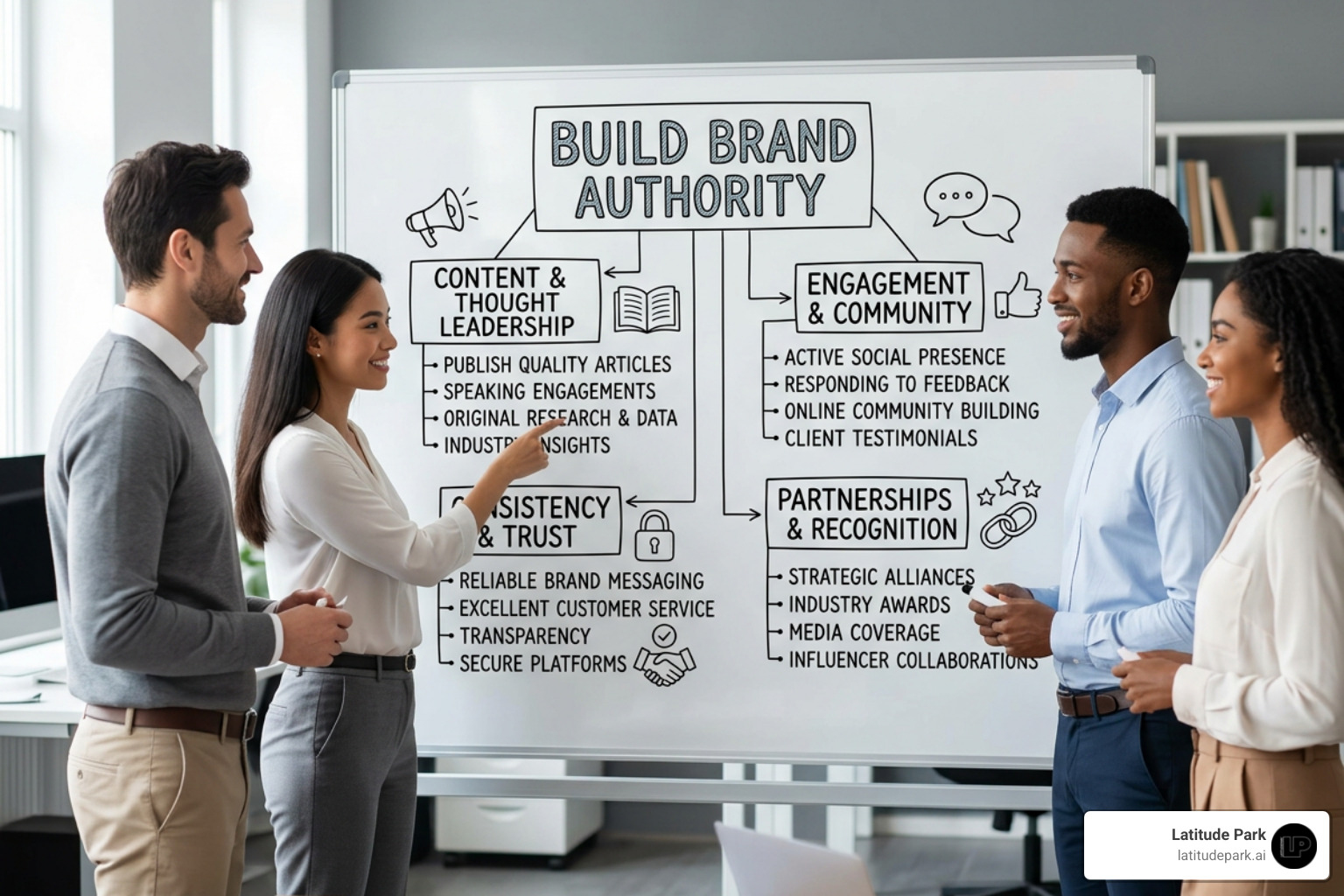
To ensure your business is highlighted when users ask AI engines for recommendations, you must understand How to Build Brand Authority That AI Engines Will Cite | Digital Strategy Force.
Engineering Content to Build Brand Authority
To win in the AI search era, content must be engineered for both human readers and machine retrieval. AI engines are designed to surface highly credible, factual, and unique information. According to recent generative engine optimization benchmarks, simple shifts in how you present your content can yield massive visibility lifts:
- Adding Quotations: Incorporating credible quotes from internal or external subject matter experts produces a 40% lift in AI visibility.
- Integrating Statistics: Including hard data and statistics in your content results in a 30% to 37% lift in generative engine visibility.
- Citing Sources: Transparently referencing primary sources and linking to them provides a 30% lift in visibility.
- Fluency and Technical Depth: Writing with high linguistic fluency and using precise, category-specific technical terms can boost AI retrieval rates by up to 30% and 17% respectively.
This means that thin, AI-generated content that merely summarizes existing web pages will not cut it. AI engines prioritize “information gain”—content that adds new, unique value to the digital ecosystem. For a complete blueprint on optimizing for this dual-engine landscape, read Authority Branding (ABC): Rank in AI Search & Google.
Establishing Unambiguous Entity Recognition
Before an AI engine can cite your brand, it must be 100% certain that your brand exists as a single, unambiguous entity. If your business is referenced inconsistently across the web (e.g., using different names, addresses, or descriptions), AI crawlers will get confused and fail to connect the dots.
You can establish clear entity recognition by taking the following steps:
- Define a Canonical Name and Description: Choose one exact spelling of your brand name and one core description, and use them consistently across your website, social media, and directories.
- Implement Organization Schema Markup: Use structured data code on your website to explicitly tell search engines who you are, what you do, and where your official profiles live.
- Leverage sameAs Links: Within your schema markup, use
sameAstags to link your website directly to your official social profiles, Wikipedia pages, or major industry listings. This helps search engines resolve your brand to a single node in their Knowledge Graphs.
For a practical step-by-step timeline on setting up this technical foundation, consult How to Build Brand Authority Online: The Founder Playbook.
A Systematic Playbook to Build Brand Authority Through Content and Social Proof
Building authority requires a structured system rather than sporadic content creation. You must produce compounding assets—content that remains valuable and continues to attract links and citations for years, rather than social media posts that expire in 48 hours.
The most powerful compounding asset you can create is original research. By surveying your customers, analyzing anonymized proprietary data, or conducting industry benchmarks, you create a primary data source. When other writers and journalists search for statistics to back up their claims, they will cite your study, naturally building your backlink profile and brand authority.
| Content Type | Primary Authority Signal | AI Search Impact | Human Buyer Impact |
|---|---|---|---|
| Original Research & Data | Primary source citations, natural backlinks | Extremely High (highly citable) | High (establishes industry leadership) |
| Thought Leadership / POVs | Unique perspectives, proprietary frameworks | High (drives brand-specific queries) | Very High (builds deep trust and connection) |
| In-Depth Case Studies | Proof of results, customer success stories | Medium (validates specific solutions) | Extremely High (drives conversions) |
| Evergreen Hub Guides | Comprehensive topical coverage | High (builds topical authority) | High (serves as a go-to resource) |
To support this content engine, you must actively manage how your brand is perceived across social channels. Learn more about this by reading our guide on Brand Reputation Management Social Media.
Leveraging Third-Party Validation and Reviews
While your own content is crucial, what others say about your brand carries far more weight than what you say about yourself. This is why earned media, digital PR, and customer reviews are the ultimate authority accelerators.
- Earned Media & Digital PR: Securing editorial mentions, guest columns, or podcast appearances on high-authority industry platforms signals to both Google and AI engines that your brand is a trusted player.
- Customer Reviews & Testimonials: Reviews are not just conversion boosters; they are critical trust signals. In fact, 71% of consumers read online reviews before making a purchase.
By systematically collecting and showcasing client feedback, you transform subjective marketing claims into objective facts. For local and multi-location businesses, mastering this process is essential. Discover how to win this battle with The Essential Guide to Winning Local Reputation Marketing.
Strategic Tactics to Build Brand Authority Across Channels
To maximize your authority, you must distribute your expert insights across a clean, multi-channel platform stack:
- LinkedIn Distribution: Don’t just post updates; share deeply detailed breakdowns of your frameworks, client wins, and lessons learned. Take your long-form articles and extract bite-sized, actionable insights for your professional network.
- Video Channels: Record short, conversational videos explaining complex industry challenges. Video adds a human face to your brand, which builds trust much faster than text alone.
- Guest Blogging: Write highly detailed, original articles for reputable publications in your niche. Ensure these articles include your verified author bio and links back to your core content hubs.
- Industry Events: Speak at local business groups, virtual webinars, or major industry conferences. Positioning your leadership team on stage immediately elevates your brand to category-leader status.
To see how your competitors are positioning themselves across these channels, you can conduct a structured analysis using our guide on Social Media Competitor Analysis How Why and What You Can Learn From It.
Maintaining Brand Consistency Across Multi-Location Networks
For franchise systems and multi-location businesses, building brand authority comes with a unique set of challenges. While a single-location business only has to manage one digital footprint, a franchise must coordinate branding across dozens, hundreds, or thousands of locations.
If your local partners are publishing off-brand graphics, using inconsistent messaging, or failing to respond to local reviews, your national brand authority will suffer.

Consistency is the bedrock of trust. To maintain a unified front, you must establish clear guidelines that govern both visual and verbal identity across every touchpoint. For a deeper look at why this matters, read The Power of Consistent Branding Across Franchise Locations.
Overcoming the Fragmented Entity Problem in Franchises
When search engines and AI models crawl the web, they often struggle to understand the relationship between a parent franchise brand and its individual local branches. If local listings are set up incorrectly, it creates a “fragmented entity” problem, which dilutes your overall search visibility.
To solve this problem, franchises must implement a rigorous local optimization strategy:
- Local Schema Markup: Every local location page on your website should feature specific
LocalBusinessorProfessionalServiceschema that links back to the main franchise organization. - Consistent Descriptors: Ensure that local directory listings (Google Business Profile, Apple Maps, Yelp) use a standardized naming convention and clear, consistent business descriptions.
- Brand Monitoring: Actively monitor local mentions, reviews, and social media pages to ensure compliance with national brand standards.
To keep your entire network aligned, check out these essential resources:
- Consistent Franchise Branding Excellence
- Franchise Brand Consistent Materials
- Franchise Brand Consistency
- Mastering Social Listening Latitude Park
How to Measure and Track Your Brand Authority Over Time
You cannot manage what you do not measure. Because brand authority is a commercial asset rather than a single technical metric, tracking it requires looking at a combination of search, reputation, and engagement signals.
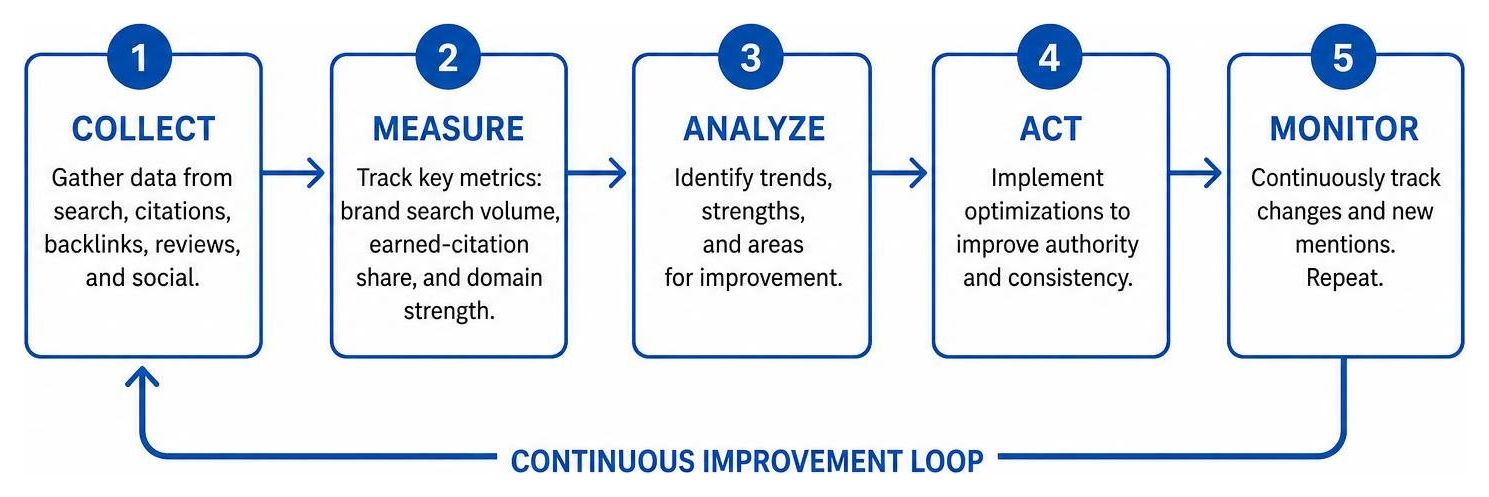
Here are the key metrics you should track monthly to measure your progress:
- Brand Search Volume: Track how many people are searching for your exact brand name (or your brand name + a keyword, e.g., “Latitude Park franchise marketing”) in Google. An upward trend here is a direct indicator of growing brand authority.
- Earned-Citation Share: Measure the proportion of your brand’s AI citations that come from independent, off-site sources (like news articles or review sites) rather than your own website.
- Backlink Profile & Domain Strength: Monitor the growth of high-quality, unsolicited backlinks from authoritative websites in your industry.
- Share of Voice (SOV): Analyze how often your brand is mentioned in industry conversations, media coverage, and social media channels compared to your competitors.
To keep a close ear to the ground, implement a structured brand monitoring process. You can learn how to set this up by reading Whos Saying What the Guide to Brand Monitoring.
Frequently Asked Questions About Brand Authority
How long does it take to build brand authority?
Building meaningful brand authority is a long-term investment. While you can secure quick wins within 30 to 90 days by fixing entity inconsistencies, updating your schema markup, and launching targeted PR campaigns, true category-leading authority typically takes 12 to 24 months of consistent output to solidify. Because authority signals compound over time, the early efforts you make today will pay dividends for years to come.
Can small businesses compete with established brands for authority?
Absolutely. In fact, small businesses often have a distinct advantage because they can be highly niche and deeply human. While large corporations must please everyone and often write bland, committee-approved content, a small business can take a bold stance, share unique practitioner insights, and build deep, localized trust with a specific target audience.
What is the single highest-leverage tactic for AI search visibility?
The single highest-leverage tactic is earned media backed by clean entity data. AI models are trained on high-authority publications, trusted databases, and community platforms like Reddit. When independent, high-DR (Domain Rating) sites repeatedly mention and link to your brand in relation to your core topics, AI engines quickly learn to trust and cite your business in their generated answers.
Conclusion
At Latitude Park, we know that you cannot build a sustainable business on empty follower counts or fleeting social media trends. Real growth requires building a brand that both human buyers and digital search engines trust implicitly.
As specialists in franchise marketing and Meta advertising, we help multi-location businesses navigate the complex digital landscape to build consistent, high-impact campaigns that drive real commercial results. We help you eliminate the fragmented entity problem, unify your local marketing efforts, and build the compounding authority your brand needs to dominate the search results in 2026 and beyond.
Ready to turn your online reputation into your strongest customer acquisition channel? Get started with Latitude Park’s Review Management Services today, and let’s start building an authority engine that drives predictable revenue for your business.