
Stop wasting money on the wrong press release distribution service
Is Your Press Release Budget Actually Working for You?
Press release distribution is the process of sending your company’s news to journalists, media outlets, and online networks so more people see it. Here’s a quick breakdown of what it involves and why it matters:
| What It Is | Why It Matters |
|---|---|
| Syndicating news to media outlets and newsrooms | Builds brand credibility and earned media coverage |
| Reaching journalists via newswires or direct email | Gets your story in front of people who can amplify it |
| Publishing on news sites and aggregators | Creates backlinks and boosts search visibility |
| Targeting by industry, region, or audience | Ensures the right people see your announcement |
The problem most businesses run into is simple: they pay for distribution without knowing what they’re actually getting. Some services charge over $1,000 per release and reach 500,000+ outlets. Others charge $49 and quietly push your news to a handful of low-authority directories. The gap between those two outcomes is enormous — and so is the gap in price.
For franchise marketing managers, this gets even more complicated. You’re not just distributing one release. You’re coordinating messaging across multiple locations, trying to keep the brand voice consistent while still making each market feel local. Picking the wrong service doesn’t just waste money — it wastes the entire campaign.
This guide cuts through the noise. We compare the top press release distribution services on reach, targeting, pricing, SEO impact, and AI visibility so you can make a confident, informed decision.
I’m Rusty Rich, President of Latitude Park, a full-service digital advertising agency where I’ve helped small businesses and multi-location franchises use press release distribution as a measurable part of their broader marketing strategy. Let’s get into it.
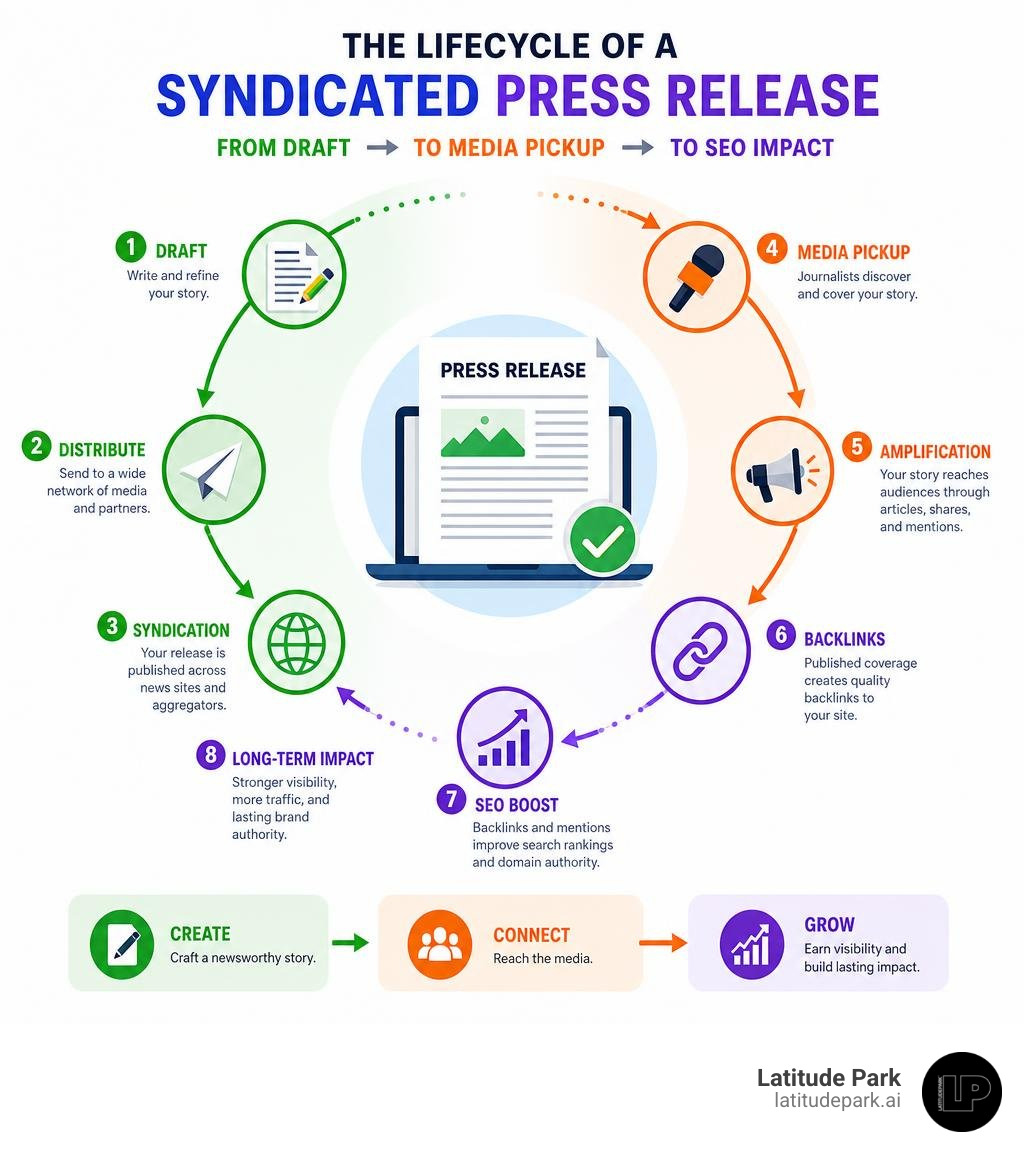
Press release distribution terms you need:
Understanding Modern Press Release Distribution
The landscape of media outreach has shifted dramatically. If you picture a PR professional standing next to a fax machine blasting out paper sheets to a smoky newsroom, it is time to update that mental image. Today, distributing news is a highly digital, multi-channel process that blends traditional syndication with sophisticated digital marketing.
When we talk about modern distribution, we are talking about the strategic process of sending your news announcement out to a vast network of media outlets, search engines, and journalists simultaneously. Rather than pitching a single reporter at a local newspaper, you are leveraging syndication networks to place your story on hundreds of authoritative websites overnight.
This process is critical for establishing brand visibility and building long-term media relations. When a journalist is researching a story, they do not just wait for pitches to land in their inbox; they actively search trusted wire databases. If your company has a steady stream of well-optimized, professional announcements available, you are much more likely to be found.
To make this work, your news must be structured correctly. If you are new to the formatting, our PR Press Release Complete Guide covers the essential building blocks, including datelines, boilerplates, and media contact info. The goal is to make your news as easy as possible for a busy editor to copy, paste, and publish. When you do this consistently, you can Stop Being a Secret and Start Getting Publicity Today.
The Core Benefits of a Press Release Distribution Service
Why do businesses continue to budget for these services year after year? The answer lies in three main pillars: earned media, instant credibility, and brand authority.
- Earned Media at Scale: Unlike paid advertising, where the moment you stop paying is the moment your leads dry up, earned media has a compounding effect. A single syndicated release can catch the eye of an industry blogger or a trade magazine editor, leading to an organic feature article that drives traffic for years.
- Instant Credibility: Having your company announcement published on trusted, household-name news platforms instantly elevates your brand. When potential clients or franchise partners search your company name, seeing your news syndicated across major networks builds immediate trust.
- Enhanced Brand Authority: Consistently sharing milestones—such as product launches, executive hires, or community initiatives—signals to the market that your business is active, growing, and influential.
To explore how these benefits fit into a broader, comprehensive public relations strategy, check out our PR Services Complete Guide.
Traditional Newswires vs. Direct Media Pitching
One of the most common points of confusion for businesses is deciding whether to use a traditional newswire service or to handle media outreach manually via email.
Traditional newswires are automated syndication networks. When you submit a release, it is blasted out to thousands of newsrooms, databases, and websites simultaneously. It guarantees that your release will be published on a set number of partner websites (often between 200 and 800+ sites) within hours. It is fast, broad, and highly efficient for building an online footprint.
Direct media pitching, on the other hand, is highly targeted and relational. It involves using a media database to find specific journalists who cover your niche, and then sending them personalized, individual emails.
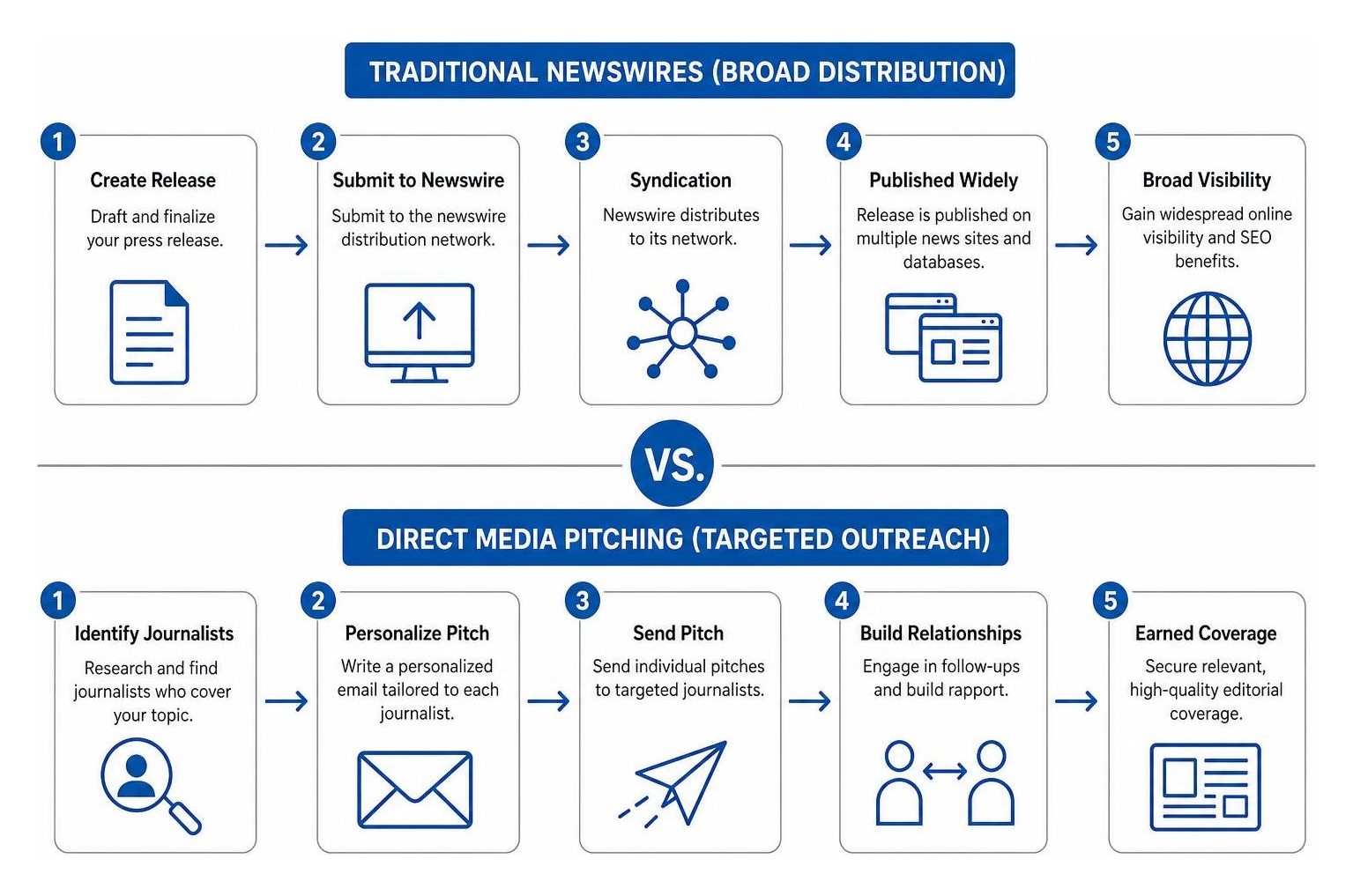
While newswires excel at rapid syndication and broad digital visibility, direct pitching is far better for securing deep, narrative-driven editorial coverage. In most successful marketing campaigns, these two methods are not mutually exclusive. Instead, they are used together to maximize both immediate online presence and high-value media relationships. We break down these differences further in our guide on Digital PR vs Press Release.
How to Choose the Best Press Release Distribution Service
With dozens of distribution services competing for your marketing dollars in July 2026, finding the right platform can feel overwhelming. If you make the wrong choice, you risk spending thousands of dollars on a service designed for Fortune 500 investor relations, or conversely, saving a few bucks on a budget service that syndicates your news to spammy, unindexed link farms.

To avoid these costly mistakes, you need to align your campaign goals with the service’s specific capabilities. We have written an in-depth survival guide on How to Pick a Press Release Distribution Service Without Losing Your Mind to help you navigate this exact process. Additionally, understanding standard market rates is crucial before signing any contracts; you can review our breakdown in The Transparent Guide to PR Agency Pricing and Packages.
Evaluating Reach, Targeting, and Pricing Tiers
When evaluating any press release distribution service, there are three main variables to consider: geographic targeting, industry beats, and pricing structures.
Instead of looking at individual brands, it is more helpful to understand the different tiers of distribution networks available on the market:
- Enterprise Newswires: These are the gold standard for public companies, enterprise brands, and investor relations. They reach tens of thousands of media outlets, newsrooms, and global databases, offering secure, regulatory-compliant networks. However, they come with premium price tags, often starting at $1,000 or more per national release, plus annual membership fees.
- Mid-Tier Syndicators: A highly popular option for small businesses and growing franchises. These services partner with major national networks to distribute your news at a fraction of the cost. They offer excellent reach to journalists, bloggers, and regional news sites, with transparent flat-rate packages typically ranging from $300 to $700.
- SEO-Centric Platforms: These modern services focus heavily on digital visibility, search indexation, and link building. They distribute to hundreds of digital media outlets and often include writing assistance or guaranteed permanent placements, with packages starting around $300 to $600.
- Budget & Regional Services: Built for startups, local businesses, or highly targeted regional campaigns. These pay-as-you-go or low-cost options allow you to target specific local markets or online directories starting as low as $49, scaling up depending on the level of national syndication you require.
To dig deeper into the mechanics of these networks, read our analysis of PR Wire Services.
Free vs. Paid Press Release Distribution Options
Is it actually worth paying for a distribution service when there are free options available? For any business serious about brand authority and search visibility, the short answer is yes.
While free services can be tempting for tight budgets, they come with heavy limitations. To help you weigh your options, we have compiled a direct comparison of what you actually get:
| Feature | Free PR Distribution | Paid PR Distribution |
|---|---|---|
| Guaranteed Syndication | Extremely limited; often only published on the host’s own directory. | Guaranteed placement on 200 to 800+ real, high-authority news sites. |
| Journalist Reach | Virtually none; journalists do not search free directories for stories. | Direct distribution to major newsrooms (AP, Reuters) and targeted opt-in media lists. |
| SEO & Link Quality | No-follow or unindexed links on low-authority, spam-heavy domains. | High-quality, contextually diverse links (often dofollow depending on the partner network). |
| Editorial Review | Automated or non-existent; high risk of formatting errors. | Professional, accredited editors review and format your release before it goes live. |
| Multimedia Support | No images or video allowed, or requires a heavy upgrade fee. | Seamless integration of high-resolution images, videos, and custom logos. |
If you are operating on a strict budget, you can explore the top free options in our guide to Free PR Release Websites. However, if your goal is to build genuine authority and secure clean search indexation, we highly recommend investing in Paid PR Sites that protect and elevate your brand image.
The SEO Impact: Backlinks, Visibility, and AI Search
For years, digital marketers have debated the direct search engine optimization (SEO) value of press releases. Some claim they are a magic bullet for link building; others argue that search engines ignore them entirely. The truth in July 2026 lies somewhere in the middle: when used strategically, press release distribution is an incredibly efficient tool for building brand authority, securing rapid indexation, and diversifying your backlink profile.
To maximize these search benefits, your website must be prepared to receive the traffic and authority flowing from your campaigns. We recommend reading our guide on How to Optimize Your Website for Better PR Results to ensure your landing pages are built to convert this highly qualified traffic. It is also important to follow search engine best practices; Google’s own spam policies for Google web search make it clear that links should not be used in manipulative ways.
Leveraging Syndication for Search Engine Optimization
The primary SEO benefit of a syndicated press release is the rapid acquisition of branded mentions and contextual backlinks from high-domain-authority websites.
When a major newswire syndicates your release, your news is published on real, established media sites. These sites carry massive domain authority, meaning search engines crawl them constantly. If your release contains a link to your website, search engines will discover, crawl, and index that link within hours.
While many syndicated links are set to “nofollow” by default to comply with search engine guidelines, they still hold immense value. A natural, healthy backlink profile consists of a mix of dofollow and nofollow links. Furthermore, some modern, SEO-focused distribution networks guarantee a set number of permanent dofollow backlinks (ranging from 30 to 80+ depending on the tier) on real publisher sites.
These high-quality branded mentions signal to search engine algorithms that your business is a legitimate, active authority in your space. For a deeper dive into how to structure these links safely, read our 5 Golden Rules for Building PR Backlinks. And if you are wondering about the logistics of scaling your campaigns, we answer a common industry question in Can We Post Through Multiple PR Sites.
Answer Engine Optimization (AEO) and the SOAR Framework
In July 2026, SEO is no longer just about ranking on page one of Google. We are in the era of Answer Engine Optimization (AEO). Generative AI engines like ChatGPT, Gemini, and Claude are actively reshaping how consumers find information. These engines do not just display a list of blue links; they interpret, prioritize, and decide which sources to cite directly in their conversational answers.
To ensure your brand is cited by these AI models, you must optimize your press releases for machine readability. This is where frameworks like the SOAR Content Framework™ become essential:
- Structure: Present your news in a clean, highly structured format (using clear headings, bullet points, and standard tables) so AI scrapers can easily parse the data.
- Originality: Focus on unique, first-party data, proprietary research, or original quotes that cannot be found anywhere else online.
- Authority: Publish on trusted, high-authority syndication networks to signal to AI models that your content is credible and verified.
- Recency: Maintain a consistent cadence of news releases to signal that your business is highly relevant and active in real-time.
By aligning your distribution strategy with these AI-friendly signals, you dramatically increase the likelihood of your brand being cited in conversational search results. To see how modern technology is simplifying this process, read about how PR10x Revolutionizes Press Release Creation with New AI-Powered Platform.
Risks, Drawbacks, and Measuring PR Success
While press release distribution offers incredible marketing opportunities, it is not without its risks and potential pitfalls. To run a successful campaign, you must understand both the limitations of the medium and how to accurately measure your return on investment.
Before launching any major campaign, it is vital to establish a clear internal communication plan and crisis management protocol. You can find our top tips on managing these internal workflows in Managing Public Relations.
Potential Pitfalls of Mass Syndication
The biggest risk of modern PR distribution is falling into the trap of low-quality, automated mass syndication.
If you use a low-cost, unvetted service, your release may end up published on hundreds of low-quality “scraper” sites or spam directories. Search engines are highly sophisticated; they can easily distinguish between a genuine news publication and a link farm designed solely to manipulate search rankings. If your brand is consistently associated with these low-quality directories, it can actually harm your search visibility and damage your professional Press Relation efforts.
Additionally, you must remember that press release distribution does not guarantee organic media coverage. A newswire ensures your release is published on partner sites, but it cannot force a journalist to write an original, editorial feature about your business. If your news is poorly written, overly promotional, or lacks a genuine “hook,” it will simply get lost in the noise of high media saturation.
Key Metrics to Track Your Return on Investment
To ensure you are not wasting your marketing budget, you must track the performance of every release. Most premium distribution services provide detailed reporting dashboards within 24 to 48 hours of your release going live.
Here are the key metrics you should focus on to measure your campaign’s success:
- Proof-of-Placement Links: A comprehensive list of the exact URLs where your release has been syndicated. Verify that these are real, high-quality news sites.
- Audience Views & Impressions: The estimated number of times your release was displayed to users across the syndication network.
- User Engagement: Active interactions with your release, such as multimedia clicks, document downloads, or social media shares.
- Referral Traffic: Use tracking links (like UTM parameters) to measure the exact amount of website traffic driven directly from your syndicated releases.
- Organic Search Visibility: Track whether your brand name or target keywords see an increase in search rankings and organic impressions in the weeks following a campaign.
For a step-by-step framework on how to transition your media outreach from basic submissions to a high-yielding, measurable marketing channel, explore our guide on Press Release Distribution from Zero to Hero in Media Outreach.
Frequently Asked Questions About Press Release Distribution
What is the difference between a newswire and direct email pitching?
A newswire service is an automated network that syndicates your press release to hundreds of partner websites and news databases simultaneously. It guarantees broad digital visibility and rapid backlink acquisition. Direct email pitching involves researching specific journalists who cover your industry and sending them highly personalized pitches. While newswires are excellent for syndication and SEO, direct pitching is required to secure deep, original editorial coverage.
Can press releases guarantee media coverage?
No. While paid distribution services guarantee that your release will be published on their partner syndication networks, they cannot guarantee that a journalist will write an original, organic news story about your business. Securing earned editorial coverage requires a compelling, highly newsworthy hook that stands out in a crowded media landscape.
How do search engines treat links in syndicated press releases?
Most reputable search engines treat syndicated press release links with care to prevent spam. While many networks default to “nofollow” attributes to comply with webmaster guidelines, these links still drive valuable referral traffic and signal brand authority. Some modern, SEO-centric distribution services offer a balance by securing permanent, contextually relevant “dofollow” links on verified, high-authority publisher sites.
Conclusion
At the end of the day, press release distribution is not a one-size-fits-all marketing tool. If you are a small business looking for local buzz, spending $1,500 on a national enterprise wire is a waste of money. Conversely, if you are a multi-location brand looking to build serious national authority, relying on $49 budget directories will yield virtually zero results.
At Latitude Park, we specialize in helping businesses cut through the noise and maximize their marketing budgets. Our expertise lies in crafting tailored campaign structures that address the complex, highly localized needs of multi-location franchise businesses. Whether we are building targeted Meta advertising strategies or aligning your digital PR with local search visibility, we ensure every dollar you spend is working toward measurable, long-term growth.
Stop wasting your marketing budget on campaigns that get lost in the digital void. Let us help you build a cohesive, high-performing strategy that drives real brand authority.
Stop wasting money and maximize your brand authority today with Latitude Park