
A small business website in the US can cost anything from a few hundred dollars a year to five figures, and the spread is not random. It comes down to who builds it, how many pages and features it needs, and what you pay to keep it alive afterward. If you want one rule: budget for the build, then budget again for the next twelve months. The build is the part everyone quotes. The next twelve months are the part that bites.
This guide breaks the cost into the three paths owners actually choose, the line items that sneak in, and a practical way to decide how much your business should spend. We’re an AI-driven marketing agency that builds and promotes sites, so we’ll also tell you where we think money is wasted.
Table of Contents
- The short answer: three paths, three very different bills
- Path 1: DIY website builders
- Path 2: Hiring a freelancer
- Path 3: Hiring an agency
- What a website cost is made of
- The costs that surprise owners
- Why speed belongs in your budget
- How much should you spend? A decision framework
- Is $1,500 a good price for a website?
- Our perspective: stop buying websites, start buying outcomes
- Working with us on the build and the traffic
- Questions to ask before you sign anything
- FAQ
- Sources
The short answer: three paths, three very different bills
Most small business sites are built one of three ways. The prices below are patterns, not quotes, and the only hard published data point we can verify is how rarely agencies show prices at all (more on that below).
| Path | Who it suits | How you pay | What you give up |
|---|---|---|---|
| DIY website builder | Early-stage startups, side businesses, service pros who need a simple online card | Monthly or annual subscription, plus domain and any paid apps | Your time, and flexibility once you outgrow templates |
| Freelance designer or developer | Established local businesses with a clear brief | One-time project fee, then hosting and upkeep | Depth of strategy, and continuity if the freelancer disappears |
| Agency build | Businesses where the site must generate leads or online sales | Project fee, usually followed by a monthly care or marketing plan | The cheapest sticker price |
None of these is “right.” The right one matches your growth stage. A new landscaping company that needs a phone number, a service list and a Google-friendly page does not need a custom build. An ecommerce brand paying for traffic every day absolutely might, because every second of friction is money donated to the algorithm.
Path 1: DIY website builders
Builders such as Wix, Squarespace or Shopify’s storefront tools are the fastest way to get live. You pay a subscription, pick a template, drag in your copy and publish. For a brochure site of a handful of pages, this is a legitimate, sensible choice.
What you’re really buying is speed to market. What you’re really paying with is your own hours. A founder billing out at a real hourly rate who spends two weekends fighting a template has not saved money, they’ve moved the cost to a line item nobody records.
Where DIY starts to hurt:
- Custom features. Booking logic, quote calculators, memberships and integrations often mean paid apps, and those add up month after month.
- Performance. Templates stuffed with animations and third-party scripts can drag mobile speed down, which affects both rankings and conversions (we cover that below).
- SEO structure. A builder gives you a page. It does not give you a keyword plan, a sensible URL structure or content that answers what your customers search for.
If you go DIY, treat it as version one. Pick a platform that lets you export or migrate content later.
Path 2: Hiring a freelancer
A good freelance designer or developer is often the best value for a local service business that knows what it wants. You get a human, a custom look and a one-time fee instead of a perpetual subscription.
The trade-offs are about everything around the build:
- Scope creep. A vague brief produces a vague invoice. Write down the page count, the features and the number of revision rounds before anyone opens a design file.
- Ownership. Confirm in writing that you own the finished site, the domain and the hosting account. Owners get burned when the freelancer registered everything under their own name.
- Maintenance. Who updates plugins, fixes the broken contact form and renews the SSL certificate in month fourteen? If the answer is “you, eventually,” price that in.
- Marketing. Most freelancers deliver a site and stop. Traffic is a separate project.
Path 3: Hiring an agency
Agency builds cost more because you’re paying for a team: strategy, design, development, copy, QA and project management. Where an agency earns its fee is conversion architecture, meaning the way pages are structured so a visitor becomes a call, a booking or a purchase, plus technical SEO and a plan for what happens after launch.
Here’s the awkward truth about agency pricing: you often can’t see it. A study by the American Web Guild checked 73 US web design firms and found that only 41% publish any price for their work, and that among those that do, the lowest starting points have a median of $2,125. Translation: a published “starting at” figure is the floor of a range, and a real number requires a conversation about your pages, features and goals.
That is not evasion, it’s how scoped work behaves. A five-page lead-gen site and a 300-product store are different animals. What you should demand is a written proposal that itemizes:
- Discovery and strategy
- Design and number of revision rounds
- Development and integrations
- Content and copywriting (included or not)
- SEO setup (redirects, metadata, schema, analytics)
- Launch support and training
- Ownership terms
- Ongoing care options and their monthly price
If a proposal is one line and one number, ask for the breakdown. If they can’t give it, that tells you something.
What a website cost is made of
Whatever path you pick, the same ingredients show up. Knowing them lets you compare quotes that look nothing alike.
Design and build
This is the headline number. It scales with page count, custom layouts, animations and how much original design versus template customization is involved.
Features and functionality
Online booking, ecommerce, membership areas, multilingual versions, CRM and email integrations, payment gateways. Each is a line item. Ecommerce is the biggest multiplier because product pages, checkout, inventory and shipping rules all have to work flawlessly.
Content
Someone has to write the copy and produce the photos. Stock photos and recycled manufacturer descriptions make a site look like everyone else’s and give Google nothing new to rank. Budget for real content, especially service pages and your most important product or category pages.
Domain, hosting and security
A domain renews annually, hosting is monthly or annual, and an SSL certificate is now table stakes (many hosts include it). Cheap shared hosting can be slow, and slow costs you, as the speed section below shows.
SEO foundations
Titles, headings, internal links, a sitemap, local business markup and analytics should be set up at launch, not bolted on in month six. Skipping this is how you pay for a site that nobody finds. If local search is your lifeblood, our small business SEO tips cover what to prioritize first.
The costs that surprise owners
The sticker price is the cheap part of ownership. Here is where the budget leaks.
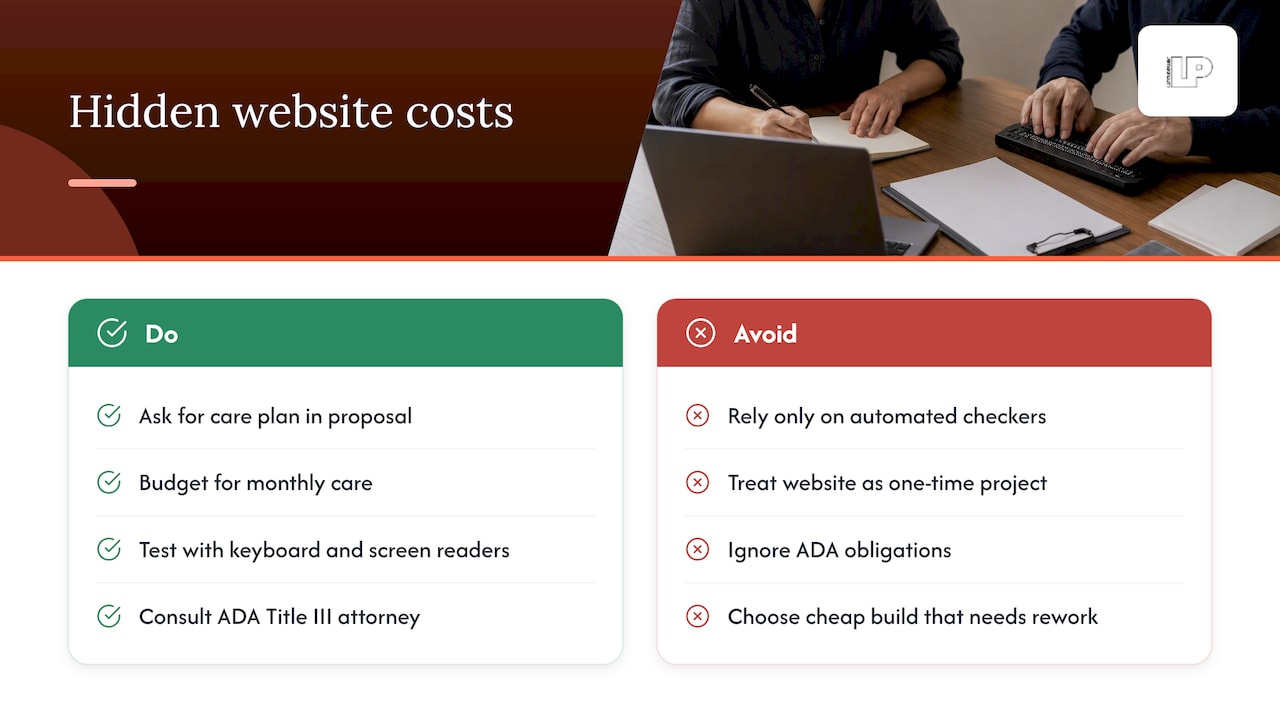
Maintenance and care. Software ages. Plugins need updates, security patches need applying, forms break, links rot. Agencies and freelancers who don’t offer a structured care plan leave all of that to you. Successful growing businesses treat the website as an ongoing operating expense, like rent or insurance, not a one-time construction project. A care plan is typically a monthly fee, so ask for it in the proposal rather than discovering it later.
Marketing to the site. A new site is a store on a street with no sign. Search optimization, Google Business Profile work, reviews and paid ads are what put people on the pages. Our guide to Google Ads management pricing explains the two separate costs, management fees and ad spend, which owners routinely confuse.
Content refreshes. Prices change, staff change, services change. A site that says 2023 on the footer in 2026 looks abandoned.
Accessibility. This one is a legal and customer-service issue, not a nice-to-have. Section 508 only applies to federal agencies, but the ADA still applies to private businesses open to the public, and the Justice Department’s web accessibility guidance says so directly. The same guidance notes that relying only on automated checkers can miss real barriers, so ask any builder how they test with keyboard navigation and screen readers, not just a scanner. The ADA’s standard for businesses open to the public scales with the size and resources of the business, but that is not a reason to ignore it. If you’re unsure of your exposure, talk to an attorney familiar with ADA Title III.
Fixing a bad build. The most expensive website is the cheap one you rebuild eighteen months later. Slow pages, broken mobile layouts and no SEO structure are rework, and rework is paid twice.
Why speed belongs in your budget
Owners often spend money on looks and nothing on performance. That’s backwards. A widely cited analysis summarized by Search Engine Land found that even a 0.1-second improvement in mobile speed was linked to higher conversions, with gains of 8.4% for retail and 8.3% for lead-gen forms. That is a study from 2020 and your results will differ, but the direction is hard to argue with.
Google’s own guidance for decision makers gives the performance thresholds to ask for: Core Web Vitals targets of Largest Contentful Paint under 2.5 seconds, Interaction to Next Paint under 200 milliseconds and Cumulative Layout Shift under 0.1. It also reminds businesses that these metrics are one measure among many and that you decide how much to invest and what return to expect.
Two practical points:
- Put speed targets in the contract. “Passes Core Web Vitals on mobile” is a testable deliverable. “Fast” is not.
- Prioritize the pages that make money. Google’s write-up on site speed and business metrics ties speed to conversion rates and bounce rates, and those effects matter most on product pages, checkout and lead forms. Owners obsess over the homepage, but your quote form is the page that pays the bills.
How much should you spend? A decision framework
There’s no universal number, but there is a sane way to get yours.
Step 1: Define the job. Is the site a credibility card (people Google you before calling), a lead machine or a store? Credibility cards can be cheap. Lead machines and stores deserve real investment because they’re directly tied to revenue.
Step 2: Do the payback math. Take your average customer value and your current close rate. If one extra customer a month covers the monthly cost of a better site, the decision is easy. If you can’t name a customer value, fix that before you spend anything.
Step 3: Match the path to the phase.
- Pre-revenue or testing an idea: DIY builder, minimal pages, ship fast.
- Steady local business with referrals: freelancer or small agency, focused on service pages and local SEO.
- Paid traffic or ecommerce: agency-grade build with tracking, speed targets and a conversion plan.
Step 4: Budget the full year. Add build, domain and hosting, care plan, content updates and the marketing needed to drive traffic. A $3,000 site with zero promotion often performs worse than a leaner site with a real SEO and ads plan behind it.
Step 5: Get three itemized quotes. Not three numbers. Three breakdowns. Compare line by line and ask each provider what’s not included.
Is $1,500 a good price for a website?
It can be, depending on what you get. For a simple five-page brochure site from a skilled freelancer with clear ownership terms, it’s plausible. For an ecommerce store, a custom lead-gen build or a site that needs SEO and tracking done properly, it’s likely to cover only part of the job. The number matters less than the scope behind it: ask what pages, features, revisions, SEO setup and support it includes.
Our perspective: stop buying websites, start buying outcomes
We’ll be candid. The most common mistake we see is treating a website as a design project instead of a revenue system. The owner compares three quotes on price, picks the middle one, launches, and then wonders why the phone isn’t ringing. Nobody budgeted for tracking, nobody set up Google Business Profile properly, and the pages that matter load like it’s 2009.
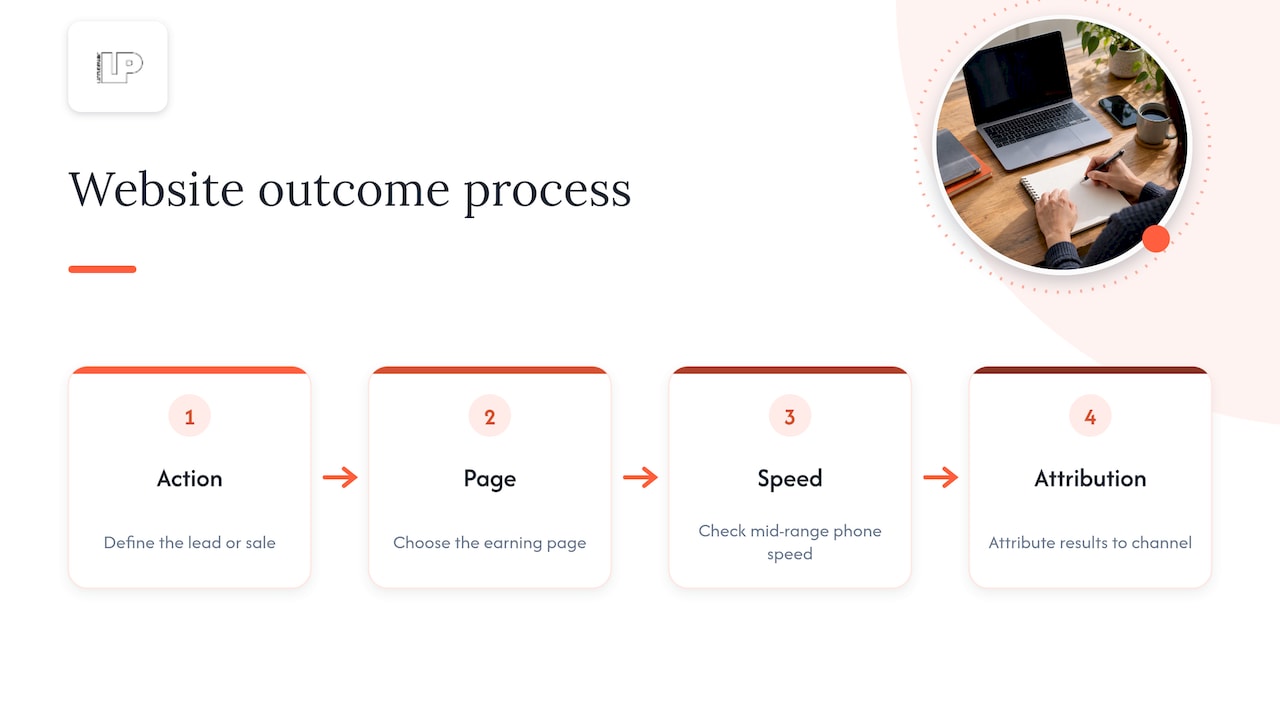
Here’s how we approach it. A site should be built backward from the lead or sale: what’s the action, which page earns it, how fast does that page load on a mid-range phone, and can we attribute the result to a channel? Without attribution, you’re doing spreadsheet cosplay: lots of tidy numbers, no idea what’s working. We tie reporting to revenue and ROI, we talk weekly and you get direct access to the people doing the work, because a site you can’t get answers about is a liability.
We also think AI should do the grunt work, not the thinking. We use it to surface missed opportunities in search and ad data, which pages leak visitors, which queries you should own but don’t. Then humans decide what to do about it.
And a note on the cheap option: DIY is fine, and we say so. If you’re at idea stage, spend $0 on agencies. Come see us when the site needs to carry weight.
— Rusty
Working with us on the build and the traffic
If your site needs to bring in leads or sales, our website design work is built around conversion, speed and SEO structure from day one, and we pair it with SEO, Google Ads and social campaigns so the site has visitors on launch week instead of month six. We don’t publish a price list, because scope drives cost, so the quickest route is to tell us what you need through the Latitude Park homepage and we’ll scope it with you. If you’re still comparing, our own explainer on how much web design costs is a good companion read.
Questions to ask before you sign anything
Whatever you choose, run every provider through the same list:
- Who owns the domain, hosting account and final files?
- What does the monthly care plan include, and what does it cost?
- Which Core Web Vitals results will you commit to on mobile?
- How do you handle accessibility testing beyond an automated scan?
- What SEO setup is included at launch?
- What happens if I want to leave?
- Can I see work for a business like mine, and speak to that client?
The questions to ask when choosing a website design and development agency go deeper if you’re interviewing agencies.
FAQ
How much does a small business website cost?
It depends mainly on the path: a DIY builder is a recurring subscription, a freelancer is usually a one-time project fee, and an agency build is a larger project fee often followed by a monthly plan. Because scope varies so much, only 41% of agencies publish any price, so expect to request a proposal. Budget for hosting, maintenance and marketing on top of the build.
Can I build my own small business website?
Yes, and for a simple brochure site it’s often a smart start. Be honest about your time, and check whether the platform handles SEO basics, mobile speed and accessibility well. Plan to upgrade once the site becomes central to your lead flow or sales.
What ongoing costs should I expect after launch?
Expect a domain renewal, hosting, security and software updates, content changes and any paid apps or integrations. Many owners also add a monthly care plan so patches and fixes are handled for them. Marketing, such as SEO or ads, is a separate budget line.
Does my small business website have to be accessible?
If your business is open to the public, the ADA applies, and the Justice Department says so in its web guidance. Automated scanners alone are not enough, so combine them with manual testing. For your specific situation, consult an attorney who handles ADA matters.
Sources
- American Web Guild: Do Web Design Agencies Publish Prices? 2026 Study
- Section508.gov: Do Section 508 Accessibility Standards Apply to My Website?
- ADA.gov: Guidance on Web Accessibility and the ADA
- ADA.gov: Businesses That Are Open to the Public
- Search Engine Land: The need for (mobile) speed
- web.dev: Optimize Core Web Vitals for business decision makers
- web.dev: Relating site speed and business metrics