
Why Evaluating Keywords for SEO Can Make or Break Your Search Visibility
Evaluating keywords for search engine optimisation is the process of identifying which search terms are worth targeting — based on relevance, search volume, difficulty, and user intent — so your content attracts the right audience and drives real business results.
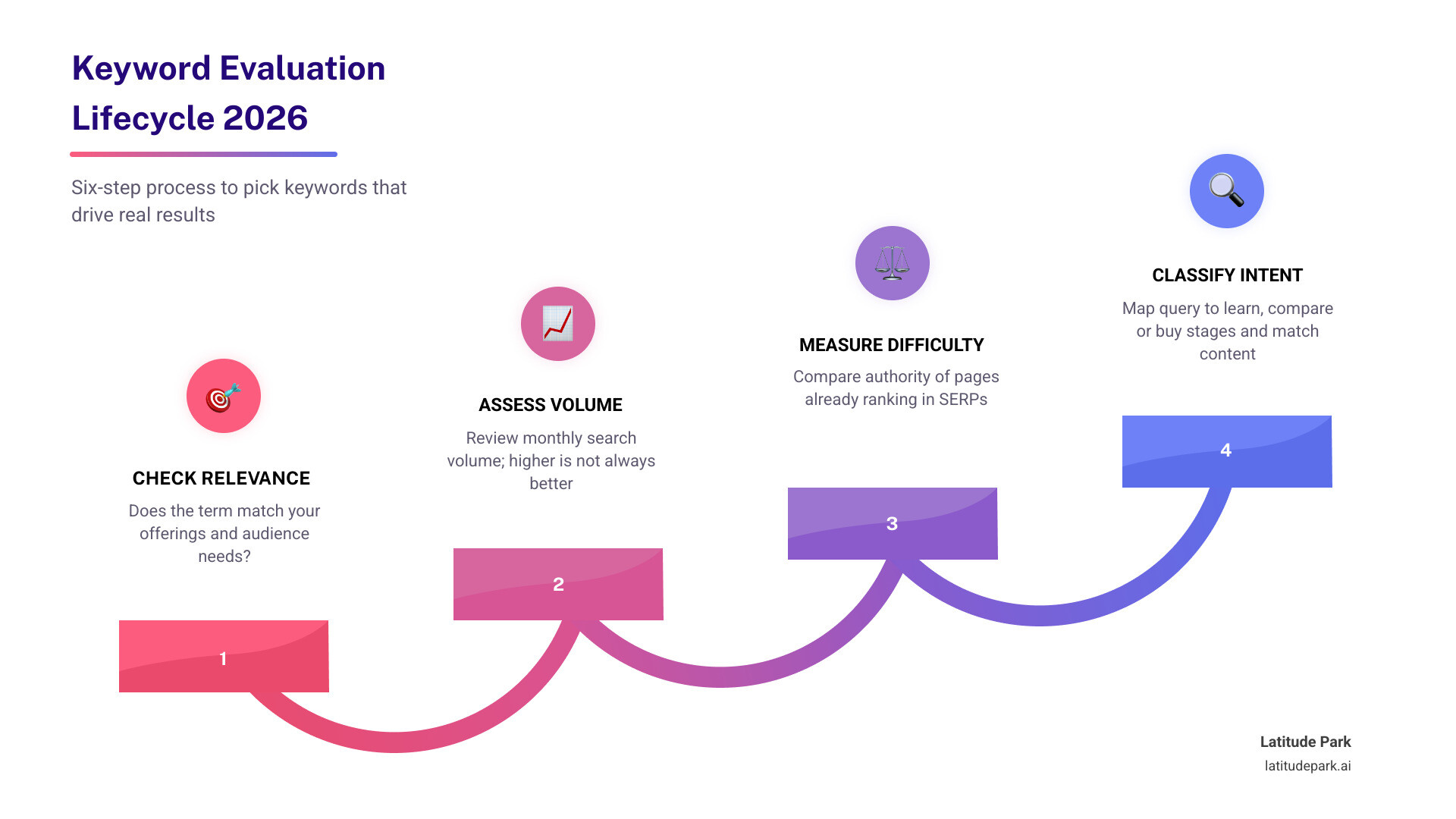
Here’s a quick overview of how to evaluate keywords for SEO:
- Check relevance — Does the keyword match what your business offers and what your audience actually needs?
- Assess search volume — How many people search for this term each month? Higher isn’t always better.
- Measure keyword difficulty — How hard is it to rank? Compare the authority of pages already ranking.
- Classify search intent — Is the searcher looking to learn, compare, or buy? Match your content accordingly.
- Estimate traffic potential — A #1 ranking only earns clicks 27–39% of the time; factor in SERP features like AI Overviews.
- Score business value — Will ranking for this keyword actually move the needle for your goals?
Getting this process wrong is costly. Target the wrong keywords and you’ll attract traffic that never converts — or worse, produce content that ranks for nothing at all. According to research from Ahrefs, roughly 90% of web pages get zero organic traffic from Google. The difference between those pages and the ones that do rank usually comes down to one thing: smarter keyword selection upfront.
This guide walks you through exactly how to do that — without the guesswork.
I’m Rusty Rich, founder of Latitude Park, a full-service digital advertising agency, and I’ve spent over 15 years helping businesses — from small local shops to multi-location franchises — build SEO strategies grounded in disciplined keyword evaluation. In that time, I’ve seen how evaluating keywords for search engine optimisation is the single most leveraged skill you can develop to grow organic visibility at scale.
Simple guide to evaluating keywords for search engine optimisation terms:
The Three Pillars of Evaluating Keywords for Search Engine Optimisation
When we evaluate a keyword, we keep coming back to three pillars:
- Relevance
- Feasibility
- Value
Some frameworks split this differently, but in practice these three questions matter most.
1. Relevance: does this keyword truly fit?
This is the first filter, and it is the one most people skip because search volume looks shiny.
A keyword is relevant when it matches:
- what we offer
- what our audience wants
- the content we can credibly create
- the stage of the buyer journey we want to support
If a keyword brings the wrong visitor, it is not a good keyword. It is just a busy one.
For example, a franchise brand may be tempted to target a broad term like “marketing.” That term is huge, vague, and full of mixed intent. A more relevant phrase might focus on franchise growth, multi-location marketing, or lead generation for specific business models.
If you want a practical foundation, our guide on 10 keyword research tips pairs well with this evaluation process.
2. Feasibility: can we realistically rank?
This is where authority, competition, and SERP analysis come in.
Keyword tools give us difficulty scores, but those are estimates, not gospel. We still need to inspect the live search results and ask:
- Are the top-ranking pages highly authoritative?
- Are they directly satisfying the query?
- Is the SERP dominated by massive brands or mixed-quality content?
- Can we create something more useful, more specific, or better structured?
A useful reminder from modern SEO research: keyword difficulty usually reflects backlink and authority barriers more than content quality ceilings. In plain English, “hard” does not mean impossible, but it does mean we need a realistic plan.
For a deeper methodology, The Keyword Research Guide: A Modern Tutorial for SEO and Content Strategy is a strong external reference.
3. Value: will this keyword support business goals?
This is where keyword evaluation becomes strategy, not just spreadsheet therapy.
A good keyword should connect to:
- leads
- sales
- enquiries
- qualified traffic
- brand visibility in the right market
- content goals across the funnel
We score business value separately from traffic metrics because a keyword with modest search volume can outperform a high-volume vanity term if the intent is tighter and the conversion potential is higher.

As a rule, we would rather rank for a term that brings 100 qualified visitors than 10,000 curious strangers who bounce in three seconds and never return.
Decoding Keyword Types: From Short-Tail to LSI
Not all keywords behave the same way. Understanding the major keyword types helps us choose the right terms for the right pages.
Short-tail keywords
Short-tail keywords are broad, usually one to two words.
Examples:
- franchise marketing
- SEO
- advertising
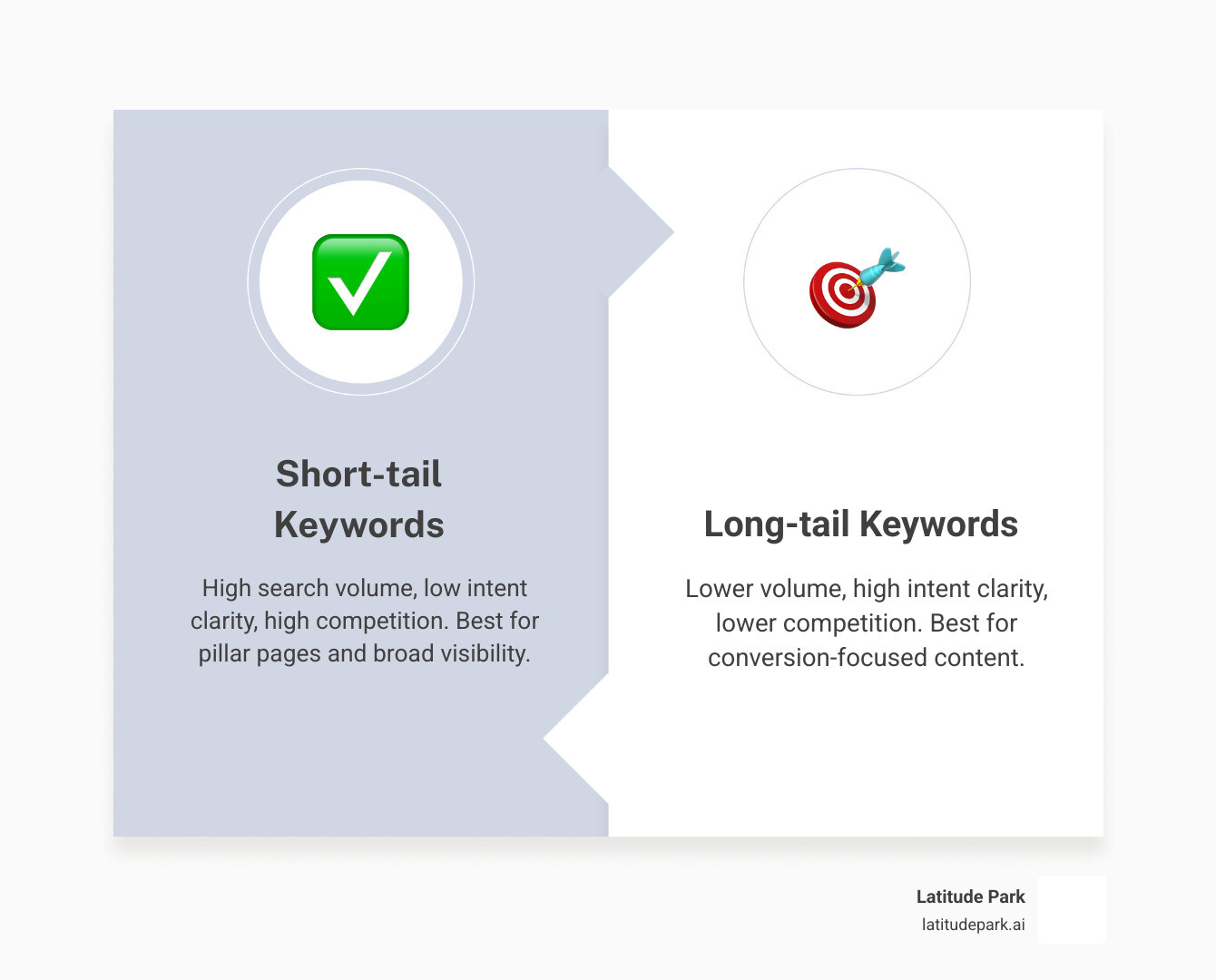
These tend to have:
- higher search volume
- vaguer intent
- stronger competition
- lower conversion precision
Use short-tail keywords when:
- building pillar pages
- defining broad topic authority
- targeting top-of-funnel awareness
But do not expect easy wins. Broad terms are often crowded and can attract mixed audiences.
Long-tail keywords
Long-tail keywords are more specific, usually three or more words.
Examples:
- best SEO strategy for franchise websites
- how to evaluate keywords for search engine optimisation
- Meta advertising for multi-location franchises
These tend to have:
- lower individual volume
- clearer intent
- better conversion potential
- lower competition
Research in the source set notes that long-tail queries account for the majority of searches and can convert at significantly higher rates than head terms. That is why newer or smaller sites often grow faster by leaning into long-tail opportunities first.
If you are unsure how many terms one page should target, our guide on how many keywords for SEO breaks that down.
Local keywords
Local keywords include geography or location intent.
Examples:
- franchise marketing agency near me
- SEO consultant downtown
- local digital advertising for franchise owners
These matter when the searcher wants a service in a specific area or when Google interprets the query as location-sensitive.
Use local keywords when:
- you serve defined geographic areas
- your pages are tied to local branches or service regions
- local pack visibility matters
LSI and semantic keywords
People still say “LSI keywords,” but in modern SEO the better idea is semantic relevance: related phrases, entities, and concepts that help search engines understand context.
Examples around a primary keyword like “franchise marketing strategy” might include:
- multi-location campaigns
- lead generation
- local landing pages
- paid social
- brand consistency
These are not there for stuffing. They help us write naturally and cover the topic fully.
Quick comparison
| Keyword type | Typical volume | Intent clarity | Competition | Best use |
|---|---|---|---|---|
| Short-tail | High | Low to medium | High | Pillar pages, broad visibility |
| Long-tail | Low to medium | High | Low to medium | Conversion-focused content |
| Local | Medium | High | Medium | Location-based service pages |
| Semantic/LSI | Varies | Supports main intent | Varies | Topical depth and relevance |
A final note: mobile devices now account for the majority of Google searches, and search behaviour has become more conversational. That is one reason long-tail and natural-language queries matter even more in 2026.
Aligning Search Intent with Your Target Audience
If keyword research is the map, search intent is the compass.
A keyword can have perfect volume and manageable difficulty, but if the intent is wrong, the page will struggle.
Search intent usually falls into four categories.
Informational intent
The searcher wants to learn.
Examples:
- what is keyword difficulty
- how to do keyword research
- evaluating keywords for search engine optimisation
Best content types:
- guides
- tutorials
- explainers
- checklists
Navigational intent
The searcher wants a specific website or brand.
Examples:
- Latitude Park SEO
- Google Search Console login
Best content types:
- homepage
- brand pages
- tool access pages
Commercial investigation
The searcher is comparing options before acting.
Examples:
- best keyword research tools
- Ahrefs vs Semrush
- SEO agency for franchises
Best content types:
- comparison pages
- service explainers
- case-study-led pages
- “best of” roundups
Transactional intent
The searcher is ready to take action.
Examples:
- hire SEO consultant
- buy keyword research tool
- book franchise marketing strategy call
Best content types:
- service pages
- product pages
- landing pages
- demo or contact pages

To check intent properly, we always review the live SERP:
- What type of pages rank?
- Are they guides, tools, homepages, product pages, or category pages?
- What angle keeps repeating?
- What proof points show up in top results?
This “SERP contract” tells us what Google believes searchers want.
Search intent should also match our audience. That means asking:
- What language do they actually use?
- What problem are they trying to solve?
- Are they beginners, evaluators, or buyers?
- What would make this keyword commercially meaningful for us?
Our article on choosing good keywords for your target market expands on this alignment, and Website Keyword Analysis: The 2026 Guide – Incremys offers useful thinking on intent-first evaluation.
One quick clarification: E-E-A-T is useful as a content quality framework, but it is not itself a direct ranking factor. What matters is creating content that clearly demonstrates experience, expertise, trustworthiness, and usefulness in ways users and search systems can recognise.
Analyzing Metrics: Volume, Difficulty, and Competition
Once relevance and intent look solid, we move into the numbers.
Search volume
Search volume estimates how often a keyword is searched over a typical month. Useful? Yes. Perfect? No.
Volume is directional, not exact. Treat it like a weather forecast, not a blood test.
Also remember:
- search volume is not traffic
- traffic is not clicks
- clicks are not conversions
A top ranking can earn only a fraction of available searches. Some research in our source set puts position-one organic CTR around 27% to 39%, and that can drop when SERP features, ads, featured snippets, or AI Overviews push organic results down.
Keyword difficulty
Keyword difficulty estimates how hard it may be to rank for a term.
Most tools calculate this differently, which is why scores vary. Use KD as a filter, not a verdict.
For newer sites, many teams start by prioritising lower-difficulty opportunities. For stronger sites, medium-difficulty terms can become realistic if relevance and business value are high.
Competition
Competition has two sides:
- paid competition, often shown in ad tools
- organic competition, seen in the live SERP
Organic competition matters more for SEO evaluation. We look at:
- page quality
- domain strength
- backlink profiles
- search intent match
- content freshness
- SERP features
- whether the result set is stable or volatile
Google has changed constantly for years. One historical stat from our research shows Google made more than 500 algorithm changes in 2010 alone. The exact number today matters less than the lesson: SEO is not static, so keyword choices must be reviewed regularly.
Essential keyword research tools for 2026
Here are the tools we rely on most often:
- Google Search Console for real impressions, clicks, CTR, and existing opportunities
- Google Keyword Planner for volume ranges and keyword expansion
- Google Trends for seasonality and momentum
- Google Autocomplete, People Also Ask, and Related Searches for intent and variants
- Ahrefs or Semrush for keyword discovery, SERP analysis, and competitive gap analysis
- Analytics platform for engagement and conversion tracking
- Spreadsheets or planning tools for keyword mapping and prioritisation
For more on competitive discovery, see Competitor Keyword Research: Is It Really That Important? and Keyword Research Methodology: The Complete Guide | Digital Codex.
A Step-by-Step Workflow for Evaluating Keywords for Search Engine Optimisation
Here is the workflow we use.
1. Start with seed keywords
List the core topics tied to your products, services, audience problems, and customer language.
2. Expand the list
Use Search Console, Keyword Planner, autocomplete, related searches, and SERP features to uncover variants, questions, and long-tail phrases.
3. Classify intent
Tag each keyword as informational, navigational, commercial, or transactional.
4. Check relevance
Score how closely each term aligns with:
- your offer
- your audience
- your expertise
- your funnel stage
5. Review metrics
Add:
- search volume
- difficulty
- traffic potential
- competition notes
- CTR risks from SERP features
6. Inspect the SERP manually
This step is non-negotiable. A tool cannot fully tell you:
- what format ranks
- how strong the competition really is
- whether the query is dominated by AI snapshots, ads, or videos
- whether you can produce a better result
7. Group into topic clusters
Instead of creating one page per tiny keyword variation, cluster related terms under one primary page. This helps avoid cannibalisation and strengthens topical relevance.
8. Build a keyword map
Assign:
- one primary keyword per page
- several supporting semantic terms
- a clear content type
- a target URL
- a priority score
Our broader SEO Complete Guide 2025 supports this with planning context across the full channel.
9. Prioritise by business value
We typically score keywords using:
- relevance
- intent fit
- ranking feasibility
- traffic potential
- conversion potential
- strategic importance
10. Publish, monitor, refine
Keyword evaluation is never done once. It is a recurring process.
Measuring Success and Avoiding Common Pitfalls
Choosing keywords is only half the job. The rest is checking whether those choices actually worked.
What to measure
Track performance at three levels.
Visibility metrics
- impressions
- average position
- clicks
- CTR
Traffic and engagement metrics
- organic sessions
- bounce or engagement signals
- time on page
- page pathways
Business metrics
- leads
- enquiries
- sales
- booked calls
- assisted conversions
Search Console is especially useful for finding quick wins:
- pages with high impressions but low CTR
- keywords ranking in positions 4 to 15
- queries where the page appears but does not fully match intent yet
Common pitfalls to avoid
Keyword stuffing
Google does not use the keywords meta tag, and keyword stuffing is against its spam policies. Write naturally. Use the keyword where it helps clarity, not where it starts sounding like a robot trying to win a raffle.
Targeting overly broad terms
Broad terms can look attractive, but many have mixed intent and brutal competition.
Ignoring business fit
A keyword is not valuable if it cannot lead to meaningful outcomes.
Creating one page for every variation
This leads to thin content, duplication, and cannibalisation. One strong page can often rank for many related queries.
Relying only on tool data
Always sanity-check with the actual SERP and your own site data.
Forgetting existing opportunities
Before chasing new keywords, review the queries you already rank for. Some of the best gains come from improving pages that are almost there.
Our piece on why content gets ghosted by search explains this problem well, and How To Do Keyword Research: A Practical Guide for UK Businesses reinforces the value of practical, intent-led keyword selection.
Refining Your Strategy for Evaluating Keywords for Search Engine Optimisation
A solid strategy gets sharper over time.
We recommend:
- monthly monitoring for core pages
- quarterly keyword audits
- faster reviews in fast-changing industries
- updates when SERPs shift significantly
What should those reviews cover?
Seasonal and trend changes
Some keywords rise and fall. Use Trends and Search Console period comparisons to separate seasonality from genuine gains or losses.
AI Overviews and zero-click behaviour
In 2026, some informational searches lose clicks because users get quick answers directly in the SERP. That does not make those keywords useless, but it does mean we should evaluate:
- click potential
- conversion proximity
- whether the query benefits from deeper human insight
- citeability in AI-generated environments
Content performance by page type
Not every keyword deserves a new page. Sometimes the right move is to:
- improve an existing page
- merge overlapping pages
- strengthen internal links
- adjust title and meta description for better CTR
Performance-based prioritisation
Keep investing in keywords that show:
- qualified traffic
- stronger engagement
- conversion assist or direct conversion
- realistic ranking upside
For on-page execution, our Ultimate Guide to On-Page SEO is the natural next step.
Frequently Asked Questions about Keyword Evaluation
How long does it take to see the impact of new keywords?
It varies. Some changes can influence visibility in days or weeks, while others take months. Google has said some updates may show effect quickly and others can take several months. In general, newer pages, competitive terms, and weaker sites need more patience.
Should I still use the keywords meta tag in 2026?
No. Google does not use the keywords meta tag for web search rankings. Spend that time improving titles, headings, content quality, internal links, and intent alignment instead.
What is the difference between a keyword and a topic cluster?
A keyword is a specific query someone types into a search engine. A topic cluster is a group of closely related keywords and subtopics organised around a core theme. Modern SEO works best when we target one primary keyword per page while covering the wider topic thoroughly enough to rank for many related terms.
Conclusion
Evaluating keywords for search engine optimisation is not about chasing the biggest numbers. It is about choosing terms that connect audience need, realistic ranking opportunity, and business value.
That matters even more for brands with complex structures, multiple offerings, or multi-location growth goals. At Latitude Park, we bring that same strategic discipline to franchise marketing, where tailored campaign structures and clear targeting are essential across both SEO and Meta advertising.
If you want a more complete system for selecting the right opportunities, planning content, and growing organic visibility with purpose, get started with a comprehensive SEO strategy.