
Why White Label Online Reputation Management Is a Game-Changer for Agencies
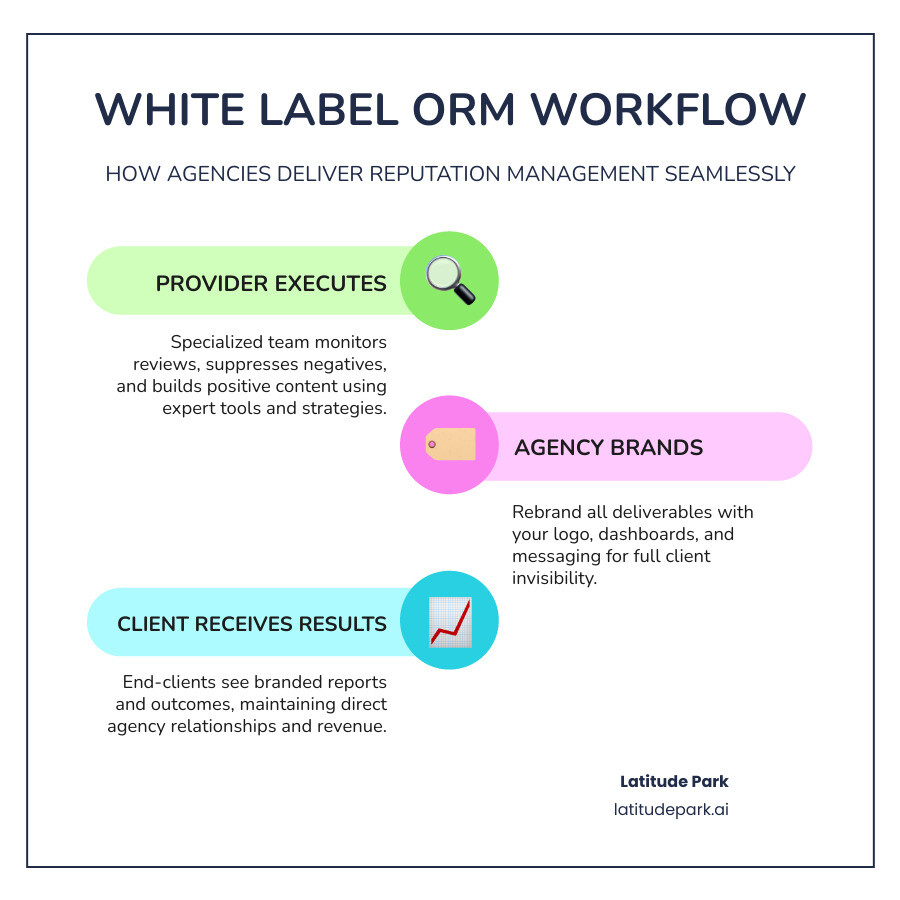
White label online reputation management is a service model where a specialized provider handles reputation work — monitoring reviews, suppressing negative content, and building positive brand presence — while your agency delivers it to clients under your own brand name.
In plain terms, here’s how it works:
- A third-party expert does the reputation management work
- Your agency puts its logo and branding on everything
- Your clients never know a partner is involved
- You keep the client relationship and the revenue
It’s the same model a general contractor uses — hiring specialists to do the plumbing while the GC takes credit for the finished house.
For franchise marketing managers, this is especially valuable. You’re already juggling campaign coordination across dozens of locations and fighting to keep brand messaging consistent. Adding a full in-house PR or reputation team on top of that isn’t realistic. But your clients need reputation management — because consumers trust online reviews as much as personal recommendations, and one bad news article or review spike can undo months of advertising work.
White label ORM lets you offer that service now, without the hiring, training, or overhead.
I’m Rusty Rich, President of Latitude Park, a full-service digital agency I’ve grown from the ground up since 2009, and white label online reputation management has become one of the most powerful tools we use to help franchise clients protect their brand across multiple locations. In the sections below, I’ll walk you through exactly how to evaluate, implement, and profit from white label ORM — without building a PR team from scratch.
White label online reputation management glossary:
What is White Label Online Reputation Management?
At its core, white label online reputation management is a subcontractor model designed for brand invisibility. When we talk about “white labeling,” we mean that a specialized firm performs the heavy lifting of reputation repair and maintenance, but the end client only ever sees your agency’s logo, colors, and domain.
This goes beyond just buying a software subscription. It is a comprehensive service expansion that gives you reseller rights to expert-level strategies. Whether it is suppressing a negative news article or managing a surge of reviews across 100 franchise locations, the white label provider remains behind the curtain.
By following an Online Review Management Complete Guide, you’ll see that professional oversight is the key differentiator. Instead of your account managers spending hours manually checking Yelp or Google, a white label partner provides client-facing dashboards that are fully branded as your own proprietary technology. This allows you to offer a high-ticket service without having to develop the software or hire the specialists yourself.
Why Choose White Label Over In-House Teams?
Building an in-house reputation team is a massive undertaking. Between salaries, benefits, and the specialized tools required, the overhead can quickly eat into your agency’s margins. White label online reputation management offers significant cost savings because you only pay for the services you use, often on a per-project or per-location basis.
Expertise is another major factor. Specialized reputation firms have spent years dealing with specific challenges—like removing content from Ripoff Report or navigating the complexities of news site suppression. An in-house hire might have general PR knowledge, but they likely lack the decade of experience required to handle high-stakes crises.
Comparing In-House Hiring vs. White Label Partnerships
| Feature | In-House Team | White Label Partner |
|---|---|---|
| Initial Cost | High (Recruitment, Salary) | Low (Setup fee or per-client) |
| Scalability | Slow (Must hire more people) | Instant (Add locations anytime) |
| Expertise | Limited to the hire’s skill | Deep bench of specialists |
| Overhead | Office space, software, taxes | None |
| Focus | Management & Training | Client results & Strategy |
Beyond the numbers, there are 11 Reasons to Hire Review Management Services for Your Business that highlight how resource management and rapid deployment can save an agency. If a client signs a 50-location franchise deal tomorrow, a white label partner can scale with you immediately. An in-house team would buckle under that sudden weight.
Key Features of White Label Online Reputation Management Software
If you are looking for the right platform to power your services, you need more than just a basic dashboard. The best white label online reputation management tools leverage AI sentiment analysis to categorize feedback instantly. This allows you to see if customers are complaining about “staff behavior” or “pricing” across hundreds of reviews without reading every single one.

Key features to look for include:
- Review Widgets: Customizable displays (carousels, lists, or grids) that aggregate 5-star reviews from over 100 sites and embed them directly on your client’s website.
- Automated Requests: The ability to send SMS and email sequences to customers to encourage new, positive feedback.
- Multi-location Support: Essential for Small Business Online Reputation Management and franchises, allowing you to manage all branches from a single login.
- Real-time Alerts: Notifications sent to your team (or the client) the moment a negative review is posted, allowing for an immediate response.
Advanced Integrations for White Label Online Reputation Management
To be truly effective, your reputation tools must play well with others. CRM syncing is vital; it allows the software to automatically trigger a review request via email or text the moment a job is marked as “complete” in the client’s system.
Social sharing integrations allow you to take a glowing 5-star review from Facebook and turn it into a branded social media post with one click. Some top-tier platforms even offer API access for custom builds, deep linking to native apps (which increases review completion rates), and white-label mobile apps that your agency can list in the app store under its own name. This level of integration builds massive authority on professional networks like LinkedIn.
Handling Challenges with White Label Online Reputation Management
Reputation management isn’t just about getting more stars; it’s about damage control. A professional white label partner can handle specific, high-difficulty challenges like suppressing negative news articles or dealing with “revenge reviews” on sites like Twitter.
When a client faces a crisis—perhaps a negative video going viral on YouTube—a white label expert uses advanced SEO strategies to push that content off the first page of Google. This “search result suppression” is a technical skill that 99% of general marketing agencies don’t have in-house.
Implementing a Successful White Label Strategy
The first step in a successful implementation is partner selection. You need a partner whose values align with yours and who understands the specific needs of your niche. For us at Latitude Park, that means finding partners who understand the complexity of multi-location franchise structures.
Once you’ve chosen a partner, focus on:
- Reporting Frequency: Decide whether you want automated weekly reports or high-level monthly summaries for your clients.
- Custom Domains: Ensure the dashboard lives on your domain (e.g., reviews.youragency.com) to maintain the “white label” illusion.
- Profitability: Set pricing that reflects the value of the expertise. Many agencies charge $499 to $999 per month for combined reputation and retargeting services.
- Client Onboarding: Use a standardized process to gather client login info for Google Business Profiles and other directories.
By following a guide like Your Businesss Digital Shield Picking the Perfect Online Reputation Partner, you can ensure your agency is protected while building a new, recurring revenue stream.
Frequently Asked Questions about White Label ORM
How does the white label process work?
The process is designed to be hands-off for the agency. The white label provider executes the technical work—monitoring, responding (using AI or manual experts), and suppressing negatives. The agency provides the branding assets (logo, colors). All communication and automated reporting flow through the agency’s branded portal. You remain the sole point of contact for the client, while the provider acts as your invisible fulfillment department.
What industries benefit most from these services?
While any business with a name can benefit, high-stakes industries see the most ROI. This includes Healthcare (where HIPAA compliance is key), Real Estate, Hospitality, and Automotive. For multi-location brands, our Business Online Reputation Management Guide explains how centralized management prevents one bad location from ruining the entire franchise’s name.
Can white label services handle negative news articles?
Yes. Unlike simple software that only handles reviews, a full-service white label online reputation management partner uses “reverse SEO.” This involves building up positive assets—like new social profiles, press releases, and guest posts—to outrank and suppress the negative article. In some cases, they can even facilitate search engine de-indexing if the content violates specific legal or platform policies.
Conclusion
Mastering white label online reputation management doesn’t require a massive hiring budget or a dedicated PR department. It requires the right partnership. By leveraging the expertise of specialists, your agency can offer high-value, high-margin services that protect your clients’ most valuable asset: their name.
At Latitude Park, we specialize in helping franchises grow through tailored Meta advertising and comprehensive marketing strategies. We understand that for a franchise to succeed, every location needs a pristine digital presence. Whether you are managing five locations or five hundred, the ability to scale your reputation services is what will set you apart from the competition.
Don’t let a few negative search results or a lack of reviews hold your clients back. Take control of the narrative and build a brand that converts.